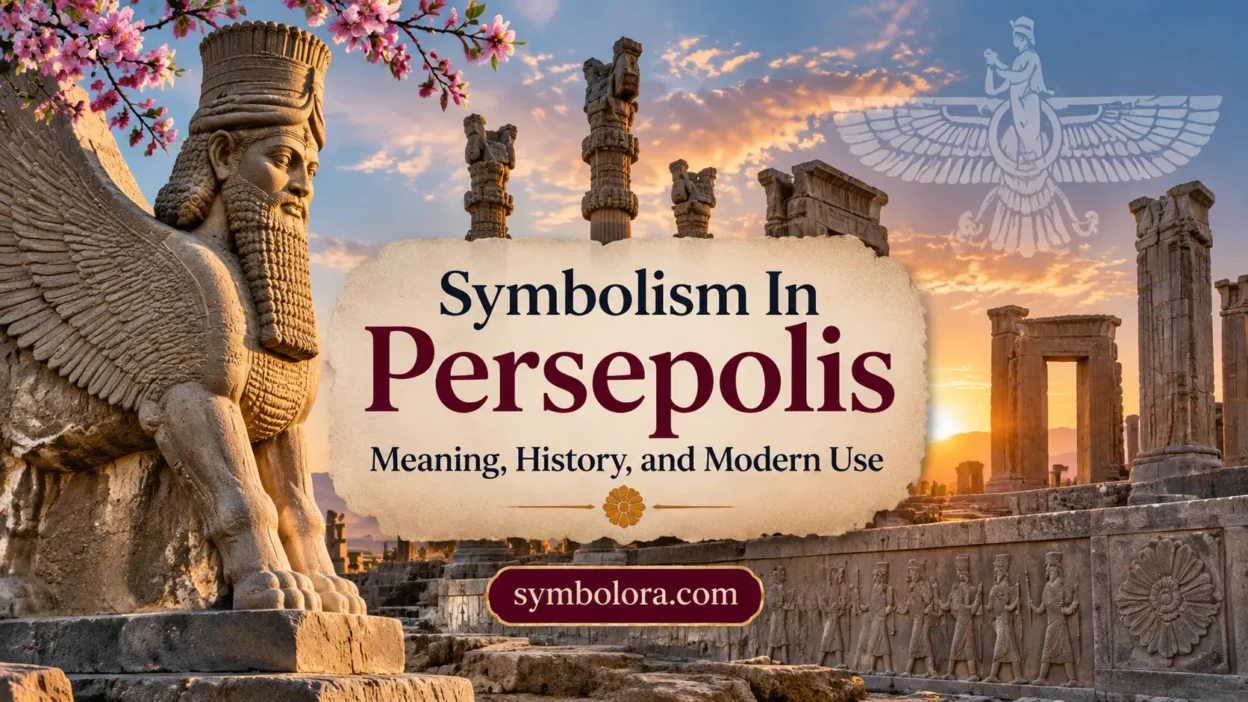
The ancient city of Persepolis represents one of the most recognizable symbols of the Persian Empire and remains an important subject for understanding ancient power, culture, identity, and artistic expression. The symbolism in Persepolis reflects ideas of authority, unity, diplomacy, religious belief, and the connection between rulers and society.
Built during the Achaemenid Empire in what is now Iran, Persepolis was more than a royal residence. Its architecture, sculptures, inscriptions, and ceremonial spaces communicated messages about leadership, diversity, order, and the empire’s worldview.
Today, Americans often encounter Persepolis through history education, museum exhibitions, documentaries, academic studies, and discussions about ancient civilizations. Its meaning has expanded beyond a single empire, becoming a symbol of cultural heritage, artistic achievement, and the importance of preserving historical memory.
Quick Answer
Symbolism in Persepolis commonly represents leadership, cultural unity, and human achievement in modern American understanding. Historically, the site symbolized the authority of the Achaemenid kings, the cooperation of different peoples, and the religious and political ideals of ancient Persia.
TL;DR
- Persepolis symbolizes Persian authority and imperial identity.
- Its reliefs represent unity among diverse cultures.
- Architecture reflects ancient Persian beliefs and values.
- Americans view it as cultural heritage and history.
- Modern uses connect Persepolis with identity and preservation.
What Persepolis Was And Why It Became A Symbol
Persepolis was a ceremonial capital of the Achaemenid Empire, founded by King Darius I around 518 BCE near modern-day Shiraz, Iran. Unlike a typical city designed for everyday living, Persepolis served mainly as a place for royal ceremonies, especially gatherings connected with the Persian New Year celebration known as Nowruz.
The site included massive stone terraces, grand staircases, audience halls, royal palaces, and detailed carvings. Every feature was designed to communicate a message. The size of the buildings demonstrated royal authority, while the artwork showed cooperation among different groups within the empire.
The symbolism of Persepolis comes from the way its creators combined architecture, art, and political ideas. The site was built to show that the Achaemenid Empire was powerful but also organized and connected.
For modern audiences, Persepolis is not only a reminder of an ancient empire. It represents how civilizations use monuments to express their values, beliefs, and identity.
The Core Meanings Associated With Persepolis
Several major ideas are connected with Persepolis symbolism. These meanings developed from the physical design of the site and the historical role it played.
| Context | Meaning in the USA | Common Associations | Notes |
|---|---|---|---|
| Ancient Empire | Authority and leadership | Kingship, government, power | Connected to Achaemenid rulers |
| Architecture | Human creativity | Design, engineering, achievement | Shows advanced craftsmanship |
| Stone Reliefs | Cultural unity | Diversity, cooperation | Depicts different peoples of the empire |
| Modern Heritage | Historical preservation | Identity, education | Viewed as a global cultural landmark |
One of the strongest meanings associated with Persepolis is leadership. The royal buildings and ceremonial spaces were designed to represent the strength of Persian rulers. However, the symbolism was not only about domination. The artwork also emphasized organization and harmony among different communities.
Another important meaning is cultural connection. The empire included many regions and ethnic groups, and the carvings at Persepolis showed representatives from different lands bringing gifts to the king. These images communicated the idea of a united empire made up of many peoples.
Ancient Roots And Early Symbolism
The symbolic meaning of Persepolis began with its creation during the Achaemenid period, one of the largest empires of the ancient world. Persian rulers used architecture as a way to communicate political and cultural messages.
The entrance gates, columns, stairways, and relief sculptures were carefully planned. Visitors approaching the site would experience a sense of scale and order before entering the ceremonial areas.
The famous reliefs on the eastern staircase of the Apadana palace show delegations from various regions of the empire. These figures are often interpreted as representing cooperation and the peaceful organization of a diverse population.
The design also reflected religious and philosophical ideas connected with ancient Persian traditions. Concepts such as truth, order, and responsibility were important values in Achaemenid culture. The structure of Persepolis presented the king as a figure responsible for maintaining stability.
Although later historical events changed how the site was viewed, its original purpose was to communicate the ideals of the empire that built it.
How Architecture Creates Meaning In Persepolis
The architecture of Persepolis is one of its strongest symbolic elements. Ancient builders used space, height, and decoration to create specific impressions.
The enormous stone columns of Persepolis represented strength and permanence. The wide staircases leading to ceremonial halls created a formal experience for visitors, emphasizing respect for the royal setting.
The use of repeated patterns, carved animals, and organized figures also reflected ideas of balance and structure. The architecture showed that the empire valued order rather than randomness.
The symbolic language of the buildings can be compared with how modern societies use monuments. Government buildings, memorials, and public spaces today often communicate ideas about national identity and shared values.
In the United States, Persepolis is frequently studied as an example of how architecture can preserve political messages long after the original society has disappeared.
The Meaning Of The Persepolis Reliefs
The stone reliefs at Persepolis are among the most important parts of the site because they communicate stories without written explanations. They show kings, guards, animals, and representatives from different regions.
The delegations shown carrying gifts are especially significant. Instead of portraying conquered groups as defeated enemies, the artwork presents them as organized participants within the empire.
This visual message helped reinforce the idea that the Persian Empire included many cultures working within a larger system.
Modern viewers often interpret these carvings through themes of diversity and cultural exchange. In American discussions, they can connect with broader ideas about multicultural societies and the importance of recognizing different historical traditions.
However, historians also recognize that these images were created by royal authorities and reflected an official version of the empire. Like many ancient monuments, Persepolis presents a carefully constructed image of power.
Persepolis Symbolism In The United States
In the United States, Persepolis is mainly understood through education, museums, cultural studies, and discussions about ancient civilizations. Many Americans encounter the site through world history courses or exhibitions focused on the ancient Middle East.
Its symbolism often connects with themes such as:
- preservation of cultural heritage
- artistic achievement
- ancient political systems
- connections between past and present societies
For Iranian Americans and people connected with Persian heritage, Persepolis can also represent cultural identity and historical continuity. The site serves as a reminder of a civilization with contributions in architecture, administration, art, and literature.
At the same time, American interpretations generally separate the ancient meaning of Persepolis from modern political debates. The site is often appreciated as a historical achievement rather than a symbol belonging to only one modern viewpoint.
The continued interest in Persepolis shows how ancient places can carry different meanings for different communities while maintaining their original historical importance.
Cross-Cultural Interpretations Of Persepolis
Although Persepolis originated within ancient Persian culture, its symbolism has been interpreted by many societies around the world. Different communities often focus on different aspects of the site depending on their historical connection and cultural perspective.
In Persian culture, Persepolis is strongly connected with national heritage, artistic accomplishment, and the memory of the Achaemenid Empire. It represents a period when Persia was a major center of political organization and cultural development.
In Western academic traditions, Persepolis is often studied as an example of ancient imperial architecture and diplomacy. Scholars examine how the site demonstrates relationships between rulers, subjects, and different cultural groups.
For many global audiences, Persepolis represents the achievements of ancient civilizations and the importance of protecting archaeological sites. It serves as a reminder that human creativity and organization existed in complex forms thousands of years ago.
Religious interpretations are also considered carefully. The site reflects values connected with ancient Persian beliefs, including ideas about order and moral responsibility, but it is not a religious monument in the same way as a temple or sacred shrine from other traditions.
The Role Of Animals And Natural Symbols In Persepolis Art
Animals appear throughout Persepolis artwork and contribute to the site’s symbolic language. Lions, bulls, horses, and mythical creatures were commonly used in ancient Persian art because they represented strength, protection, and royal authority.
The lion and bull imagery found in Persepolis is especially notable. These animals were not simply decorative. Their placement communicated ideas about power, balance, and controlled forces of nature.
The recurring use of animals also connected the human world with the natural world. Ancient societies often used animals in royal art because they represented qualities that rulers wanted to associate with themselves, such as courage, stability, and dominance.
Modern viewers may interpret these images through the lens of symbolism in art. In American museums and classrooms, animal figures from Persepolis are often discussed as examples of how civilizations used visual storytelling before modern forms of communication.
Emotional And Psychological Meaning Of Persepolis
Beyond its historical importance, Persepolis carries emotional meanings for many people. Standing among the ruins of such an ancient site can create feelings of connection, curiosity, and respect for human achievement.
The remaining columns, carvings, and stone structures remind visitors that societies rise and change over time. This can create reflection on themes such as memory, survival, and the relationship between past and present.
For people connected with Persian heritage, Persepolis may represent belonging and cultural pride. It can provide a link between modern identity and ancient history.
For others, the site may symbolize curiosity about civilizations outside their own background. It encourages people to explore different cultures and recognize the complexity of human history.
The emotional meaning of Persepolis depends on personal experience, but many interpretations share an appreciation for creativity, endurance, and cultural preservation.
Persepolis In Art, Education, And Popular Culture
Persepolis continues to appear in books, documentaries, museums, and educational materials. Its imagery is used to introduce audiences to ancient Persian history and the development of early empires.
In American education, Persepolis often appears in world history lessons about the Achaemenid Empire, ancient government systems, and cultural exchange. Teachers use the site to explain how architecture and artwork can reveal information about societies.
The name “Persepolis” also appears in modern creative works. One well-known example is the graphic memoir Persepolis, which uses the title as a connection to Persian history and identity. Although the memoir focuses on modern Iranian experiences rather than the ancient site itself, the reference shows how Persepolis remains a meaningful cultural symbol.
The continued appearance of Persepolis in modern culture demonstrates how ancient symbols can gain new interpretations while keeping connections to their original meanings.
Why Persepolis Appears In Modern Identity And Design
Ancient symbols often return in modern design because they communicate ideas that remain meaningful. Persepolis imagery is sometimes used in cultural events, artwork, jewelry designs, and educational displays connected with Persian heritage.
For some people, images inspired by Persepolis represent ancestry and connection to Iranian history. For others, they represent appreciation for ancient architecture and artistic traditions.
Modern use requires cultural awareness. Because Persepolis has specific historical connections, using its imagery only as decoration without understanding its background can remove important context.
When used thoughtfully, Persepolis-inspired designs can celebrate craftsmanship, history, and cultural memory.
Persepolis Symbolism In Jewelry, Tattoos, And Personal Expression
Ancient monuments often influence personal expression, and Persepolis is no exception. Some people choose Persepolis-inspired tattoos or artwork because they want to express cultural identity, interest in history, or admiration for ancient architecture.
A Persepolis tattoo may represent:
- connection to Persian heritage
- respect for ancient civilizations
- appreciation for art and architecture
- personal interest in history
Unlike simple decorative symbols, Persepolis imagery carries a specific historical background. People who choose this symbol often value the story behind the design rather than only its appearance.
In modern American tattoo culture, historical symbols are frequently used to communicate identity, personal beliefs, or meaningful experiences. Persepolis fits into this larger tradition of using ancient imagery as a way to express personal connections.
Common Misunderstandings About Persepolis
Because Persepolis is an ancient site with complex history, some interpretations can oversimplify its meaning. One common misunderstanding is viewing it only as a symbol of royal power.
While the site certainly represented the authority of Persian kings, it also reflected administration, cultural exchange, artistic skill, and relationships among different communities.
Another misunderstanding is treating Persepolis as a purely religious location. Although ancient Persian beliefs influenced the values represented at the site, Persepolis primarily functioned as a ceremonial and political center.
Some modern discussions may also use Persepolis imagery without acknowledging its historical context. Separating accurate history from modern assumptions helps preserve the meaning of the symbol.
Understanding Persepolis requires looking at both its original purpose and the many ways people interpret it today.
How The Meaning Of Persepolis Has Changed Over Time
The meaning of Persepolis has evolved significantly since the Achaemenid Empire. During its creation, it was a statement of imperial organization and royal authority.
After the fall of the Achaemenid Empire and the destruction associated with Alexander the Great’s conquest, the site became a historical reminder of a previous era.
For centuries, Persepolis existed mainly as an archaeological site. Modern discoveries and preservation efforts brought renewed attention to its architecture and artwork.
Today, Persepolis represents more than an ancient royal center. It symbolizes cultural survival, historical study, and the importance of protecting humanity’s shared heritage.
This change shows how symbols are not fixed. Their meanings develop as new generations interact with them and place them within different cultural contexts.
Persepolis And The Importance Of Cultural Preservation
The preservation of Persepolis highlights a larger conversation about protecting historical places. Ancient monuments provide evidence of how earlier societies organized themselves, expressed beliefs, and created art.
In the United States, discussions about preserving global heritage often focus on the idea that historical sites belong to a broader human story. Persepolis is valued not only because of its connection to Persia but also because it represents a major achievement of ancient civilization.
The condition of archaeological sites can be affected by natural changes, tourism, and environmental factors. Protecting these locations allows future generations to study and understand cultures from the past.
Persepolis reminds modern societies that monuments are not only physical structures. They are records of human creativity and collective memory.
The Political And Social Messages Behind Persepolis
Persepolis was created during a period when rulers used monuments as a way to communicate political ideas. The Achaemenid kings understood that architecture could influence how people viewed leadership and the empire itself.
The size of Persepolis showed the resources and organizational ability of the Persian government. Large building projects required skilled workers, planning, transportation systems, and cooperation across different regions.
The artwork also communicated social ideas. The repeated images of representatives from various territories suggested that the empire was made up of many communities connected under one administration.
However, historians also recognize that royal monuments usually present an idealized version of society. The reliefs at Persepolis show a carefully designed image of harmony and order created by the ruling class. They provide valuable historical information but should also be understood as political communication.
This balance between celebration and interpretation is important when studying ancient symbols. Monuments can reveal both the values a society wanted to promote and the power structures behind them.
The Symbolism Of Kingship And Leadership
Leadership is one of the strongest themes associated with Persepolis. The site was designed to reinforce the position of the Persian king as the central figure responsible for maintaining stability.
The royal halls and ceremonial spaces created an environment where visitors experienced the authority of the ruler before direct interaction took place. The architecture itself became part of the message.
The symbolism of kingship in Persepolis was not only about personal power. In Achaemenid ideology, the king was connected with ideas of justice, protection, and maintaining order throughout the empire.
Modern audiences may interpret this differently. In the United States, Persepolis is often examined as an example of how governments use public spaces and monuments to express national values.
The site provides an opportunity to study how leadership, identity, and political messages have been represented throughout history.
Persepolis As A Symbol Of Cultural Diversity
One of the most important modern interpretations of Persepolis focuses on cultural diversity. The empire represented many different regions, languages, and traditions, and the artwork reflects this variety.
The delegations shown in the reliefs are often recognized as evidence of the empire’s multicultural character. Each group is represented with distinct clothing, hairstyles, and objects, highlighting differences while showing their place within a larger political structure.
For American audiences, this aspect often connects with modern discussions about multicultural societies. Persepolis can be viewed as an example of how different communities interacted within a shared system.
At the same time, it is important not to apply modern ideas directly onto ancient societies. The Achaemenid Empire operated under different political and social structures than modern nations.
The value of Persepolis lies in studying how ancient people represented diversity and connection according to their own historical circumstances.
The Influence Of Persepolis On Modern Persian Identity
For many people of Persian descent, Persepolis remains an important symbol of heritage. It represents a connection to a civilization known for contributions in government, architecture, art, and cultural exchange.
The site can carry emotional meaning because it links modern identity with a long historical tradition. It reminds people that Persian history extends far beyond recent political events.
In cultural celebrations, educational programs, and artistic expressions, Persepolis may appear as a symbol of continuity between past and present.
Among Iranian Americans, historical symbols like Persepolis can play a role in preserving cultural memory. They provide a way to maintain connections with ancestral history while living within a different cultural environment.
The meaning is personal as well as historical. For some, Persepolis represents family heritage; for others, it represents appreciation for one of the world’s major ancient civilizations.
Persepolis In Museums And Public Education
Museums play a major role in introducing Persepolis to audiences who may never visit Iran. Exhibitions featuring Persian artifacts allow visitors to explore the artistic and historical importance of the site.
In American museums and classrooms, Persepolis is often used to explain topics such as:
- ancient empire building
- architectural innovation
- cultural exchange
- archaeological preservation
- historical interpretation
Artifacts connected with Persepolis help people understand that ancient societies were complex and highly organized.
The educational value of Persepolis extends beyond Persian history. It encourages broader conversations about how civilizations develop, how governments communicate authority, and how cultural traditions survive.
By studying monuments like Persepolis, students learn that history is not only about dates and rulers. It is also about the ideas people expressed through art, buildings, and shared spaces.
Positive And Negative Interpretations Of Persepolis Symbolism
Like many historical symbols, Persepolis can carry different interpretations depending on context. Many people associate it with positive ideas such as creativity, heritage, knowledge, and cultural achievement.
The site can represent:
- artistic excellence
- historical continuity
- human innovation
- cultural pride
- preservation of memory
However, some interpretations focus on the connection between Persepolis and imperial authority. Because it was built as a royal ceremonial center, it also represents the power of ancient rulers and the systems that supported them.
Neither interpretation completely replaces the other. A historical symbol can represent achievement while also reflecting social and political realities of its time.
A balanced understanding recognizes both the accomplishments represented by Persepolis and the complexities of the empire that created it.
The Connection Between Persepolis And Memory
One reason Persepolis remains meaningful today is its connection to collective memory. Ruins often become symbols because they preserve evidence of lives, ideas, and achievements from earlier generations.
The remaining structures of Persepolis allow modern people to imagine the ceremonies, artistic work, and political systems that existed thousands of years ago.
Memory plays an important role in cultural identity. Historical places help communities remember where traditions came from and how societies changed over time.
In American culture, museums, memorials, and historic landmarks serve similar purposes. They preserve stories and create opportunities for reflection.
Persepolis represents this broader human relationship with the past. It shows how physical places can become symbols that connect generations.
Modern Digital Use Of Persepolis Imagery
Today, Persepolis imagery also appears in digital spaces, including educational websites, online history discussions, social media posts, and virtual museum experiences.
Digital platforms allow people around the world to learn about Persepolis without traveling to Iran. Photographs, virtual tours, and educational videos have expanded access to the site.
However, online use can sometimes remove historical context. A dramatic image of ancient ruins may attract attention while leaving out the complex history behind it.
Responsible digital sharing helps maintain the meaning of Persepolis by explaining its cultural and historical background.
The modern internet has changed how people encounter ancient symbols. Instead of existing only in museums or textbooks, Persepolis now participates in global conversations about history and identity.
Why Persepolis Still Matters Today
Persepolis continues to matter because it represents questions that remain relevant in modern societies. How do communities express identity? How do governments communicate values? How do cultures preserve memories?
The site provides answers through its architecture, artwork, and historical story.
For researchers, it offers evidence about one of the ancient world’s most influential empires. For cultural communities, it can represent heritage and connection. For general audiences, it offers a way to understand how human societies create meaning through symbols.
The continued interest in Persepolis shows that ancient monuments are not simply remains of the past. They continue to influence how people think about culture, history, and human achievement.
FAQs
What Does Persepolis Symbolize In Modern Culture?
Persepolis commonly symbolizes cultural heritage, historical achievement, and the relationship between different communities. In modern culture, especially among people interested in ancient history, it is often viewed as a representation of Persian civilization and human creativity.
Why Is Persepolis Important In Persian History?
Persepolis is important because it was a major ceremonial center of the Achaemenid Empire and reflects the political, artistic, and administrative achievements of ancient Persia. Its architecture and reliefs provide insight into how the empire presented itself.
Does Persepolis Have A Religious Meaning?
Persepolis was not primarily a religious site, although ancient Persian beliefs influenced some of the values represented there. Themes such as order, responsibility, and moral balance were connected with the broader cultural environment of the Achaemenid period.
What Does A Persepolis Tattoo Symbolize?
A Persepolis tattoo may represent Persian heritage, appreciation for ancient history, artistic interests, or a personal connection to cultural identity. The meaning depends on the individual, but it often reflects respect for the history behind the symbol.
How Do Americans Usually Understand Persepolis?
Many Americans understand Persepolis as an example of ancient architecture, world history, and cultural preservation. It is commonly discussed in schools, museums, and historical research as an important achievement of the ancient world.
Is Persepolis A Symbol Of Power Or Peace?
Persepolis can represent both ideas. Its royal structures reflect political authority, while its reliefs showing different groups within the empire are often interpreted as symbols of organization and cooperation.
Why Is Persepolis Still Studied Today?
Persepolis remains important because it helps people understand ancient government, art, architecture, and cultural relationships. It also shows how monuments can preserve ideas and identities long after the societies that created them have changed.
Conclusion
Persepolis represents much more than the remains of an ancient royal complex. Its architecture, sculptures, and historical role communicate ideas about leadership, cultural connection, artistic skill, and the way societies preserve their identity.
The symbolism in Persepolis continues to evolve as new generations study and interpret the site. In modern American culture, it is often recognized as a symbol of Persian heritage, ancient achievement, and the importance of protecting historical places.
The lasting value of Persepolis comes from its ability to connect the present with the past. It reminds people that monuments are not only made of stone; they also preserve the stories, values, and experiences of the civilizations that created them.


