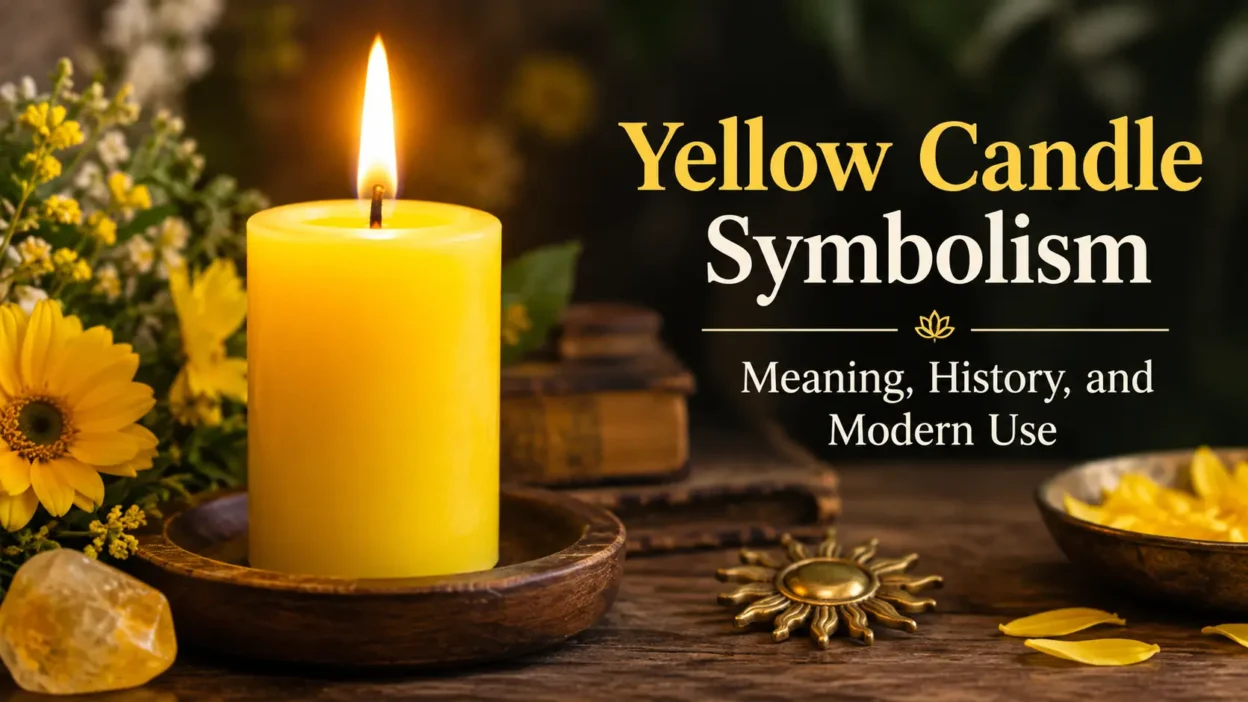
A yellow candle can represent happiness, mental clarity, optimism, creativity, and hope. In yellow candle symbolism, the color matters as much as the flame: yellow is commonly associated with sunlight, warmth, attention, and intellectual activity. People in the United States may light yellow candles during meditation, use them in home decor, or include them in personal rituals focused on confidence, communication, and fresh opportunities.
Unlike a symbol with one fixed religious meaning, a yellow candle can communicate different ideas depending on its setting. A candle on a birthday table may suggest celebration, while one used during quiet reflection may represent a desire for clearer thinking. In spiritual practices, its meaning often comes from the symbolic associations of yellow rather than from a single universal tradition.
Understanding this symbol requires looking at color psychology, candlelight, religious customs, folk practices, and modern American culture. These influences help explain why a simple yellow candle can suggest anything from everyday cheerfulness to a personal intention for change.
Quick Answer
Yellow candle symbolism commonly represents happiness, optimism, mental clarity, creativity, and confidence in modern American culture. Historically, yellow has been associated with sunlight, gold, learning, and prosperity, while candles have served as sources of light in religious observances, household life, and personal rituals.
TL;DR
- Yellow candles commonly symbolize joy, hope, confidence, and clear thinking.
- Sunlight and gold help explain yellow’s associations with warmth and prosperity.
- American spiritual practices often connect yellow candles with communication and personal intentions.
- Religious candle meanings depend on the faith, ceremony, and local tradition.
- Yellow candle decor can create a cheerful, welcoming atmosphere.
- Cultural context matters because yellow can also suggest caution or mourning.
1. What a Yellow Candle Represents
The most common meanings of a yellow candle are positive, practical, and connected to the qualities people associate with yellow itself.
Happiness and optimism are central associations. Yellow resembles sunshine, which many people connect with warm weather, outdoor activities, and brighter days. A yellow candle can therefore serve as a reminder to approach a situation with hope rather than discouragement.
Mental clarity and learning form another major group of meanings. Yellow is often linked with attention, ideas, and intellectual activity. Someone might choose a yellow candle for a study space or a quiet planning session because the color expresses a desire for focus and understanding.
Other common interpretations include:
- Confidence: A reminder to trust your abilities and speak clearly.
- Creativity: A symbol of imagination, curiosity, and original thinking.
- Communication: An expression of openness, honest conversation, and social connection.
- Prosperity: A visual association with gold, success, and material well-being.
- Renewed hope: A way to mark a fresh start or a change in attitude.
These meanings are associations, not guarantees. Lighting a yellow candle does not automatically improve concentration, attract wealth, or change someone’s circumstances. Its value may come from the intention, memory, or personal significance attached to it.
2. Why Yellow Is Associated With Sunlight and Gold
Two familiar things help explain yellow’s symbolic meaning: the sun and gold.
Sunlight makes yellow a natural symbol of warmth, visibility, and renewed hope. For people who associate sunny weather with outdoor activities, longer days, and a cheerful atmosphere, yellow can suggest relief after a difficult period. A yellow candle brings that association into a smaller, more personal setting.
Gold contributes a different meaning. Its yellow appearance has connected it with wealth, achievement, prestige, and value in many societies. A yellow candle may therefore represent ambition or a wish for financial stability, although the association does not mean that the candle itself attracts money.
Yellow also appears in ripe grain, autumn leaves, and many flowers. These natural examples can suggest harvest, maturity, abundance, and the completion of a task.
The symbolism is not identical in every culture. Yellow pigments, materials, religious customs, and historical events have shaped its meaning in different ways. Sunlight and gold provide useful starting points, not universal explanations for every yellow object or ritual.
3. How Yellow Candle Symbolism Developed Historically
The history of yellow candle symbolism involves two related but distinct developments: the long-standing cultural meaning of yellow and the use of candles in religious and spiritual settings.
Before colored candles became common household products, people already attached meaning to colors found in nature and valuable materials. Yellow ocher was used as a pigment in ancient art, while gold held important roles in the objects, clothing, and ceremonies of various societies.
Candles and oil lamps also developed religious associations. A maintained flame could represent devotion, remembrance, prayer, or the presence of light in a sacred setting. In some traditions, people lit candles to accompany prayers or commemorate the dead.
However, the modern practice of selecting a particular candle color for a specific intention is not one unchanged system inherited from antiquity. Contemporary color-based candle rituals draw from several streams, including European esoteric traditions, modern witchcraft, and African American folk practices.
Over time, books, spiritual communities, and commercial candle makers helped circulate recognizable color correspondences. Yellow became widely associated in some contemporary practices with intellect, communication, optimism, and confidence.
It is more accurate to describe this development as a combination of older color associations and newer ritual conventions than to claim that every modern yellow candle meaning originated in one ancient religion.
4. Yellow Candle Meaning in American Culture
In the United States, a yellow candle can have a straightforward decorative meaning or a personal spiritual purpose.
For everyday users, yellow is often a cheerful accent. A candle on a kitchen table, desk, or living room shelf can make a space feel warmer and more welcoming. Its symbolism may be as simple as celebrating spring, brightening a room, or creating a pleasant atmosphere.
In spiritual communities, yellow candles may be selected for intentions involving learning, communication, confidence, and personal growth. Someone preparing for an important presentation might light one while reviewing notes or setting an intention to speak clearly.
Yellow can also express hope during a period of transition. A person starting a new job, beginning a course, or working toward a personal goal might use a yellow candle as a reminder of the qualities they want to develop.
American interpretations are influenced by popular culture, advertising, interior design, and social media. Because these influences overlap, there is no single national definition of the color.
The setting matters. A yellow candle at a celebration communicates something different from one placed on a meditation table. In each case, the object gains meaning from the purpose people assign to it.
5. Spiritual Meaning of a Yellow Candle
In contemporary spiritual practices, yellow candles are commonly associated with mental focus, positive thinking, confidence, and clear communication.
Some practitioners choose a yellow candle before meditation, journaling, prayer, or an intention-setting exercise. The candle gives the activity a visible starting point and helps distinguish a period of reflection from the rest of the day.
For example, a person who wants to become more confident in conversations might light a yellow candle before writing down three points they want to communicate. The candle represents the intention; the preparation and practice provide the practical support.
In some modern metaphysical systems, yellow is linked to the solar plexus chakra, a concept associated with personal agency, self-confidence, and will. This is a spiritual framework rather than a universally accepted scientific explanation of how color works.
Spiritual interpretations also differ between practitioners. One person may use yellow to symbolize intellectual growth, while another may associate it with optimism or social connection.
A balanced interpretation allows room for personal belief without presenting symbolic associations as guaranteed supernatural effects.
6. Yellow Candles in Hoodoo and Contemporary Witchcraft
Yellow candles appear in some forms of Hoodoo, a historically African American system of folk spiritual practice, as well as in contemporary witchcraft and eclectic candle magic.
In these settings, colors can be selected to correspond with a specific purpose. Yellow may represent intellectual activity, successful communication, confidence, or mental clarity. The exact interpretation depends on the practitioner, tradition, and ritual being followed.
Hoodoo developed through African American cultural and spiritual experiences, with influences from African traditions, Christianity, and other sources. It should not be treated as interchangeable with Wicca or generalized modern witchcraft, which have their own histories and practices.
Some practitioners combine candle lighting with prayer, written intentions, devotional objects, or other ritual actions. Others simply use a colored candle as a focal point during quiet reflection.
There is no single yellow-candle ritual followed by all practitioners. Nor should a color correspondence found in a modern spiritual guide automatically be attributed to every historical tradition.
For respectful use, learn the context of a practice before adopting its rituals. A candle color can be meaningful without assuming that all spiritual communities interpret it in the same way.
7. Yellow Candle Symbolism in Religious Traditions
The meaning of a yellow candle depends on the religion and the ceremony in which it appears. Yellow wax does not have one universal religious definition.
In many Christian settings, candles symbolize prayer, remembrance, devotion, or Christ as the light of the world. Gold and yellow may also appear in religious art and decoration, where they can suggest glory, sacred light, or celebration. However, church candle practices do not follow one universal yellow-specific rule.
In Buddhism, yellow and saffron-colored robes have significance in many monastic traditions. They can be associated with renunciation, discipline, and the religious life. These meanings belong to particular cultural and monastic contexts; they do not automatically establish a standard meaning for yellow candles.
In Hindu traditions, yellow and saffron can be associated with auspiciousness, sacred observances, knowledge, and spiritual life, depending on the setting. Lamps and flames may play roles in worship, but the meaning of a particular light depends on the ritual rather than its color alone.
Jewish candle lighting also has specific religious meanings in practices such as Shabbat observance and certain holidays. These customs should not be reduced to modern color correspondence charts.
For American readers, the central distinction is between a religion’s established practices and personal interpretations influenced by color symbolism. A yellow candle may be meaningful in a religious setting, but its significance should be understood within that setting.
8. What a Yellow Candle Means for Love and Relationships
Yellow candle symbolism in relationships usually centers on communication, friendship, warmth, and optimism rather than romantic passion alone.
Someone might associate a yellow candle with the desire to speak honestly, resolve a misunderstanding, or reconnect with a friend. Its bright color can represent openness and a willingness to approach a difficult conversation constructively.
In a romantic relationship, a yellow candle may symbolize companionship, shared laughter, and renewed enthusiasm. A couple might use one during a quiet dinner or as part of a personal anniversary tradition.
Yellow can also represent emotional independence. It may remind someone that healthy relationships involve individual confidence as well as affection and mutual support.
These interpretations differ from the associations often assigned to red candles in modern color-based rituals, where red is commonly connected with passion and romantic desire.
A yellow candle cannot change another person’s feelings or guarantee reconciliation. Its practical value lies in expressing an intention and helping someone reflect on the actions needed to build a healthier relationship.
9. Yellow Candles for Success, Money, and Career Goals
Because yellow is associated with gold, achievement, and intellectual activity, some people use yellow candles to symbolize career development or financial goals.
The meaning may be especially relevant when success depends on communication or learning. A student might use a yellow candle as a reminder to prepare for an exam. A job seeker might light one before practicing interview answers. An entrepreneur might include one in a workspace as a symbol of creativity and informed decision-making.
Some candle-magic traditions also associate yellow with prosperity, but interpretations vary. In other practices, green or gold candles may be more closely connected with money and material success.
The distinction between symbolism and action is important. A candle can serve as a cue to review a budget, submit an application, or work toward a qualification. It cannot guarantee employment, higher income, or a favorable business outcome.
Used thoughtfully, the candle becomes a small reminder of a larger commitment. Its meaning comes from the goal it represents and the effort that follows.
10. Emotional and Psychological Meaning of Yellow Candlelight
Yellow candles can create an emotional association with warmth, comfort, and optimism. Some of this response comes from learned cultural meanings, while some comes from the sensory experience of seeing a flame in a dim room.
Candlelight often feels intimate because it is localized and relatively soft compared with bright overhead lighting. A yellow candle can add a warm visual accent to a quiet evening, a reading corner, or a reflective routine.
The psychological response to yellow itself is more complicated than the claim that yellow always makes people happy. Responses can vary with brightness, shade, personal memories, cultural associations, and the surrounding environment. A soft golden yellow may feel comforting to one person, while a vivid yellow may seem distracting to another.
The moving flame can also provide a focal point for slow breathing or a brief pause from digital distractions. These effects should not be confused with evidence that a candle color has a unique therapeutic power.
A yellow candle can support a calming routine, but it is not a substitute for professional mental health care when someone needs it.
11. Yellow Candle Meanings by Context
The table below summarizes common interpretations in contemporary American settings. These are flexible associations, not fixed rules.
| Context | Common Symbolic Meaning | Typical Association |
|---|---|---|
| Meditation or reflection | Clarity and optimism | Setting a personal intention |
| Study or work | Learning and concentration | Preparing for a task |
| Relationships | Friendship and communication | Encouraging honest conversation |
| Spiritual ritual | Confidence or intellectual activity | Expressing a specific intention |
| Home decor | Warmth and cheerfulness | Creating a welcoming atmosphere |
| Career or finances | Ambition and prosperity | Representing a personal goal |
The same candle can carry more than one meaning. A person may choose yellow for its appearance while also associating it with a new beginning. Personal meaning and cultural convention can coexist without being identical.
12. Yellow Candles in Home Decor, Gifts, and Personal Style
Outside spiritual settings, yellow candles are popular as decorative objects because they introduce color without requiring a major change to a room.
Pale yellow can complement light, neutral interiors, while mustard and golden shades can work well with natural wood, cream fabrics, or autumn decorations. Brighter yellow can add contrast to a minimalist space.
Seasonal arrangements also influence interpretation. A yellow candle in a spring centerpiece may suggest fresh growth, while a golden candle in an autumn display may evoke harvest and abundance.
As a gift, a yellow candle can communicate friendship, encouragement, or a wish for a brighter period ahead. It may suit someone starting a new job, moving into a new home, or celebrating an achievement.
In personal style, a yellow candle can also reflect a preference for cheerful colors or an interest in meditation and spiritual rituals. It does not necessarily indicate that the owner follows a particular religion or believes in candle magic.
The simplest explanation may be the right one: sometimes people choose a yellow candle because they like the color and enjoy the atmosphere it creates.
13. What Does a Yellow Candle Flame Symbolize?
The color of the candle wax and the color of its flame are two different things.
A yellow candle is made with yellow-colored wax, whereas a candle flame is normally yellow or golden because of the way combustion produces and emits light. A flame’s appearance depends on factors such as the fuel, wick, oxygen supply, and particles within the flame.
In symbolic interpretations, a steady flame may represent calmness, persistence, or focused attention. Some spiritual practitioners interpret flickering, dimming, or changes in flame behavior as signs within their personal rituals.
These interpretations are beliefs rather than reliable ways to predict future events or determine another person’s intentions.
A flickering flame often has an ordinary physical explanation, such as moving air, an uneven wick, or changes in the supply of fuel. If a candle burns unusually, it is better to check its placement and condition than to assume that the behavior carries a supernatural message.
Symbolic reflection can be personally meaningful, but it should not replace practical explanations.
14. Negative Meanings and Common Misunderstandings
Yellow is not positive in every symbolic system. Depending on the period and culture, it has also been associated with jealousy, cowardice, sickness, warning, or betrayal.
Some negative Western associations developed through historical conventions, literature, and the use of color to distinguish social or moral categories. These meanings coexist with positive associations involving sunlight, gold, and celebration.
In modern American life, yellow is especially visible on warning signs and caution markers. This use reflects the color’s visibility and its ability to attract attention, not necessarily a judgment that yellow is an unlucky color.
Several misunderstandings are worth avoiding:
- Yellow candles do not have one universal spiritual meaning. Their interpretation depends on the tradition and the individual’s intention.
- A yellow candle is not automatically a religious object. It may be decorative, ceremonial, or personally meaningful.
- Lighting one does not guarantee an outcome. Symbolic intention is different from evidence of a supernatural effect.
- A flickering flame does not prove that a spirit is present. Physical conditions commonly explain changes in flame behavior.
- Yellow is not universally lucky or unlucky. Cultural and historical contexts influence its meaning.
Recognizing these distinctions makes it easier to discuss yellow candles without exaggerating their significance or dismissing the personal value they may hold.
15. How Yellow Candle Symbolism Is Evolving Today
In 2025–2026, yellow candle symbolism fits into a broader culture of personal rituals, mindfulness, home styling, and online spiritual education.
Social media makes candle-color guides easy to discover. A person searching for a way to focus before an exam may encounter yellow candles associated with learning and communication. Someone exploring meditation may find the same color connected with confidence or positive intentions.
This wider access also encourages people to combine ideas from different traditions. A modern ritual might draw on contemporary witchcraft, personal affirmations, interior design, or a family custom. Such combinations can be meaningful to the individual, although they should not be presented as ancient or universally shared traditions without evidence.
The commercial candle market contributes to this evolution as well. Manufacturers offer yellow candles in many shades, fragrances, and designs, allowing people to choose them for decorative appeal, personal rituals, or both.
At the same time, increased visibility can make symbolic meanings appear more standardized than they really are. Online lists often present color correspondences as fixed rules, even though the associations vary among traditions.
The contemporary meaning of a yellow candle is therefore best understood as a combination of inherited color symbolism, modern spiritual practices, and personal choice.
Frequently Asked Questions
1. Is a yellow candle a symbol of good luck?
A yellow candle can represent optimism, prosperity, or success in some modern spiritual practices. However, yellow candles are not universally recognized as good-luck symbols, and their meaning depends on the tradition and intention involved.
2. What does a yellow candle mean spiritually?
Spiritually, yellow candles are commonly associated with mental clarity, confidence, learning, and communication. Some practitioners use them to focus on personal growth or to express an intention during prayer or meditation.
3. What does a yellow candle mean in a dream?
A yellow candle in a dream might personally suggest hope, awareness, learning, or a desire for clarity. Dream symbolism has no single scientifically established interpretation, so the dreamer’s feelings and circumstances matter more than a universal color rule.
4. Can I use a yellow candle for meditation?
Yes. You can use a yellow candle as a visual focus while breathing slowly, journaling, or setting an intention. Keep the candle on a stable, heat-resistant surface and extinguish it before leaving the room.
5. What is the difference between yellow and gold candle symbolism?
Yellow is often associated with optimism, communication, learning, and mental clarity. Gold more commonly emphasizes wealth, achievement, prestige, or abundance, although the meanings overlap in some spiritual practices.
6. Does a yellow candle have a specific meaning in Christianity?
Christian candle symbolism commonly involves prayer, devotion, remembrance, and sacred light, but yellow wax does not have one universal Christian meaning. The significance depends on the church tradition and the purpose of the ceremony.
7. Is yellow candle symbolism always positive?
No. Yellow can also suggest caution, jealousy, cowardice, or betrayal in certain cultural and historical contexts. The meaning of a yellow candle depends on how the color is being used and interpreted.
Conclusion
Yellow candle symbolism most commonly expresses happiness, optimism, mental clarity, creativity, and confidence. Its associations with sunlight and gold help explain why it appears in settings related to hope, learning, ambition, and prosperity, while contemporary spiritual practices give it additional meanings connected with intention and communication.
In modern American culture, a yellow candle can be a decorative accent, a meditation aid, a personal reminder, or part of a religious or spiritual practice. None of these uses has to define the meaning for everyone.
Ultimately, a yellow candle is most meaningful when its symbolism fits the context in which it is used. Whether it marks a fresh start, encourages a moment of reflection, or simply brightens a room, its meaning comes from the relationship between the color, the setting, and the person who chooses it.