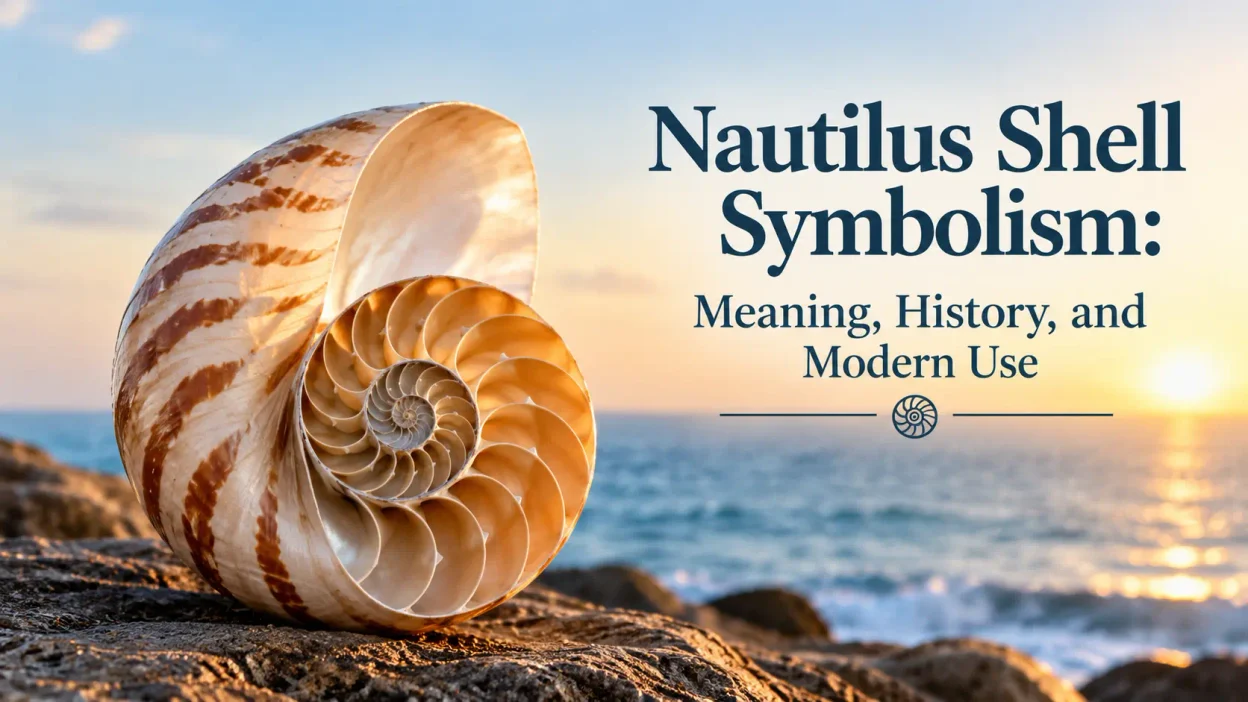
Nautilus shell symbolism often centers on growth, balance, adaptation, and the beauty of natural patterns. The nautilus is a marine animal whose hard external shell contains a series of chambers arranged in a curved, expanding form. Its distinctive appearance has made it a familiar image in jewelry, architecture, scientific illustration, and nature-inspired art.
For many Americans, the shell represents personal growth because its chambers offer a visible way to imagine development over time. Each new chamber reflects a stage in the animal’s life, making the shell an appealing metaphor for experience, change, and moving forward without abandoning the past.
The nautilus also attracts attention because its structure connects biology, geometry, and design. Although modern interpretations sometimes describe it as a perfect symbol of universal harmony, the actual animal is more interesting than a simple geometric ideal. Understanding its symbolism means separating what the shell really shows from the meanings people have added to it.
Quick Answer
Nautilus shell symbolism commonly represents personal growth, renewal, balance, and adaptation in modern American culture, especially in jewelry, home decor, and nature-inspired artwork. Its chambered spiral has also inspired historical and scientific interest in geometry, natural design, and the relationship between living organisms and their environments.
TL;DR
- The chambered shell commonly represents growth, change, and adaptation.
- Its spiral shape connects with natural patterns and mathematical geometry.
- Scientific illustration helped make the nautilus a recognizable cultural image.
- American jewelry and decor often use it to express balance and renewal.
- The shell’s growth pattern inspires reflection without proving spiritual claims.
- Modern interpretations sometimes exaggerate its connection to perfect mathematical proportions.
What a Nautilus Shell Looks Like and Why It Stands Out
The nautilus is a marine cephalopod related to octopuses and squids. Unlike these relatives, it has an external shell that protects its body and contains multiple internal chambers.
When the shell is cut across its center, the chambers become visible. A curved wall separates one chamber from the next, creating a pattern that appears to expand outward from an inner region. The animal occupies the newest, largest chamber, while older chambers remain behind it.
This structure gives the shell its distinctive appearance. From the outside, it may look like a smooth, rounded spiral with pale cream coloring and brown or reddish bands. Inside, the chamber walls form a more intricate pattern that attracts scientists, artists, designers, and collectors.
People encounter nautilus imagery in natural history museums, coastal gift shops, science textbooks, decorative prints, and jewelry. The actual shell is also sometimes displayed as a collectible object.
Its symbolic appeal comes partly from the fact that its shape is both recognizable and explainable. It looks artistic, but its structure serves a biological purpose.
The Core Meaning of the Nautilus Shell
The nautilus shell does not have one universally accepted symbolic meaning. Instead, several modern interpretations arise from its visible structure and the way the animal grows.
Personal growth is one of the most familiar associations. The expanding chambers offer a visual metaphor for adding experience and developing over time.
Adaptation is another common interpretation. The animal builds new shell material as it grows, creating a structure that accommodates its changing body. This makes the shell a useful image for adjusting to new circumstances.
Balance and order come from the relationship between the shell’s curved outline and its internal organization. Its appearance suggests that complexity can develop through a coherent structure.
Continuity is reflected in the way the older chambers remain part of the shell even as the animal grows. In a personal interpretation, this can represent carrying earlier experiences into a new stage of life.
These are interpretations rather than fixed meanings assigned to the animal by nature. The shell has a biological function first; its symbolic meaning emerges when people connect that function and appearance with human experiences.
How the Nautilus Shell Became a Symbol of Growth
The nautilus became an especially appealing image of personal development because its shell offers a clear visual analogy. As the animal grows, it constructs additional chambers rather than simply enlarging one undivided space.
Each chamber belongs to the same shell, but the overall structure changes as new sections form. People can connect this process with childhood, adulthood, learning, career changes, recovery, or the gradual development of a personal identity.
The metaphor works best when it emphasizes change with continuity. A person can develop new skills, take on new responsibilities, or change their outlook while still carrying memories and lessons from earlier stages.
However, the shell should not be treated as proof that human growth follows a predictable or perfectly orderly pattern. Biological development and personal experience are different processes. People may grow unevenly, revisit old challenges, or change direction.
The nautilus remains a useful symbol because it offers an image of development that does not require abandoning everything that came before. It suggests that earlier stages can remain part of a larger life story.
The Spiral Shape and Its Mathematical Appeal
The nautilus shell is often admired for its spiral, a shape found in many natural forms. Spirals can appear in plant growth, animal structures, weather systems, and other physical processes, although the mechanisms behind them vary.
The shell’s curve has attracted attention from mathematicians, artists, and designers because it combines visual regularity with expansion. Its internal chambers make the growth pattern especially easy to study and represent.
A common popular claim is that every nautilus shell follows a perfect golden spiral. That claim is too broad. The golden spiral is a specific mathematical construction related to the golden ratio, while real shells vary in their dimensions and growth patterns. A nautilus shell may resemble certain ideal spirals without matching them precisely.
This distinction matters because the symbolism of balance and harmony does not depend on mathematical perfection. A natural structure can inspire people through its organization even when it does not conform exactly to an ideal geometric formula.
In contemporary art, the spiral may represent progress, repetition, expansion, or a return to familiar themes from a new perspective. Those meanings come from human interpretation of the shape rather than a universal code embedded in every spiral.
Nautilus Shells in Scientific History and Natural History Illustration
The nautilus has a long history as an object of scientific interest. Its external shell makes it easier to examine and display than many soft-bodied marine animals, while its internal chambers reveal aspects of its anatomy and development.
Natural history collections and illustrated books helped bring shells into the homes and intellectual lives of people who might never encounter the living animal. Shells became objects of observation, comparison, collecting, and artistic study.
The nautilus also became associated with the broader effort to understand how living organisms develop their forms. Its shell offered a striking example of a structure that combines repeated chambers with a gradually expanding outline.
Scientific study did not require the shell to carry a spiritual meaning. Instead, it provided another reason for people to admire its structure and incorporate it into educational images and decorative design.
Over time, scientific appreciation and symbolic interpretation began to overlap in popular culture. An image could suggest both the intricacy of biological growth and a more personal idea of development. The two readings can coexist as long as metaphor is not confused with scientific explanation.
What the Nautilus Shell Means in Modern American Culture
In the United States, the nautilus shell appears most often as a symbol connected with nature, thoughtful design, and personal development rather than a formal religious tradition.
In coastal communities, shell imagery can suggest the ocean, marine life, beach memories, and a connection to the natural environment. A nautilus displayed in a home may remind its owner of a vacation, a collection, or an interest in marine biology.
In wellness-oriented decor, the shell’s spiral may be used to communicate calm, balance, or a sense of gradual progress. These meanings are especially common in settings that feature natural materials, botanical artwork, and organic forms.
The nautilus also suits educational and professional environments. Its structure can represent scientific curiosity, mathematics, engineering, or the relationship between design and function.
There is no single American tradition that assigns the shell a fixed meaning. One person may choose it for its beauty, another for its connection to the ocean, and another for its metaphor of personal growth.
Its flexibility is part of its appeal. The image is recognizable enough to communicate a connection with nature, yet open-ended enough to support individual interpretation.
The Connection Between the Nautilus and Natural Balance
The nautilus shell often represents balance because its structure combines repeated chambers, a curved outer form, and a functional relationship between its parts. Its appearance can suggest order without looking rigid or mechanical.
In biology, the chambers serve a practical purpose. The nautilus uses gas and liquid within its chamber system to help regulate buoyancy as it moves through the water. The shell is therefore not simply a decorative structure; it is part of an organism’s way of living in its marine environment.
This biological function gives the shell an interesting basis for modern interpretations of balance. People may connect it with managing competing responsibilities, adjusting to changing circumstances, or creating routines that support everyday life.
Still, balance does not mean that nature is always peaceful or perfectly symmetrical. Living systems respond to environmental pressures, and individual organisms vary. The nautilus offers an example of functional organization, not a guarantee that every part of life can be arranged into effortless harmony.
Nautilus Shell Symbolism in Spirituality and Personal Reflection
Some modern spiritual and reflective practices use the nautilus shell as an image of inner development. Its expanding chambers can represent a person’s evolving understanding, while the spiral may suggest reflection, repeated lessons, or a gradual movement toward new perspectives.
For example, someone beginning a new chapter after a career change might use a nautilus image as a reminder that previous experiences remain valuable. A person recovering from a difficult period might interpret the shell as a sign of continuing development rather than a demand to move forward quickly.
These interpretations can be meaningful without being treated as universal spiritual truths. The nautilus is not a central sacred symbol shared by all major religions, and there is no single ancient doctrine that assigns it one standard spiritual message.
When the shell appears in meditation spaces or personal journals, its meaning usually depends on the person’s own beliefs and intentions. It may serve as a prompt to reflect on growth, patience, or the relationship between past and present.
The distinction is simple: the animal’s structure is a biological fact, while its role as a spiritual reminder is a human interpretation.
Nautilus Shell Meaning in Jewelry, Tattoos, and Fashion
The nautilus shell works well in personal accessories because its spiral can be recognized even when represented with only a few lines. Designers can use a realistic shell illustration or reduce its form to a simple curved emblem.
In jewelry, a nautilus pendant may express an interest in marine life, coastal living, science, or organic design. Some wearers choose it as a personal reminder of growth and change, especially when the shell’s expanding structure fits a meaningful life experience.
In tattoo culture, the shell can carry several interpretations:
- Personal growth: The expanding chambers represent the accumulation of experience.
- Adaptability: The shell’s development suggests responding to life’s changing demands.
- Connection to the ocean: The image reflects an interest in marine environments or coastal identity.
- Scientific curiosity: Its geometry may appeal to people interested in biology, mathematics, or natural patterns.
- Continuity: The chambers offer a visual metaphor for carrying earlier experiences into later stages.
Fashion and accessory designs may use the shell simply because its outline is attractive. A wearer does not need to adopt a spiritual interpretation for the image to have personal significance.
As with other natural symbols, context matters. A highly detailed shell may communicate an interest in natural history, while a minimalist spiral may emphasize the shape rather than the animal itself.
Why the Nautilus Appears in Home Decor and Architecture
The nautilus shell has an established place in decorative design because its shape works across different scales. It can appear in a small pendant, a framed illustration, a ceramic object, or a larger architectural composition.
In American coastal interiors, shell motifs often connect a room with the sea. A nautilus print may complement beach photography, marine colors, driftwood, or other natural materials without requiring a literal nautical theme.
The spiral also appeals to designers interested in organic forms. It provides a way to introduce curved lines into spaces dominated by straight edges and rectangular shapes.
In architecture, spiral forms have been used in many contexts, but a spiral-shaped building or staircase should not automatically be described as a direct reference to the nautilus. Similar shapes can emerge from different design goals, and the designer’s intention matters.
When the shell is deliberately included, it may communicate an interest in nature’s structures, the relationship between beauty and function, or the idea that a complex form can develop through repeated units.
These associations help explain why the nautilus continues to appear in design even among people who know little about its biology.
How the Nautilus Compares With Other Shell Symbols
Different shells can communicate different ideas depending on their appearance, use, and cultural associations. The nautilus is distinctive because its internal chambers and expanding spiral are especially visible in illustrations and cross-sections.
A conch shell, for example, is often associated with the sea and has important ritual uses in some religious and cultural traditions. A scallop shell has recognizable associations with pilgrimage in Christian European contexts, particularly the traditions surrounding Saint James.
A nautilus shell is more commonly used in modern design to evoke natural geometry, marine life, and gradual growth. These distinctions are useful, but they are not universal rules; individual designs can assign different meanings to the same shell.
| Symbol | Common modern association | Notable context |
|---|---|---|
| Nautilus shell | Growth, natural patterns, adaptation | Scientific illustration, jewelry, decor |
| Conch shell | Ocean, sound, ritual, communication | Religious and cultural practices in several traditions |
| Scallop shell | Pilgrimage and spiritual journeys | Christian European traditions |
| Clam shell | Coastal life, protection, hidden contents | Decorative art and marine imagery |
| Abalone shell | Iridescence, ocean beauty, cultural significance | Jewelry and distinct Indigenous and coastal traditions |
These comparisons should not erase cultural differences. In particular, the meanings of shells used in Indigenous or religious traditions deserve to be understood within those specific contexts rather than treated as interchangeable decorative motifs.
Emotional and Psychological Associations of the Nautilus
The nautilus can communicate a combination of stability and change. Its shell provides protection, while its expanding structure makes development visible. This contrast can appeal to people who want to acknowledge change without losing a sense of identity.
The spiral may also encourage reflection because it invites the eye to follow a curve from the inner region toward the outside. Some viewers interpret this movement as a journey from earlier experiences to a wider understanding of the world.
These are aesthetic and personal associations, not psychological tests. Choosing a nautilus pendant does not demonstrate that a person is balanced, patient, or adaptable. Symbols can express an aspiration, memory, or preference without revealing a person’s inner character.
The shell’s appeal may also come from its combination of complexity and familiarity. Its repeated chambers create a structured pattern, yet the overall form remains organic. For some people, that makes it a reassuring image during periods of change.
In this sense, the nautilus works less as a fixed message and more as a visual reminder. Its value depends on the experiences and ideas a person connects with it.
Misconceptions About the Nautilus Shell
The nautilus shell is frequently used in popular discussions of mathematics and spirituality, but several common claims need qualification.
One misconception is that the shell always forms a perfect golden spiral. Real shells vary, and their growth patterns should not be assumed to match a mathematical ideal precisely.
Another is that the nautilus has always been a universal symbol of enlightenment or spiritual awakening. Such interpretations occur in modern symbolic writing, but there is no basis for treating them as beliefs shared by all ancient cultures.
It is also misleading to claim that every chamber represents a specific stage of human development. People can use that metaphor creatively, but the biological chambers form as the animal grows; they are not a documented code for human life stages.
Finally, the nautilus should not be confused with the ammonite. Ammonites were an extinct group of marine cephalopods whose fossil shells often display similar coiled forms. Their visual resemblance makes them popular in overlapping decorative and symbolic contexts, but they are not the same animal.
These distinctions do not diminish the shell’s symbolic value. They make it easier to appreciate the difference between scientific evidence, cultural history, and personal meaning.
How Nautilus Shell Symbolism Has Changed Over Time
The nautilus has moved between natural history, collecting, art, and modern lifestyle design. Its shell became an object of scientific examination because it offered visible evidence of a marine animal’s structure and growth.
As natural history collections and illustrated publications spread, shells became familiar objects for people interested in nature, classification, and decorative collecting. The nautilus could be admired as a specimen and as a naturally formed design.
Modern photography, digital illustration, and popular science have made the shell’s internal chambers easier to see. At the same time, contemporary wellness culture has encouraged people to interpret natural forms as reminders of personal development, balance, and reflection.
The result is a flexible symbol with several overlapping meanings. Its scientific interest comes from its biological structure, its artistic appeal comes from its form, and its personal symbolism comes from the stories people associate with growth and change.
There is no need to claim that one interpretation is the only correct one. The key is to identify whether a particular meaning comes from biology, documented cultural history, modern design, or an individual’s own experience.
Nautilus Shell Symbolism in Everyday Life
People do not need to own a shell or study marine biology to use the nautilus as a symbol. Its image can appear in a notebook, a piece of jewelry, a framed print, or a design chosen to mark a new stage in life.
Someone starting a business might use the expanding chambers as a reminder that progress often happens one stage at a time. A marine science student might choose the shell because it connects visual beauty with biological function. A homeowner might display it simply because its curved shape suits a coastal room.
These uses share an appreciation for the way a natural object can suggest ideas beyond its immediate physical function. The symbol becomes meaningful through the relationship between the object’s structure and the person’s experience.
A grounded interpretation does not require supernatural claims or mathematical exaggeration. The nautilus can stand for growth because its shell visibly changes as the animal develops, and it can suggest balance because its chambers form an organized structure.
That combination of observable form and personal interpretation explains the shell’s continuing appeal in modern American life.
Frequently Asked Questions
What does a nautilus shell symbolize spiritually?
A nautilus shell can symbolize personal growth, reflection, continuity, and adaptation in modern spiritual practices. These meanings are contemporary interpretations rather than a single established doctrine shared by ancient religions.
Why is the nautilus shell associated with personal growth?
As the nautilus grows, it forms additional chambers within its shell. People use this visible process as a metaphor for gaining experience and moving through different stages of life while retaining the lessons of the past.
What does a nautilus shell tattoo mean?
A nautilus tattoo may represent growth, adaptability, connection to the ocean, or an appreciation for natural geometry. Its specific meaning depends on the wearer’s intentions and the other elements included in the design.
Is the nautilus shell a symbol of the golden ratio?
The nautilus shell is often compared with the golden spiral because both have expanding curved forms. However, real nautilus shells do not necessarily match the golden spiral precisely, so the two should not be treated as mathematically identical.
What does a nautilus shell mean in American home decor?
In American homes, the shell often suggests coastal living, natural beauty, scientific curiosity, or organic design. Some people also use it as a reminder of personal development, while others choose it primarily for its appearance.
Is a nautilus shell considered a good-luck symbol?
There is no single widely established tradition that makes the nautilus shell a universal good-luck symbol. Individuals may give it that meaning, but it is more commonly interpreted in modern design through growth, balance, and connection with nature.
What is the difference between a nautilus shell and an ammonite fossil?
A nautilus shell belongs to a living group of marine cephalopods, while ammonites were an extinct group known largely through their fossils. Their coiled shells look similar, but they represent different groups of animals and have distinct natural histories.
Conclusion
Nautilus shell symbolism brings together personal growth, adaptation, natural geometry, and continuity. Its expanding chambers provide a real biological basis for the metaphor of development, while its spiral form has inspired artists, designers, and people interested in the relationship between nature and mathematics.
In modern American culture, the shell can express a connection to the ocean, an appreciation for natural design, or a personal reminder to keep growing through life’s changes. Nautilus shell symbolism is most meaningful when its scientific foundations remain clear and its personal interpretations are allowed to develop naturally. The shell’s appeal lies in a simple observation: growth can create something new without erasing what came before.


