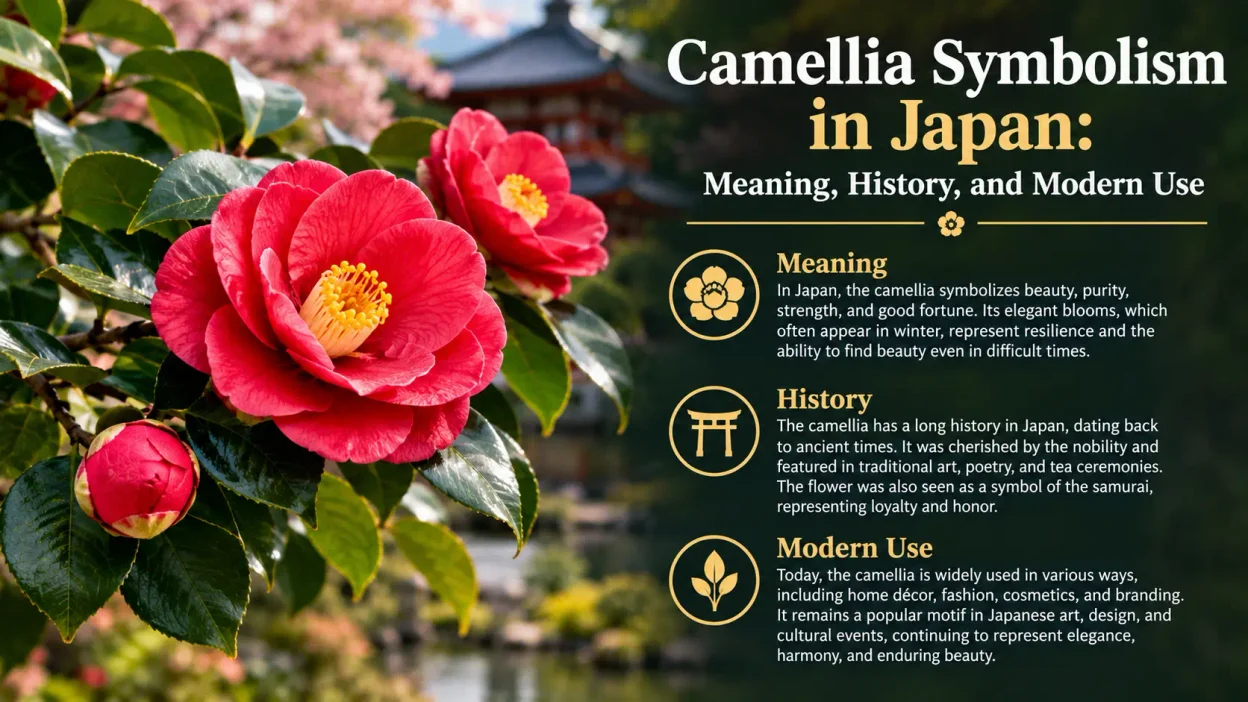
Camellia symbolism in Japan reflects the relationship between natural beauty, seasonal change, and cultural tradition. Known in Japanese as tsubaki (椿), the camellia is a flowering evergreen shrub whose elegant petals and glossy leaves have made it a familiar presence in Japanese gardens, traditional art, poetry, and floral arrangements. Its meanings vary by context, flower color, and historical period.
Unlike flowers with one widely recognized symbolic meaning, the Japanese camellia carries several associations. It can suggest beauty, refinement, and affection, while its distinctive way of shedding its flower head has also influenced historical interpretations involving death and misfortune. These contrasting meanings help explain why the flower has occupied different places in Japanese culture.
For American readers, the camellia may be familiar as an ornamental garden flower or a symbol of love and admiration. Learning about its Japanese background offers a more nuanced perspective, showing how a single flower can express elegance in one setting and carry a more complicated history in another.
Quick Answer
Camellia symbolism in Japan commonly represents beauty, elegance, affection, and devotion, especially in gardens, floral art, and traditional aesthetics. Historically, the tsubaki has also carried associations with the samurai, seasonal renewal, and death-related beliefs connected to the way its flower head falls.
TL;DR
- The Japanese camellia, called tsubaki, symbolizes beauty and refined natural elegance.
- Its evergreen leaves suggest vitality through changing seasons.
- Samurai associations and beliefs about falling flower heads complicate its historical meaning.
- Red, white, and pink camellias carry different modern interpretations.
- Japanese gardens, tea culture, and floral art feature the flower in distinct ways.
- American audiences often associate camellias with love, admiration, and ornamental beauty.
What the Camellia Looks Like in Japanese Culture
The camellia belongs to the genus Camellia, a group of flowering evergreen plants in the tea family. The Japanese camellia, Camellia japonica, is especially important in Japanese horticulture. It has glossy, dark green leaves and flowers that range from simple, open forms to densely layered blossoms resembling roses.
Camellias bloom in the cooler months, with flowering times varying by cultivar and location. Their appearance during winter and early spring makes them noticeable when many other garden plants have stopped flowering. This seasonal contrast contributes to their association with resilience and enduring beauty.
In Japan, camellias appear in gardens, painted screens, kimono patterns, decorative objects, and flower arrangements. Their forms can be rendered realistically or stylized into repeating patterns for textiles and crafts.
The flower’s visual simplicity also makes it suitable for traditional Japanese aesthetics, where the shape of a petal, the curve of a branch, or the contrast between a blossom and dark leaves can carry much of a composition’s effect.
The Core Meaning of Tsubaki in Japan
The Japanese word tsubaki refers to the camellia, especially the Japanese camellia. Its symbolism does not come from a single ancient definition. Instead, it developed through the flower’s natural characteristics, literary and artistic use, gardening traditions, and cultural associations.
Beauty is one of its most recognizable meanings. The smooth petals, balanced shape, and rich colors make the flower an emblem of natural refinement rather than elaborate ornament.
Affection and devotion are also common modern interpretations, particularly when camellias are given as gifts or used in floral designs. These meanings are not fixed rules shared by every Japanese community, and the flower does not have the same role in every ceremonial setting.
The evergreen foliage adds another dimension. Because the plant retains its leaves through the year, it can suggest vitality and continuity even when temperatures fall. That interpretation arises naturally from the plant’s growth habits, though its exact meaning depends on the setting.
The most accurate approach is to treat tsubaki as a flower with several related associations rather than as a universal code in which every blossom communicates one precise message.
Historical Roots of the Japanese Camellia
Camellias have a long history in East Asia, and the Japanese camellia became an important cultivated plant in Japan. Over time, horticultural selection produced varieties with different flower shapes, sizes, and colors.
The plant also entered Japanese visual culture. Artists could use its rounded blossom and evergreen leaves to create striking seasonal compositions, while gardeners could place it where its winter or early-spring flowers would be especially noticeable.
Its historical importance was not limited to symbolism. Camellias were valued as living plants, and cultivated varieties became objects of horticultural interest. The development of named cultivars reflects an appreciation for the flower’s form and the skill involved in growing it.
It is important to distinguish the long history of camellia cultivation from specific claims about ancient beliefs. Not every meaning found in modern flower dictionaries can be traced to a single historical source, and some popular explanations simplify a more varied cultural record.
The flower’s significance is best understood as the result of several overlapping traditions: gardening, seasonal observation, literature, visual art, and changing ideas about beauty.
Camellias, Samurai, and Historical Beliefs About Death
One of the most frequently discussed aspects of Japanese camellia symbolism is its association with the samurai and death. The explanation often centers on how a camellia blossom falls.
Unlike flowers that lose their petals gradually, some camellia varieties can drop the flower as a relatively complete unit. The fallen blossom may resemble a severed head, an image that has been connected in popular accounts with the samurai’s sensitivity to decapitation and death.
This association is widely repeated in modern descriptions of Japanese flower symbolism, but it should not be treated as a universal prohibition or a rule followed by every samurai. Historical attitudes toward flowers and death varied, and the available evidence does not justify claiming that all samurai avoided camellias.
The flower’s connection with death is therefore best described as a historical and cultural association rather than an absolute meaning. Its relevance depends on the period, the community, and the particular use of the plant.
This context explains why a camellia can be admired for its beauty while also carrying an unsettling interpretation in certain settings. Japanese flower symbolism, like symbolism elsewhere, can hold opposing meanings at once.
Seasonal Renewal and the Evergreen Camellia
The camellia’s evergreen leaves distinguish it from plants that become bare during winter. Its ability to retain foliage while producing flowers in cool weather makes it a natural image of continued life.
In Japanese gardens, seasonal awareness is central to the experience of plants. A flower’s value may come not only from its appearance but also from the time at which it appears. Camellias can bring color to a garden when the landscape otherwise seems quiet.
This seasonal role supports modern interpretations of endurance, vitality, and renewal. The flower can represent beauty that persists through difficult conditions, although that is an interpretation drawn from its growth pattern rather than a universal traditional doctrine.
The camellia’s winter and early-spring flowering also gives it a different mood from blossoms strongly associated with the height of spring. Its beauty often appears against cool weather, dark leaves, and subdued garden colors.
For people who appreciate Japanese gardens, this contrast is part of the flower’s appeal. It offers a reminder that a garden’s character changes across the year, and that quiet seasons have their own forms of beauty.
Red Camellia Symbolism in Japan
Red camellias are among the most visually striking varieties. Their rich color and smooth petals can suggest passion, affection, admiration, and vitality in contemporary floral interpretation.
The color red has several roles in Japanese culture, including associations with celebration, protection in certain contexts, and visual intensity. However, the meaning of a red camellia cannot be determined from color alone. Its setting, use, and the intention behind a gift or design also matter.
In modern floral arrangements, a red camellia may be chosen to express romantic interest or appreciation. In art, it can create a focal point against dark green leaves or a muted background.
It would be misleading to claim that red camellias have always carried one specific meaning throughout Japan. Color symbolism changes across time and setting, and modern flower-giving practices do not necessarily reproduce historical customs.
For American audiences, red camellias may resemble other red flowers associated with love, but their Japanese cultural background adds a distinct horticultural and artistic context.
White Camellia Symbolism in Japan
White camellias can suggest purity, simplicity, dignity, and quiet elegance in modern interpretations. Their pale petals emphasize the flower’s shape and texture, making them suitable for restrained floral arrangements and traditional-style artwork.
White has varied associations in Japan. It can be linked with cleanliness and sacredness, but it also has important connections with funerary and mourning practices. These meanings depend on the context, so white flowers should not be assigned one universal emotional message.
A white camellia used in a garden may simply be appreciated for its understated appearance. In a painting, it can provide contrast against dark foliage. In a gift, its meaning may be shaped more by the relationship between giver and recipient than by a formal symbolic code.
The flower’s historical association with the way a blossom falls can also influence how some people interpret camellias more generally. That concern should not automatically be applied to every white variety or every modern use.
The most useful interpretation of a white camellia combines its visual character with the circumstances in which it appears.
Pink Camellia Symbolism and Gentle Affection
Pink camellias are often interpreted in modern floral symbolism as signs of tenderness, fondness, admiration, and gentle affection. Their softer color creates a different impression from the intensity commonly associated with red blossoms.
In contemporary arrangements, a pink camellia may suit a message of appreciation that is warm without being overtly romantic. It can also be used in garden design where the goal is to create a softer transition between stronger colors.
These meanings should be understood as common modern interpretations rather than fixed Japanese traditions that have remained unchanged for centuries. The historical significance of a particular color may differ from the meanings assigned to it by present-day florists or online flower guides.
Pink camellias also show how visual details shape symbolic readings. The same species can appear formal, dramatic, delicate, or understated depending on its color, flower form, and surrounding plants.
In Japanese-inspired design, a pink camellia can express natural grace without requiring a complicated symbolic explanation.
Camellias in Japanese Gardens and Traditional Aesthetics
Japanese gardens are designed through careful attention to plants, stone, water, space, and seasonal change. A camellia can contribute to this setting through its evergreen foliage, distinctive blossoms, and ability to flower during cooler months.
The plant’s appearance works well in gardens that emphasize contrast. A bright flower against dark leaves can draw attention without overwhelming the surrounding landscape. Some varieties have simple blossoms, while others offer fuller shapes that create a different visual effect.
Camellias can also fit into gardens where plants are selected for the sequence of their flowering periods. Their seasonal presence helps create interest outside the peak bloom of spring.
Japanese aesthetics are diverse, and it would be inaccurate to claim that every camellia garden expresses a single philosophy such as minimalism or impermanence. Different gardens serve different purposes, from private enjoyment to temple landscapes and public horticultural displays.
Still, the camellia’s combination of evergreen leaves and seasonal flowers makes it well suited to designs that encourage close observation of nature. Its beauty changes with light, weather, and the plants around it.
Camellias in Tea Culture and Floral Art
Camellias belong to the same botanical family as the tea plant, Camellia sinensis. This botanical relationship is important, but it does not mean that ornamental camellias and tea leaves serve the same purpose or share identical symbolic meanings.
In Japanese tea culture, the selection of flowers for a tea gathering can reflect the season and the character of the occasion. Floral arrangements associated with the tea tradition often favor natural forms and a sense of appropriateness rather than elaborate display.
Camellias may be used in seasonal floral settings, including arrangements that complement the quiet atmosphere of a tea room. Their simple forms and winter flowering can make them appropriate in some contexts, though the choice depends on the occasion and the particular tradition being followed.
In ikebana, the Japanese art of flower arrangement, plants are considered in relation to line, space, balance, and the character of their natural growth. A camellia branch can contribute structure as well as color.
These uses show that the flower’s importance is not limited to a symbolic message. It can also be valued for how it shapes an environment and directs attention to the season.
Camellias in Japanese Literature, Painting, and Textiles
The camellia’s clear outline and varied flower forms make it suitable for visual art. Its blossoms can appear in botanical illustrations, decorative paintings, textile patterns, and objects designed for everyday use.
In paintings, a camellia may be shown as part of a seasonal landscape or as the main subject of a close composition. Artists can emphasize the contrast between its petals and glossy foliage, or use a single flower to create a restrained focal point.
Textile designs may stylize the blossom into repeating patterns. On clothing and decorative fabrics, a camellia motif can serve an aesthetic purpose without necessarily communicating a specific symbolic message.
The flower’s presence in poetry and other literary settings should likewise be interpreted in context. A blossom may help establish a season, describe a garden, or contribute to an emotional scene. Not every appearance signals a formal code of love, death, or renewal.
For modern readers, these artistic uses reveal how the camellia became familiar beyond the garden. Its recognizable shape allows it to move between nature, decoration, and cultural expression.
Camellia Symbolism in Modern American Culture
In the United States, camellias are commonly associated with beauty, admiration, affection, and ornamental gardening. They are popular in parts of the South, where the climate supports many varieties and established gardens often feature camellia shrubs.
Japanese cultural influences add another dimension to how Americans encounter the flower. Japanese-inspired gardens, botanical exhibitions, art, and fashion may use camellias to evoke Japanese aesthetics or the changing seasons.
However, an American interpretation of a camellia is not necessarily the same as a Japanese one. A gardener may appreciate its winter flowers without knowing its historical associations, while someone interested in Japanese culture may recognize its name and distinctive appearance.
The flower also appears in contemporary design, including greeting cards, fabric prints, jewelry, and floral photography. Its balanced petals and glossy leaves make it adaptable to both traditional and modern styles.
For Americans exploring Japanese symbolism, the best approach is to appreciate the flower’s cultural history without assuming that every camellia carries an ancient message. Sometimes its significance comes from its botanical beauty, its place in a garden, or the personal memories attached to it.
Why Camellias Appear in Jewelry, Tattoos, and Fashion
Camellia imagery works well in personal accessories because the flower has a recognizable outline and can be represented at different levels of detail. A small pendant might show a simple blossom, while a tattoo could include several flowers, branches, and leaves.
A camellia tattoo may represent affection, elegance, perseverance, or an appreciation for Japanese culture. Someone may also choose the flower to remember a loved one, mark a personal milestone, or celebrate a favorite plant.
When a design specifically claims to represent traditional Japanese symbolism, historical context becomes important. The flower’s associations with beauty and seasonal life can coexist with the less familiar beliefs surrounding its falling blossom.
Fashion offers another example of changing meaning. The camellia has been used in decorative accessories and clothing designs, where it may communicate sophistication or a preference for floral motifs rather than a specific religious or spiritual belief.
A personal design does not need to reproduce every historical association. It should, however, distinguish between the meanings supported by cultural history and those chosen by the wearer.
Emotional and Psychological Meaning of the Camellia
Flowers often communicate feelings indirectly. A camellia can express affection without the familiarity of a rose, or suggest elegance without the visual delicacy of a smaller spring flower.
Its evergreen foliage may encourage associations with steadiness and continuity. Its blossoms, appearing during cooler periods, can create an impression of beauty persisting through an otherwise quiet season.
These emotional responses are shaped by individual experience. Someone who grew up around camellia bushes may associate the flower with family or home, while another person may connect it with travel, Japanese gardens, or a particular work of art.
Color can also influence the impression a flower creates. Red may feel vivid and expressive, white restrained and formal, and pink gentle or affectionate. These are common visual associations, not universal psychological rules.
The camellia’s emotional meaning is therefore best understood as a combination of appearance, cultural knowledge, and personal experience. A symbol can help people communicate feelings, but it cannot reliably reveal someone’s personality or intentions.
Common Misunderstandings About Japanese Camellia Symbolism
Several popular claims about Japanese camellias require a closer look.
One is that all camellias symbolize perfect love or devotion. These associations are common in modern flower symbolism, but they do not account for the flower’s varied historical and cultural contexts.
Another is that camellias were universally forbidden among samurai because their blossoms resemble severed heads. The association is widely repeated, but it should not be treated as proof that every samurai avoided the flower or that the belief applied uniformly across Japanese society.
A third misunderstanding is that red, white, and pink camellias have fixed meanings that every Japanese person recognizes. Color interpretations can vary by period, setting, and personal experience, and modern floral conventions do not always reflect older traditions.
It is also inaccurate to assume that every flower appearing in Japanese art carries a formal symbolic message. Artists may choose a camellia for its shape, seasonal relevance, decorative value, or relationship to the surrounding composition.
Respectful interpretation means avoiding both extremes: treating the camellia as a universal mystical sign and dismissing its cultural history as nothing more than decoration.
How Camellia Symbolism Has Changed Over Time
The camellia’s meaning has developed alongside Japanese gardening, art, literature, and social customs. Its natural qualities provided the starting point, while particular historical associations added further layers.
In earlier cultural settings, the flower could be valued as a cultivated plant and used in artistic or seasonal contexts. Beliefs about its falling blossom also contributed to a more complicated reputation in certain accounts.
Later horticultural developments expanded the range of camellia varieties available to gardeners and collectors. Different flower shapes and colors created new possibilities for ornamental planting, decorative art, and personal preference.
Today, the camellia is interpreted through several overlapping perspectives. A Japanese gardener may focus on its seasonal flowering, an American homeowner may value its evergreen foliage, and a tattoo enthusiast may use it to express affection or cultural interest.
These meanings do not have to cancel one another out. The flower’s history is more informative when its traditional associations, modern interpretations, and individual uses remain distinct.
Camellia Symbolism in Japan at a Glance
| Context | Common meaning or association | Important detail |
|---|---|---|
| Red camellia | Passion, affection, admiration | Modern color interpretations vary by setting |
| White camellia | Simplicity, dignity, purity | White also has mourning-related associations in Japan |
| Pink camellia | Tenderness and gentle affection | Often used as a modern floral interpretation |
| Samurai traditions | Death-related association | Linked in popular accounts to the way blossoms fall; not a universal rule |
| Japanese gardens | Seasonal beauty and vitality | Evergreen leaves and cool-season flowers shape its appeal |
| Tattoos and fashion | Elegance, affection, personal identity | Meanings depend on the wearer and design |
Frequently Asked Questions
What does the camellia symbolize in Japanese culture?
The camellia, or tsubaki, is commonly associated with beauty, elegance, and affection. Its evergreen foliage and cool-season flowering also support modern interpretations involving vitality and seasonal renewal.
Why is the camellia associated with samurai and death?
Some traditional accounts connect the camellia with death because its blossom can fall as a complete flower head, resembling a severed head. This association is widely repeated, but it should not be interpreted as a universal belief shared by every samurai.
What does a red camellia mean in Japan?
A red camellia is often interpreted today as a symbol of passion, affection, and admiration. Its precise meaning depends on the setting, and modern color symbolism should not automatically be treated as an unchanged ancient tradition.
Is the camellia a symbol of good luck in Japan?
The camellia does not have one universally accepted meaning as a good-luck symbol. Its associations vary, and some historical interpretations are more complicated than the positive meanings commonly used in contemporary floral arrangements.
What does a camellia tattoo represent?
A camellia tattoo may represent elegance, affection, perseverance, or an interest in Japanese art and culture. Adding traditional Japanese motifs can give the design a more specific cultural context, although the final meaning depends on the individual.
Are camellias associated with death in Japanese culture?
Yes, some historical and popular interpretations connect camellias with death because of how the flower head falls. However, camellias are also admired for their beauty and cultivated as ornamental plants, so death is not their only cultural association.
What is the difference between Japanese and American camellia symbolism?
Japanese interpretations may include cultural and historical associations involving the tsubaki, seasonal aesthetics, and beliefs about the falling blossom. American interpretations more commonly emphasize garden beauty, affection, admiration, and the flower’s ornamental value, although individuals may understand both traditions.
Conclusion
Camellia symbolism in Japan combines beauty, affection, seasonal vitality, and a more complicated historical association with death. The flower’s evergreen leaves and distinctive blossoms explain much of its visual appeal, while Japanese gardens, art, and cultural traditions provide the context for understanding its broader significance.
For modern American readers, the camellia offers more than an attractive flower. It provides an example of how cultural symbols develop through nature, history, and changing personal interpretations. Understanding those layers allows the flower to be appreciated without reducing Japanese tradition to a single symbolic meaning.