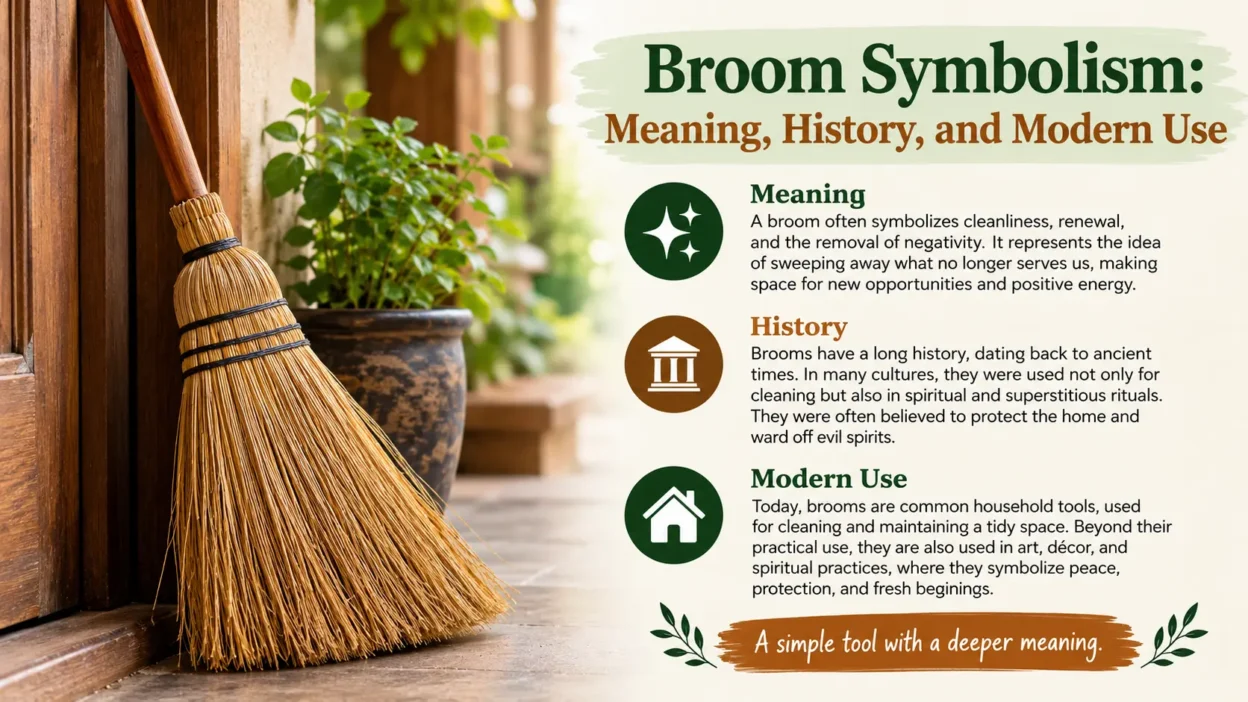
A broom is an ordinary household tool, but its symbolic meaning extends far beyond sweeping floors. In broom symbolism meaning, the familiar object often represents cleanliness, renewal, protection, domestic life, and the desire to clear away unwanted influences. Its associations with witches, folklore, and wedding ceremonies add other layers to its meaning.
In the United States, brooms appear in everyday routines, Halloween decorations, traditional wedding ceremonies, and stories about luck or spiritual protection. Their meaning depends on the setting. A broom beside a front door may suggest a clean home, while a broomstick in a Halloween display immediately brings witches and magic to mind.
Understanding broom symbolism also means looking at the people who gave this ordinary object cultural significance. Different communities have used brooms in household customs, marriage rituals, and supernatural folklore. These traditions have changed over time, and not every interpretation applies to every culture.
Quick Answer
Broom symbolism commonly represents cleansing, renewal, protection, and the maintenance of a peaceful home in modern American culture. Historically, brooms have also been associated with domestic responsibilities, folk beliefs, witchcraft, and wedding traditions such as jumping the broom.
TL;DR
- Cleansing: Sweeping represents removing dirt, disorder, and unwanted influences.
- Renewal: A broom can symbolize a fresh start or a clean slate.
- Protection: Some folk traditions connect brooms with guarding the home.
- Witchcraft: Broomsticks are recognizable symbols of witches and Halloween.
- Marriage: Jumping the broom can mark commitment and a shared future.
- Domestic life: The broom reflects household labor, care, and changing gender expectations.
1. What a Broom Represents as a Symbol
A broom consists of a handle attached to a bundle of bristles or fibers. Its practical purpose is simple: gathering dust, debris, and other unwanted material into one place so it can be removed. That action provides the foundation for many of its symbolic meanings.
The most direct association is cleansing. When someone sweeps a room, they remove what no longer belongs there. Symbolically, this action can suggest letting go of old habits, resolving problems, or preparing for a new stage of life.
Brooms also represent order. A swept floor signals that someone has taken care of a space, whether that space is a family home, a workplace, or a public building. The broom therefore connects physical cleanliness with responsibility and care.
Other meanings depend on cultural context. In a wedding ceremony, the broom may mark a transition into married life. In Halloween imagery, it suggests supernatural travel. In folk traditions, it may be associated with household protection or luck.
These interpretations share a practical starting point, but they should not be treated as one universal belief. The broom’s meaning comes from how people use it, display it, and incorporate it into their traditions.
2. Cleansing, Renewal, and Starting Over
Cleansing is one of the clearest symbolic meanings of a broom because it follows directly from the tool’s everyday function.
A person who sweeps after a difficult week may simply want a cleaner room. Yet the same activity can feel like a small reset. Removing clutter makes a space easier to use and can create a sense of readiness for whatever comes next.
This symbolism appears in several familiar situations:
- Moving into a new home: Sweeping suggests preparing a space for a new chapter.
- Spring cleaning: Removing accumulated dust represents renewal and a change of season.
- Cleaning after a gathering: Sweeping restores order after a period of activity.
- Decluttering a personal space: The action can represent a decision to simplify daily life.
The connection between physical and emotional cleansing is symbolic rather than automatic. Sweeping cannot erase grief, settle a conflict, or resolve a difficult decision. However, a practical task can give people a visible starting point when they want to regain a sense of order.
For this reason, a broom can stand for a fresh start without requiring a supernatural explanation. Its meaning grows from the ordinary experience of removing what has accumulated and making room for something new.
3. Broom Symbolism in American Homes
In the United States, the broom is closely connected with household care. It is a familiar object in kitchens, garages, porches, apartments, and utility closets. Its presence often communicates practical readiness rather than an elaborate spiritual message.
A clean floor can suggest hospitality, organization, and attention to shared responsibilities. Before guests arrive, someone might sweep an entryway or porch to make the home more welcoming. After a family meal, sweeping helps restore the room for the next activity.
The broom can also represent the invisible work involved in maintaining a household. Someone must notice the mess, find the time to clean it, and complete the task. In this sense, the broom symbolizes routine effort and the labor that makes shared spaces comfortable.
Modern American attitudes toward this meaning are more varied than they once were. Older advertising and domestic imagery frequently connected cleaning with women’s responsibilities. Today, many households understand cleaning as a shared task, and a broom may represent cooperation rather than a fixed gender role.
The object can therefore communicate two different ideas: the comfort of a well-kept home and the responsibility of maintaining it. Which meaning stands out depends on a person’s experiences, family habits, and views about domestic labor.
4. Historical Origins of Broom Symbolism
The history of the broom begins with the practical need to remove dirt, ash, and debris from living spaces. Before modern manufactured cleaning tools, people could use bundles of twigs, reeds, grasses, or other plant fibers for sweeping.
The English word broom is connected to the name of the broom shrub, whose flexible branches were traditionally suitable for making sweeping tools. The older English term besom also referred to a broom, particularly one made from bundled natural materials.
Because sweeping was an essential household activity, the broom became linked to the daily organization of domestic life. It was not merely an object with an abstract meaning; it was a tool people relied on to keep living spaces usable.
Over time, folklore added other interpretations. Some communities associated brooms with luck, protection, marriage, or supernatural activity. Such beliefs developed in different places and periods, so there is no single historical moment when the broom acquired all its symbolic meanings.
It is also important to distinguish documented practices from later explanations. A custom may survive for generations even when people disagree about its origin. The broom’s history is best understood as a combination of practical use, household customs, and cultural storytelling.
5. Brooms, Witchcraft, and Halloween Folklore
The broomstick is one of the most recognizable objects associated with witches in American popular culture. During October, it appears alongside pointed hats, black cats, cauldrons, and other familiar Halloween decorations.
This connection developed through European folklore rather than from the broom’s original cleaning function. By the fifteenth century, illustrations and accounts had begun depicting witches riding brooms or similar objects. One early example appears in a French manuscript from 1451. Later stories helped establish the flying broomstick as a recognizable feature of witchcraft imagery.
Historians have proposed several explanations for the association, including folk beliefs about magical ointments and possible links to agricultural rituals. However, the precise origins of the flying-broom tradition remain uncertain. It would be inaccurate to present one speculative explanation as an established historical fact.
In the United States, the image has become especially familiar through Halloween costumes, children’s books, movies, television, and fantasy art. A broomstick can communicate magic, independence, mischief, or an escape from ordinary rules.
The distinction between folklore and actual religious practice matters here. Modern practitioners of witchcraft do not all share the same beliefs or use the same symbols. Many people simply enjoy the broomstick as a fictional Halloween image, while others may incorporate brooms into personal spiritual practices.
6. Broom Symbolism and Spiritual Protection
Some folk traditions treat the broom as a protective household object. In these settings, it represents the boundary between a safe home and the outside world, as well as the removal of unwanted influences.
Historical customs in parts of Europe and North America have included placing brooms near entrances, positioning them across doorways, or using them in practices intended to protect a household. The details differ between communities, and the beliefs do not establish that a broom has supernatural powers.
The reasoning behind these customs is understandable. A broom is associated with keeping a home clean, and a clean, orderly home can serve as a visible sign of care and security. Folklore extends that practical association into the spiritual realm.
For people who interpret household objects symbolically, a broom near an entrance may serve as a reminder to protect personal boundaries, maintain a peaceful environment, or leave outside worries at the door.
In contemporary American life, these meanings may appear in folk spirituality, personal rituals, or decorative choices. They are best understood as cultural and personal beliefs rather than universal rules about how protection works.
A broom can carry a reassuring meaning for someone who values the tradition without requiring everyone in the household to share the same interpretation.
7. Jumping the Broom: Marriage, Commitment, and Family Heritage
One of the most culturally significant American broom traditions is jumping the broom, a ceremonial practice associated particularly with African American weddings.
In this ritual, a couple jumps over a broom, often together near the end of a wedding ceremony. The act can symbolize entering married life, establishing a household, and publicly affirming a commitment to one another.
The practice carries particular historical importance because enslaved people in the United States were denied many of the legal rights and protections associated with marriage. Under those conditions, some couples created or maintained their own ways of recognizing their unions within their communities.
The historical origins of jumping the broom are more complex than a single-origin explanation suggests. Comparable broom-jumping customs existed among different communities in the British Isles, and scholars have examined how traditions crossed cultural boundaries in the Atlantic world. The precise route by which particular versions developed is not completely settled.
For many African American families today, jumping the broom offers a way to acknowledge ancestors, honor family history, and celebrate a union through a tradition with historical weight. Other couples adopt the ceremony because they appreciate its symbolism of commitment and transition.
The broom itself may be decorated with ribbons, flowers, fabric, or family keepsakes. Some couples preserve it after the ceremony as a wedding memento.
It is important not to reduce the tradition to a generic symbol of good luck. Its significance can include cultural continuity, the history of slavery, community recognition, and the determination of couples to affirm their relationships despite past restrictions.
8. Household Labor, Gender, and Changing Social Meaning
The broom’s association with domestic life also reveals how ordinary objects can reflect social expectations.
For centuries, many societies assigned women primary responsibility for cleaning and other household duties. Images of women sweeping became common in domestic art, advertisements, and everyday representations of family life. The broom consequently came to represent not only cleanliness but also the expectations placed on women.
In the United States, these associations remain visible in older household advertising and nostalgic illustrations. A vintage image of a woman holding a broom may reflect a particular period’s ideas about marriage, work, and gender roles.
Contemporary interpretations are more varied. A broom may represent independence for someone who takes pride in managing a household, shared responsibility for a family that divides chores equally, or the undervalued labor involved in keeping a home running.
The object can even carry a critical meaning. In discussions about gender equality, domestic work, and unpaid labor, the broom may represent the unequal distribution of responsibilities within families.
This does not mean that every image of a broom makes a statement about gender. Context matters. A cleaning product advertisement, a wedding ritual, and a feminist illustration can use the same object to express very different ideas.
9. Broom Symbolism Across Cultures
Broom traditions vary across cultures, and similar practices do not necessarily share the same origins.
| Cultural context | Common symbolic association | Important distinction |
|---|---|---|
| United States household life | Cleanliness, care, and order | Usually connected to practical use |
| African American wedding traditions | Commitment, family heritage, and transition | May carry specific historical significance |
| European witchcraft folklore | Magic and supernatural travel | Developed through historical stories and imagery |
| Pennsylvania German folk traditions | Household protection and spiritual concerns | Customs vary by family and community |
| Traditional Chinese and other East Asian ritual contexts | Cleansing or ritual preparation in particular settings | Practices differ; there is no single universal broom meaning |
In some Chinese cultural and religious settings, sweeping has a role in preparing spaces for festivals, worship, or household observances. Particular customs may also place restrictions on sweeping during specific occasions because of beliefs about luck or prosperity. These practices should be understood within their own cultural contexts rather than treated as universal rules.
In parts of Europe, brooms appear in marriage folklore, household superstitions, and stories about witches. Some communities associated stepping over a broom with marriage or used the object in customs intended to protect a household.
Certain Pennsylvania German folk practices also connect household brooms with protection against spiritual harm. These beliefs demonstrate how an everyday cleaning tool could become part of a wider system of household folklore.
The central lesson is that a broom does not carry one fixed meaning across the world. Its significance depends on local history, religious practice, family tradition, and the purpose for which it is used.
10. The Emotional and Psychological Meaning of a Broom
A broom can evoke feelings of relief, control, responsibility, or even frustration. These responses are influenced by personal experience rather than by an inherent psychological meaning attached to the object.
For someone who finds cleaning calming, a broom may represent the satisfaction of completing a task. The visible result of sweeping provides a clear before-and-after change, which can make a small accomplishment feel tangible.
For another person, the same object may recall exhausting chores, family conflict, or expectations that seemed unfair. Its symbolism can therefore be negative even when its practical purpose is helpful.
The broom can also serve as a reminder of personal boundaries. Sweeping away clutter may become a metaphor for deciding which obligations, habits, or distractions deserve attention. This is a common way people use physical activities to express a desire for change.
However, sweeping should not be confused with resolving an underlying emotional problem. A clean room can support comfort and organization, but it cannot substitute for addressing grief, conflict, financial stress, or other serious concerns.
The emotional meaning of a broom ultimately comes from the connection between an ordinary action and the experiences a person associates with it.
11. Broom Symbolism in Tattoos, Art, and Home Decor
Modern design often uses familiar objects to communicate an idea quickly. The broom is especially recognizable because it has a distinctive shape and a long association with household life and witchcraft folklore.
In tattoos, a broom can have several possible interpretations:
- A broomstick with a witch’s hat: An expression of interest in fantasy, Halloween, or witchcraft imagery.
- A simple hand broom: A personal reminder of renewal, order, or a fresh start.
- A broom incorporated into a wedding design: A reference to marriage traditions or family heritage.
- A broom surrounded by stars or a moon: A design that combines household imagery with magical or supernatural themes.
The meaning of a tattoo cannot be determined from the image alone. Someone may choose a broom because of a personal memory, a family tradition, a favorite fictional character, or an interest in historical folklore.
In home decor, small decorative brooms may appear in seasonal displays, rustic kitchens, or folk-inspired interiors. During Halloween, a broomstick is often used to establish a witch-themed atmosphere without requiring much additional decoration.
Artists may also use the broom as a visual contrast: a mundane object that becomes extraordinary when placed in a magical setting. This contrast helps explain its continuing popularity in fantasy illustrations and entertainment.
12. Common Superstitions and Misunderstandings About Brooms
Broom folklore includes many claims about luck, marriage, household spirits, and misfortune. Some are local customs passed down within families; others circulate widely without a clear historical origin.
One common type of superstition concerns sweeping at particular times. Some traditions warn against sweeping after dark or during specific holidays because doing so might symbolically remove luck, prosperity, or blessings from the household. These beliefs differ by place and period, and they should not be presented as universal customs.
Another set of beliefs concerns the position of a broom. In some folklore, a broom placed near a doorway may indicate protection; elsewhere, similar placement can be interpreted as a warning or sign associated with witchcraft. The same object can therefore acquire opposite meanings in different traditions.
The broom’s association with witches also leads to misunderstandings about modern spiritual practices. A broomstick in a Halloween display does not necessarily represent a religious belief, and a person who uses a broom in a spiritual ritual does not necessarily subscribe to every traditional story about witches.
Likewise, jumping the broom should not be confused with a universal wedding custom. Its meaning varies according to the couple, their family history, and the cultural tradition they are honoring.
The most reliable way to interpret a broom is to ask what it is doing, where it appears, and who is using it. Context offers more useful information than a list of supposedly universal symbolic meanings.
13. How Broom Symbolism Has Changed Over Time
The broom’s symbolic development reflects changes in household life, folklore, and popular culture.
Its earliest practical role was straightforward: people needed a way to clear dirt and debris from living spaces. That function connected the object with cleanliness and domestic maintenance.
As household customs developed, brooms also became part of beliefs about luck, protection, and important life transitions. In some communities, they appeared in marriage ceremonies or customs intended to protect a home. In European witchcraft stories, the broom became associated with supernatural travel.
Later, books, illustrations, theater, and film helped standardize the flying witch’s broomstick as a recognizable fictional image. In the United States, Halloween culture made that association familiar to children and adults alike.
At the same time, the broom’s domestic associations changed as social expectations changed. An object once commonly depicted as a marker of women’s household duties can now represent shared work, independence, family care, or criticism of unequal labor.
Jumping the broom illustrates another form of change. A practice shaped by historical circumstances can become a cherished way for later generations to honor family history and celebrate a marriage.
These developments show that symbols are not static. People continue to reinterpret familiar objects as their communities, values, and circumstances change.
14. How to Interpret a Broom in a Dream or Personal Experience
Some people wonder whether seeing a broom in a dream, encountering one unexpectedly, or noticing it repeatedly has a special meaning. There is no reliable evidence that such experiences predict future events or carry a universal supernatural message.
A more grounded approach is to consider the circumstances and the person’s own associations.
For example, dreaming about sweeping a messy room might reflect a current desire to organize responsibilities or resolve an unfinished task. A broom appearing in a wedding-related dream might connect with thoughts about commitment, family, or a new stage of life. A broomstick in a frightening dream could draw on familiar Halloween imagery or a personal fear.
These are possible interpretations, not fixed explanations. Dreams often combine memories, emotions, and ordinary experiences in ways that cannot be reduced to a single symbol.
If a broom repeatedly catches someone’s attention, it may be useful to ask what the object represents personally. Does it suggest a fresh start, an unwanted obligation, a family memory, or a connection to folklore?
Personal reflection can make an object meaningful without treating coincidence as proof of an omen. The most useful interpretation is one that helps someone understand their own thoughts and experiences more clearly.
Frequently Asked Questions
What does a broom symbolize spiritually?
A broom may symbolize cleansing, protection, renewal, or the removal of unwanted influences in some spiritual and folk traditions. Interpretations vary, and no single meaning applies to every religion or spiritual practice.
Is a broom a symbol of good luck?
In some folk traditions, a broom is associated with household protection, prosperity, or good fortune. Other customs treat sweeping at particular times as unlucky, so the meaning depends on the tradition rather than on a universal rule.
What does a broom symbolize in a wedding?
In jumping-the-broom ceremonies, the act can represent a couple’s transition into married life, commitment, and the creation of a shared household. For many African American couples, it can also honor family heritage and the history of Black marriage traditions.
Why are witches associated with brooms?
The association developed through European folklore, historical illustrations, and stories about witchcraft, eventually becoming a familiar feature of popular culture. Today, the flying broomstick is especially recognizable in Halloween decorations, fantasy stories, and children’s entertainment.
Does a broom symbolize cleansing negative energy?
Some people interpret sweeping as a symbolic way to clear unwanted influences or establish a more peaceful home. This is a personal or cultural belief, not scientific evidence that a broom physically removes supernatural energy.
What does a broom tattoo mean?
A broom tattoo can represent renewal, independence, household pride, witchcraft interests, or a connection to a particular family or wedding tradition. Its meaning depends on the design and the reason the person chose it.
Is a broom a positive or negative symbol?
A broom can carry either meaning, depending on its context. It may represent cleanliness, protection, and new beginnings, or it may evoke exhausting domestic responsibilities, frightening folklore, or a particular superstition.
Conclusion
Broom symbolism meaning begins with a simple action: sweeping away dirt and restoring order. From that practical purpose, the broom has come to represent cleansing, renewal, household care, protection, witchcraft folklore, and important life transitions.
In the United States, its meaning is especially visible in everyday domestic life, Halloween imagery, and the tradition of jumping the broom. These associations reflect different histories and experiences, so the object should not be assigned one universal interpretation.
Whether it appears in a wedding ceremony, a work of art, a household superstition, or an ordinary cleaning routine, the broom shows how a familiar object can carry cultural meaning. Its significance becomes clearest when we consider not only what it represents, but also who uses it and why.