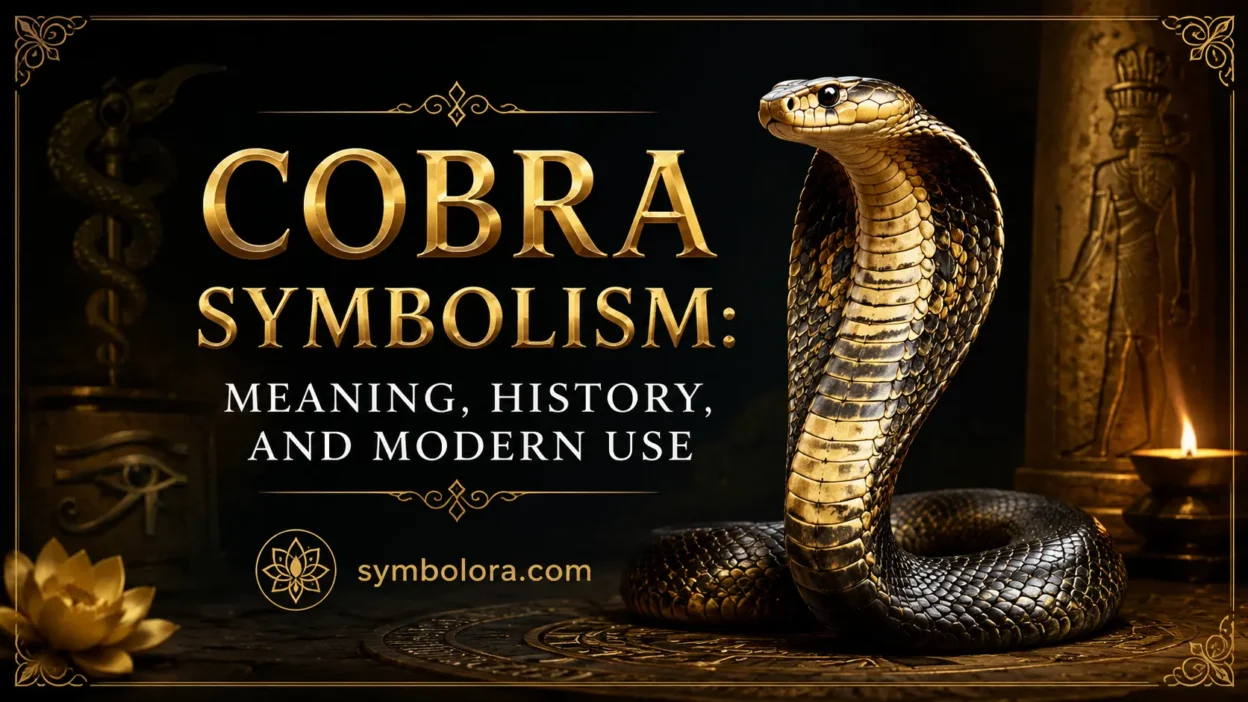
Cobra symbolism centers on protection, controlled power, danger, authority, and transformation. The raised body and expanded hood create an image that reads as both defensive and commanding — a warning that strength is present but doesn’t need to strike unless a boundary is crossed.
That meaning shifts by culture. In ancient Egypt, the upright cobra marked royal authority and divine protection. In South Asian religious art, cobra-like nagas can represent guardianship, fertility, water, strength, or sacred presence. In modern American culture, the same animal shows up in tattoos, logos, and entertainment as a sign of fearlessness, speed, rebellion, or calculated aggression. Understanding the symbol means separating the real animal from the stories built around it — a cobra isn’t constantly attacking, and its famous hood is really part of a threat display, which is why the image can suggest restraint just as strongly as violence.
Quick Answer
Cobra symbolism commonly represents protection, alertness, controlled strength, and dangerous authority in modern American culture. Historically, it also signified royal protection in ancient Egypt and sacred guardianship in several Hindu and Buddhist traditions.
At a glance:
- A raised cobra warns, guards, and commands attention
- Ancient Egyptian rulers used it as a royal protective emblem
- South Asian traditions connect nagas with guardianship, water, and strength
- Americans often read the cobra as fearless, fast, and intimidating
- Tattoos may express boundaries, survival, discipline, or personal transformation
- Context determines whether the image feels sacred, protective, or threatening
What a Cobra Looks Like and Why Its Shape Matters
The most recognizable cobra image shows the snake lifting the front of its body, flattening its neck into a hood, and facing forward — sometimes with its mouth open. Real cobras form that hood by spreading specialized ribs and muscles in the neck when they feel threatened, making themselves look larger and warning an approaching danger to stop.
That posture drives most of the symbolism. A coiled snake tends to suggest patience or hidden potential, while an upright cobra appears fully aware and ready: its direct gaze reads as vigilance, its hood forms a crownlike silhouette, and its venom adds the weight of real consequences.
| Context | Meaning in the USA | Main Association | Important Note |
|---|---|---|---|
| Raised cobra | Warning and readiness | Boundaries, defense | Not always an attack symbol |
| Crowned or golden cobra | Authority and prestige | Royalty, command | Often influenced by Egyptian imagery |
| Coiled cobra | Stored power | Patience, strategy | Suggests action held in reserve |
| Striking cobra | Aggression and danger | Conflict, retaliation | Usually the most hostile version |
| Cobra with flowers | Strength in transition | Growth, healing | Primarily a modern interpretation |
| Cobra with sacred imagery | Guardianship | Faith, protection | Cultural context should be identified |
Protection, Boundaries, and Defensive Power
The cobra reads as a protection symbol largely because its most famous posture is a visible warning rather than a hidden threat. It rises, expands, and signals that further approach carries consequences — without ever pretending it lacks the ability to defend itself.
That makes it a natural emblem of firm boundaries: “I am calm, but I am not defenseless.” It’s a different kind of power than symbols built around pursuit or domination, since the cobra’s force is usually imagined as reactive — protecting space, identity, family, status, or belief rather than seeking out conflict. That’s part of why the image appears so often in personal art. Someone who has recovered from manipulation, bullying, or a period of helplessness may choose a cobra to represent regained control, or simply watchfulness — staying observant without living in constant panic.
The meaning turns darker once fangs, blood, weapons, or an attacking pose enter the design. At that point defense shifts toward revenge or intimidation, and the surrounding details end up mattering as much as the animal itself.
Royal Authority and the Cobra in Ancient Egypt
In ancient Egyptian art, the upright cobra appeared as the uraeus, a royal emblem worn at the brow of rulers and certain deities, closely tied to Wadjet, the cobra goddess associated with Lower Egypt. Mounted on a crown or headdress and facing outward, the raised cobra signaled kingship, divine authority, and the power to repel enemies — Egyptian imagery even described this protective force in supernatural terms, including the ability to destroy threats with fire or venom. The emblem did more than decorate a ruler; it presented royal power itself as sacred, alert, and dangerous to oppose.
That history explains why a gold cobra still feels regal in American jewelry, costume design, album artwork, and luxury decor. Many viewers today may not recognize the name Wadjet or the term uraeus, but they still read the visual language instantly: a cobra above the forehead resembles a living crown. It’s worth resisting the temptation to flatten this into generic “snake wisdom,” though — the Egyptian meaning was specific: legitimate rule, divine protection, territorial unity, and punishment of a ruler’s enemies.
Cobra and Naga Meaning in Hindu Traditions
In Hindu art and storytelling, cobra imagery most often appears through the broader figure of the naga — serpent beings rather than ordinary zoological cobras, whose meanings shift across regions, texts, and local traditions. Depending on the tradition, nagas may be linked with water, fertility, protection, hidden realms, ancestry, or sacred power.
Shiva is frequently shown with a cobra coiled around his neck, where the snake communicates strength, fertility, mastery over fear, and command over forces that would threaten an ordinary person — not simply an enemy, but something brought into a controlled relationship with the deity. Other Hindu images place divine figures near multihooded serpent forms, compositions that can suggest cosmic order or the presence of supernatural guardians, with the hood forming an almost sheltering canopy.
Modern Western design sometimes borrows this outward appearance while stripping away the religious context underneath it. A multiheaded cobra, a cobra beside Shiva, or a naga-inspired form can carry specific devotional meaning, and treating it purely as an exotic danger symbol risks misrepresenting the tradition it comes from.
Buddhist Meaning: Shelter, Guardianship, and Composure
A major Buddhist cobra-like image comes from the story of Mucalinda, the naga king who sheltered the meditating Buddha during a storm — coiling beneath or around him and spreading multiple hoods above as protection. The emotional center of this image isn’t aggression; it’s steadiness under pressure. The Buddha stays composed while the storm continues, and the naga becomes a guardian rather than a threat, suggesting protection of spiritual practice and the transformation of dangerous force into service.
This image became especially prominent across parts of South and Southeast Asian Buddhist art, and it’s worth distinguishing clearly from a modern cobra logo or a striking-snake tattoo. The body shape may look similar, but the message differs entirely: shelter instead of attack, devotion instead of intimidation. For American viewers encountering the image in museums, temples, or meditation spaces, the most accurate reading starts with the story being represented rather than a general unease around snakes.
What the Cobra Commonly Means in the United States
Unlike the rattlesnake, the cobra never became a foundational emblem of early American political identity. Americans have mostly encountered it through imported religious imagery, museums, zoos, action entertainment, martial-arts branding, automobiles, fashion, and tattoo culture — which makes its American meaning highly visual and largely secular.
In that context, the cobra usually signals speed, danger, confidence, toughness, and immediate readiness. Its hood works well in logos because it creates a symmetrical, instantly recognizable shape, and its forward-facing posture can make a team, product, or fictional group appear aggressive and disciplined. American pop culture has leaned on the name and image repeatedly for performance and menace alike: the Shelby Cobra linked the word with automotive speed and power, while the fictional Cobra organization in G.I. Joe used it for villainy, secrecy, and domination. Martial-arts entertainment has reinforced a similar association with a hard-edged fighting identity.
None of this erases the older sacred meanings, but it tends to dominate everyday American interpretation — a cobra on a T-shirt is usually read as bold style, with no religious or historical message intended.
Fear, Danger, and the Cobra’s Shadow Side
Cobras are venomous, so danger isn’t an invented association — their ability to rise, hood, hiss, and strike gives the image real threat value. In symbolic use, that danger can stand in for an enemy, betrayal, concealed hostility, retaliation, or a situation demanding caution. The cobra can also represent power without conscience: used for a villain, criminal faction, or authoritarian figure, it suggests intelligence joined with cruelty — an animal that watches, waits, and acts quickly, making it effective shorthand for a calculating opponent rather than a chaotic one.
Psychologically, the cobra can represent fear that’s become impossible to ignore. A hidden snake might stand for an unseen concern, while an upright cobra suggests the issue has announced itself and the confrontation is now direct.
Even so, it’s misleading to call the cobra purely evil. That reading usually comes from blending real fear of venom with broader Western serpent imagery. In other traditions, that same raised hood protects a ruler, shelters the Buddha, or identifies a sacred naga.
Transformation, Renewal, and Self-Control
Like other snakes, cobras shed their skin as they grow — a biological fact that has fed symbolic links to renewal, transition, and leaving an old identity behind. In modern personal symbolism, the cobra can mark recovery, reinvention, or a decisive break from the past, though its version of transformation carries a sharper edge than the general snake theme: emerging more alert, more guarded, more capable of defending what’s changed.
Self-control is the other major thread here. A cobra in a poised position looks ready but not yet committed to action — a pause that can represent discipline, or the ability to hold force in reserve until it’s actually needed. In leadership imagery this becomes strategic authority; in personal imagery it can stand for emotional control after a period of impulsiveness. There’s a caution built into this reading too, though: readiness can slide into hypervigilance, and strong boundaries can curdle into isolation. The cobra can symbolize healthy control, but it can just as easily reveal someone who expects danger everywhere.
Emotional and Psychological Meaning
Emotionally, a cobra image communicates intensity — rarely casual, playful, or passive, even when beautifully decorated, because the viewer always senses the possibility of a strike. For the wearer or creator, the symbol often expresses courage in the presence of fear rather than fearlessness in a literal sense: the cobra doesn’t deny danger, it faces danger while displaying its own capacity to respond. That can appeal strongly to people who value resilience, independence, and personal sovereignty.
The image can also signal guardedness — someone drawn to the cobra may identify with being misunderstood, approached cautiously, or respected from a distance, though that’s far from a fixed psychological rule; symbols get chosen for plenty of reasons, including aesthetics, heritage, fandom, or simple admiration for the animal. In dreams or private reflection, a cobra often functions as a mental picture of a boundary, threat, authority figure, or forceful part of the self. The more useful question isn’t “what does every cobra dream mean,” but what the cobra was doing, and how it felt to be near it.
Tattoos, Jewelry, Fashion, and Home Decor
Cobra tattoos often represent protection, survival, courage, authority, or a warning against betrayal. A raised cobra facing outward can act like a personal guard, a coiled cobra emphasizes patience and stored power, and a striking cobra gives the design a more confrontational tone. Additional elements reshape the message further: flowers soften the image and connect danger with growth or healing, a skull leans toward mortality or acceptance of death, a crown suggests command or Egyptian royal influence, and a dagger implies conflict or survival through harm.
In jewelry, gold cobra forms often feel luxurious and regal thanks to their connection with ancient Egyptian design, while silver or blackened metal produces a colder, more rebellious effect — cobra rings and bracelets also make natural use of the animal’s curved body, wrapping around a finger, wrist, or neck. In home decor, the image can create real drama, but sacred figures deserve care: a decorative naga or deity-associated cobra shouldn’t be treated as interchangeable with a generic Halloween snake or villain emblem.
Pop Culture, Branding, and Digital Identity
The cobra works well in modern branding because people recognize it instantly — its hood creates a bold outline, its face stylizes without losing identity, and its body bends naturally into circles, letters, shields, or badges. Brands and fictional groups typically reach for it to imply speed, precision, intimidation, or elite performance; sports teams and gaming identities use it to project competitive confidence, and online avatars lean on the same shorthand to signal: don’t underestimate this person.
Entertainment tends to push the symbol toward aggression specifically — villainous organizations, hard-edged martial-arts groups, and action characters use cobra names to suggest ruthless discipline or sudden attack, while cars and performance products use it differently, focusing on speed and responsiveness instead. Digital use often flattens the cultural history behind it: a cobra emoji, sticker, or gamer logo usually carries little connection to Wadjet, Shiva, or Mucalinda. That doesn’t make the use automatically disrespectful, but it does show how an old religious and royal image can drift into a general sign of attitude.
How Color, Pose, and Composition Change the Message
Design choices shift a cobra’s meaning considerably. Gold commonly suggests royalty, wealth, or Egyptian influence; black feels secretive, severe, or deadly; red emphasizes aggression or warning; white can suggest rarity or controlled purity, though that reading is mostly modern rather than traditional.
Pose matters even more than color. An upright cobra with a closed mouth reads as alert authority, exposed fangs raise the hostility, a lowered head suggests stalking, and a cobra curled around an object can appear to protect, possess, or control it. Direction changes the emotional effect too — a cobra facing the viewer creates confrontation, a side profile feels more emblematic and less personal, and two mirrored cobras can suggest balance, rivalry, or opposing forces. No color or pose has one permanent definition; the surrounding culture, accompanying symbols, and intended audience should always guide the read.
Common Misunderstandings and the Evolution of Meaning
A few mistakes come up often. The first is treating every snake symbol as a cobra, when cobras have a distinct hooded form and many serpent traditions involve entirely different snakes or composite mythical beings. The second is assuming every cobra represents evil — Egyptian and Buddhist examples show clear protective uses, where the upright form guards a ruler, defends sacred authority, or shelters a figure in meditation. A third is collapsing all South Asian serpent imagery into one definition; naga traditions are diverse, and a naga is not simply a decorative cobra — religious figures, regional stories, and ritual settings all shape meanings that a generic animal logo doesn’t carry.
The symbol has evolved by moving between contexts. In ancient Egypt it marked divine kingship and protection. In Hindu and Buddhist art, cobra-like forms became guardians and signs of controlled force. In the modern United States, mass media and commercial design shifted the emphasis toward speed, threat, toughness, and rebellion. These meanings now coexist rather than replace one another — a cobra can be sacred in one room, fashionable in another, and frightening in a third, and accurate interpretation starts with context rather than a single universal definition.
Frequently Asked Questions
Is a cobra a positive or negative symbol?
It can be either. Protective, royal, and sacred uses are positive, while striking or villainous designs emphasize danger, aggression, or betrayal — the pose and cultural setting usually reveal which meaning is intended.
What does a cobra tattoo symbolize?
A cobra tattoo commonly represents boundaries, survival, courage, controlled power, or a warning not to provoke the wearer. Religious elements, crowns, flowers, skulls, and weapons can substantially change the message.
What did the cobra symbolize in ancient Egypt?
The upright cobra, or uraeus, represented royal authority, divine protection, and the ruler’s power against enemies. It was strongly associated with the goddess Wadjet and appeared on royal and divine headdresses.
What does the cobra mean in Hinduism?
Cobra imagery often appears through nagas and through depictions of deities such as Shiva. Depending on the tradition, it may suggest strength, fertility, water, guardianship, sacred power, or mastery over fear.
What does a cobra symbolize in Buddhism?
The best-known example is Mucalinda, the naga king who shelters the meditating Buddha during a storm. The image represents guardianship, devotion, composure, and protection of spiritual practice.
What does a cobra in a dream mean?
There’s no universal dream definition. A cobra may reflect a visible threat, a boundary issue, fear of retaliation, personal authority, or a forceful emotion demanding attention — the dreamer’s own reaction is usually the best clue.
Does a cobra symbolize transformation?
Yes, especially in modern personal symbolism. Because cobras shed their skin, they can represent renewal, identity change, recovery, or becoming more self-protective after a difficult period.
Conclusion
Cobra symbolism brings together warning, protection, authority, danger, and disciplined strength. The raised hood explains much of its appeal: the animal is visible, alert, and prepared, yet the image doesn’t always depict an attack.
Its meaning becomes clearer once the setting is identified — Egyptian royal art, Hindu naga traditions, Buddhist guardianship, American pop culture, and personal tattoo designs don’t use the cobra in quite the same way, and a careful reading respects those differences rather than flattening them.
At its most grounded, the cobra represents power that announces its limits. It asks for awareness before action, and respect before approach.