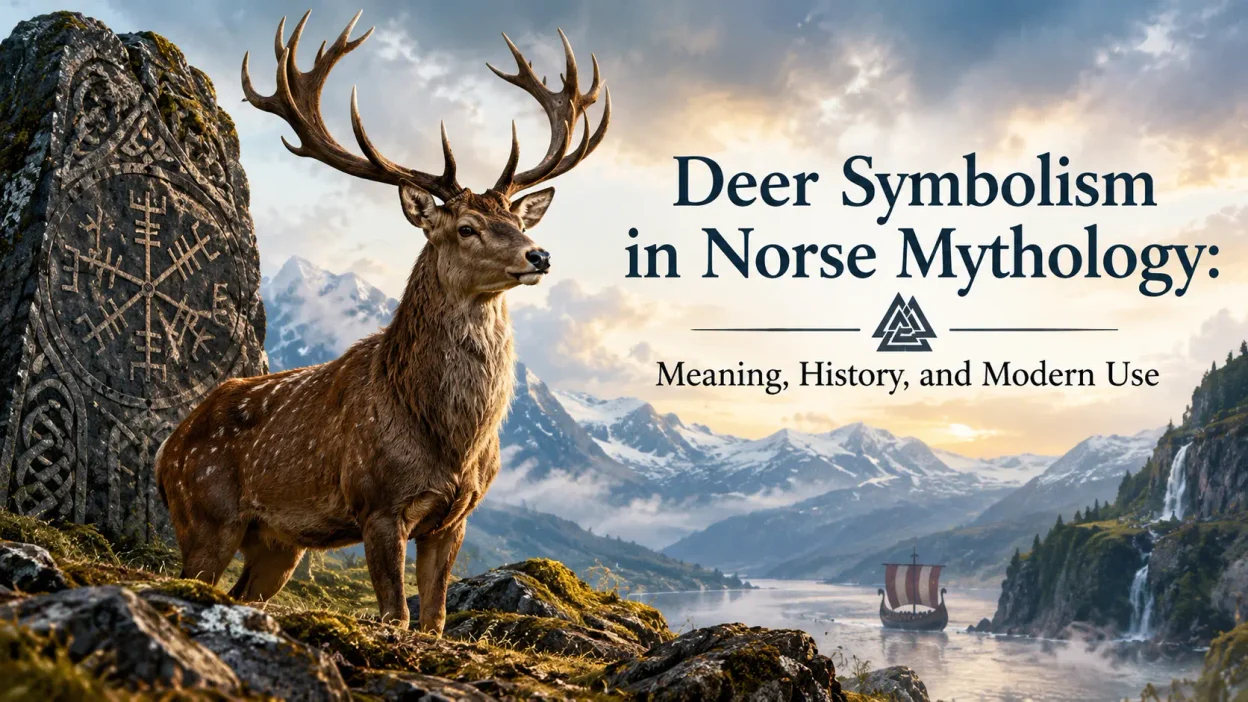
Deer symbolism in Norse mythology connects the natural world with the sacred landscape of the Norse cosmos. Deer and stags appear in stories about Yggdrasil, the great world tree, where their presence links animals, vegetation, and the structure of the universe. In modern American culture, these animals may suggest gentleness, alertness, renewal, and a connection to nature, but their historical Norse meanings deserve a closer look.
Unlike some mythological animals that have clearly defined personalities or well-developed legends, deer occupy a more specialized place in surviving Norse sources. Their significance often comes from where they appear, particularly around Yggdrasil, rather than from a single story about a heroic deer.
Understanding this distinction matters because contemporary interpretations sometimes combine Norse mythology with modern spirituality, fantasy fiction, and broader European folklore. These connections can be interesting, but they do not all represent beliefs documented in medieval Scandinavian sources.
Quick Answer
Deer symbolism in Norse mythology is most closely associated with the natural cycles of life, the interconnectedness of the cosmos, and the animals inhabiting Yggdrasil, the Norse world tree. Four stags are described among its branches, while a separate deer-like creature appears in other mythological contexts, making their symbolism more complex than a simple association with peace or gentleness.
TL;DR
- Four stags appear among the branches of Yggdrasil in Norse tradition.
- Deer imagery connects the mythological landscape with animals, trees, and natural processes.
- Stags can suggest vitality, alertness, and the natural world’s rhythms.
- Modern Americans often associate deer with gentleness, wilderness, and renewal.
- Contemporary spiritual meanings should be distinguished from surviving medieval Norse beliefs.
- Deer tattoos and artwork often combine historical mythology with personal interpretation.
What Deer Represent in Norse Mythology
Deer in Norse mythology are best understood through their place in the wider mythological world rather than through one universal symbolic definition. The surviving stories do not establish a single meaning that applies to every deer or stag.
Their most notable appearance involves Yggdrasil, the immense tree that connects the different regions of the Norse cosmos. The animals associated with this tree participate in a landscape where life, decay, movement, and renewal exist together.
A stag’s antlers also make it a visually distinctive figure. Antlers grow, develop, and are shed and regrown in many deer species, making them natural subjects for interpretations involving vitality and seasonal change. However, these biological observations are useful interpretive parallels, not proof that medieval Norse people assigned every stag a specific spiritual meaning.
The safest reading combines the details actually preserved in the myths with careful interpretation. Deer belong to a living mythological environment, and their presence helps make that environment active rather than merely decorative.
The Four Stags of Yggdrasil
One of the most important references to deer in Norse mythology concerns four stags that live among the branches of Yggdrasil. Their names are commonly rendered as Dáinn, Dvalinn, Duneyrr, and Duraþrór, although spellings and transliterations vary between editions.
These stags appear in the Grímnismál, a poem preserved in the medieval Poetic Edda. The poem describes the animals in relation to the world tree and the vegetation growing around it.
Their presence contributes to the image of Yggdrasil as a living structure. The tree is not simply a symbolic pillar holding the universe together; it is inhabited by creatures that interact with its branches and foliage.
Readers sometimes interpret the four stags as representing the four directions, the four seasons, or four stages of life. Such interpretations may work in modern symbolic art, but the surviving passage does not clearly establish these meanings. It is more accurate to treat the stags first as mythological inhabitants of the cosmic tree.
Their number is significant to the scene, but it should not automatically be converted into a universal four-part spiritual system without supporting evidence.
Yggdrasil and the Connection Between Animals and the Cosmos
Yggdrasil is central to understanding why the deer matter. Often called the world tree, it connects the different realms described in Norse cosmology and serves as a setting for numerous mythological creatures and events.
The tree is associated with wells, roots, branches, animals, and forces that affect the wider cosmos. Its condition is not presented as completely static or untouched by danger. Creatures feed on it, serpents and other beings occupy its lower regions, and the tree exists within a world shaped by ongoing processes.
The stags reinforce this sense of activity. They place ordinary animal behavior inside an extraordinary cosmic setting, connecting the familiar natural world with a structure of mythological importance.
This relationship can support a modern interpretation of deer as symbols of interdependence. Trees provide food and shelter, animals affect vegetation, and living systems depend on relationships between different forms of life. That environmental reading is relevant today, although it should not be mistaken for a direct quotation of ancient Norse ecological philosophy.
In Norse-inspired artwork, a stag standing beneath or within the branches of a great tree can therefore communicate a relationship between earthly life and a larger cosmic order.
Dáinn, Dvalinn, Duneyrr, and Duraþrór: What Their Names Tell Us
The names of the four stags are often reproduced in modern books, games, and artwork, but their precise meanings and origins require caution. Old Norse names can be difficult to interpret because of changes in language, uncertain etymologies, and differences between scholarly translations.
Dáinn and Dvalinn are names that also occur elsewhere in Norse literary tradition, including contexts involving dwarfs. The recurrence of names across different stories does not necessarily mean that all the characters are identical or share one fixed symbolic function.
Duneyrr and Duraþrór are less familiar to many modern readers, and their names are not consistently explained in popular interpretations. Claims that each stag represents a particular emotion, direction, virtue, or stage of spiritual development should therefore be treated as modern interpretations unless supported by a specific textual argument.
For contemporary readers, the four names are useful primarily because they identify a distinctive group of creatures within the Yggdrasil tradition. Their individual symbolic roles remain less certain than their collective place in the myth.
Eikþyrnir and the Stag Above Valhalla
Another important deer-like figure in Norse mythology is Eikþyrnir, a stag associated with Valhalla, the hall connected with Odin and the honored dead.
In the Grímnismál, Eikþyrnir stands on the roof of Valhalla and feeds on the foliage of the tree Læraðr. The poem also connects the creature with water flowing from its horns into Hvergelmir, a well associated with the sources of rivers.
This description gives Eikþyrnir a different setting from the four stags of Yggdrasil. Rather than simply appearing among the branches of the world tree, this stag participates in a mythological image linking a heavenly hall, a tree, horns, and the flow of water.
Modern interpretations may associate Eikþyrnir with abundance, the circulation of life, or the relationship between the upper and lower parts of the cosmos. These readings draw on the imagery of the poem, particularly the movement of water, rather than on an explicit statement that the stag symbolizes one specific concept.
Eikþyrnir also demonstrates why Norse deer symbolism cannot be reduced to one animal or one legend. Different creatures appear in different settings, and their roles need to be considered individually.
Deer, Stags, and the Meaning of Antlers
Antlers are among the most recognizable features of a mature stag. In modern visual symbolism, they can suggest maturity, vitality, strength, and the ability to endure seasonal change.
Norse mythology gives antlers a particular role in the description of Eikþyrnir because water is said to flow from them. This image connects an animal’s body with the movement of water through the mythological landscape.
It is tempting to interpret antlers as a direct Norse emblem of authority, divine power, or spiritual awakening. Yet such claims require evidence beyond the existence of antlers in a myth. The poems do not provide a general rule that every stag’s antlers represent kingship or supernatural energy.
A more grounded interpretation recognizes that antlers make the stag visually imposing and help connect the animal with the changing natural world. When antlers appear in modern Norse-inspired art, they may communicate strength alongside the vulnerability of living creatures.
This combination is one reason stags work well as symbols in contemporary illustration: their appearance can suggest both physical presence and a connection to natural cycles without requiring an elaborate explanation.
Nature, Renewal, and the Norse View of the Living World
Norse mythology presents nature as a realm of beauty, danger, dependence, and change. Forests, animals, rivers, mountains, and weather are part of a world in which divine beings and human lives unfold.
Deer fit naturally into this setting. They are living creatures rather than abstract symbols, and their presence around mythological trees reinforces the relationship between vegetation and animal life.
Renewal is a reasonable modern theme to associate with deer, especially when viewers think about antler growth, seasonal movement, and the survival of wildlife through changing conditions. However, the distinction between an interpretation inspired by nature and a documented medieval belief remains important.
The Norse myths also do not portray nature as a peaceful refuge in every instance. Yggdrasil’s inhabitants exist within a cosmos subject to damage, conflict, and eventual transformation. The world tree is connected to both the continuity of life and the vulnerabilities of existence.
For readers today, deer imagery can express respect for nature without suggesting that Norse mythology viewed the wilderness as entirely gentle or harmonious.
Did Deer Symbolize Peace and Gentleness to the Norse?
Peace and gentleness are common modern associations with deer, particularly in American wildlife imagery. A doe with her fawn may suggest care and protection, while a stag standing quietly in a forest can communicate calmness or dignity.
Those interpretations are understandable, but the surviving Norse accounts do not establish gentleness as the defining meaning of deer. The four stags of Yggdrasil are described as part of the tree’s mythological environment, and Eikþyrnir appears in a scene involving Valhalla and flowing water.
Nor should deer be treated as the opposite of wolves, ravens, or other animals associated with more dramatic mythological events. Norse animal imagery does not divide neatly into peaceful and dangerous categories.
A modern artist can certainly use a stag to symbolize peace within a Norse-inspired design. The important distinction is that this meaning represents an interpretive choice rather than a universally documented Norse doctrine.
The same principle applies to claims that deer always signify innocence, healing, or spiritual protection. These meanings may be personally valuable, but they should not be presented as established facts about pre-Christian Scandinavia.
What Deer Symbolism Means in Modern American Culture
In the United States, deer are familiar animals in forests, suburban neighborhoods, wildlife photography, hunting traditions, and seasonal decorations. Their modern associations come from a mixture of direct experience, popular imagery, and broader folklore.
A deer seen near a home may evoke curiosity, beauty, or concern about gardens and road safety. A stag pictured in a forest may communicate wilderness and independence. A deer incorporated into a Norse-inspired illustration adds another layer by connecting the animal with mythology.
American interpretations also reflect different relationships with wildlife. For some people, deer represent conservation and the value of protecting natural habitats. For hunters, deer may be connected with outdoor skills, food traditions, family practices, and wildlife management. For others, deer imagery mainly provides a peaceful decorative motif.
These meanings can coexist without being identical. There is no single American interpretation of deer symbolism, just as there is no single universal meaning for the animal in Norse mythology.
When a modern American audience encounters a stag beside Yggdrasil, the symbolism often combines two sources: the documented mythological setting and the viewer’s own associations with forests, animals, and renewal.
Comparing Norse Deer Symbolism With Other Traditions
Deer appear in many cultural and religious traditions, but their meanings vary according to the stories and practices surrounding them. Similar imagery does not automatically demonstrate that different cultures shared the same beliefs.
In Celtic-influenced folklore, deer may appear in stories about the wilderness, transformation, or encounters between human and otherworldly realms. Specific meanings differ between traditions and individual tales.
In Buddhist art, deer are associated with the Buddha’s first teaching at Deer Park in Sarnath, making them recognizable symbols connected with the beginning of his public teaching. This association has a different historical basis from the Norse stags of Yggdrasil.
In Christian art, the deer can be associated with spiritual longing, drawing in part on biblical imagery of the deer seeking water. The meaning depends on the passage and artistic context rather than on a universal rule about deer.
These comparisons help clarify the Norse material. Deer can become important symbols in several cultures, but the four stags of Yggdrasil and Eikþyrnir should be understood through their own literary settings instead of having unrelated meanings transferred to them.
Deer Symbolism in Norse-Inspired Tattoos, Jewelry, and Art
Modern Norse-inspired deer imagery often combines a stag with runes, knotwork, forest scenes, or Yggdrasil. These designs may communicate a personal connection to Scandinavian heritage, an interest in mythology, or an appreciation for the natural world.
A stag positioned within the branches of a world tree can suggest the relationship between living creatures and the larger cosmos. A more realistic deer surrounded by woodland may emphasize wilderness and seasonal renewal, while a stylized antler design may focus on strength or personal identity.
The meaning of a tattoo depends partly on the wearer. Someone may choose a deer because of a family memory, a love of wildlife, or a connection with Norse literature. Another person may use the image as a reminder of adaptability or a personal commitment to conservation.
Historical accuracy matters when a design claims to reproduce an ancient symbol. A modern composition that includes Yggdrasil and the four stags can be inspired by a medieval poem, while additional geometric patterns or spiritual meanings may be contemporary inventions.
Before treating a design as historically authentic, distinguish between documented mythological imagery, later artistic traditions, and modern decorative additions. A design can still be meaningful without every element having an ancient origin.
Emotional and Psychological Interpretations of the Deer
Deer can evoke a distinctive combination of alertness and vulnerability. Their ability to detect movement and react quickly may suggest awareness, while their relatively quiet presence in a forest can create an impression of restraint.
These associations can influence how people interpret deer imagery even when they know little about Norse mythology. A stag near a world tree may feel watchful or connected to its environment because of the way the animal is depicted.
Psychological interpretations should remain personal rather than diagnostic. Choosing a deer tattoo does not prove that someone is gentle, anxious, resilient, or spiritually inclined. Symbols offer ways to communicate identity, but they cannot reliably reveal a person’s character.
For some viewers, the Norse setting adds a sense of scale: an ordinary animal appears within a cosmic landscape. For others, the same image expresses belonging to nature or interest in stories that connect the human world with a larger order.
The most useful interpretation is the one that accounts for both the image’s historical context and the meaning the individual deliberately gives it.
Common Misunderstandings About Norse Deer Symbolism
Several popular claims about Norse deer symbolism go beyond what the medieval sources establish.
One common mistake is to describe the four stags as the guardians of the four directions. The number four may encourage that interpretation, but the surviving description does not clearly assign each stag a cardinal direction.
Another is to claim that deer universally represented peace, innocence, or spiritual awakening to the Norse. These associations are common in modern symbolic writing, yet the principal mythological passages focus on the animals’ places within a larger setting rather than defining them through those qualities.
A third mistake is to treat every modern design featuring antlers or a stag as an authentic ancient Norse emblem. Contemporary art often combines elements from different periods and traditions. A design may be attractive and culturally meaningful without reproducing a documented historical symbol.
Finally, deer symbolism should not be confused with a single, standardized system of Norse spiritual beliefs. Medieval Scandinavian traditions developed across different communities and periods, and the surviving literature does not preserve every belief or practice.
The most reliable approach is to identify what a source actually describes, explain what can reasonably be inferred, and label later interpretations as interpretations.
How Deer Symbolism Has Evolved From Medieval Texts to Modern Culture
The Norse deer references known today survive largely through medieval Icelandic literary sources, including poems preserved in the Poetic Edda. These texts provide important evidence for Norse mythology, but they were written down in a Christian-era context after the pre-Christian religious world they describe had changed.
That historical distance matters. A medieval poem can preserve older traditions, literary conventions, and mythological material without giving a complete record of how every Scandinavian community understood an animal.
Modern audiences encounter these stories through translations, retellings, museum displays, fantasy fiction, games, and online artwork. Each medium can emphasize different aspects of the myth. A literary translation may focus on the details of the poem, while a fantasy game may turn the stag into a guardian, guide, or source of magical power.
Contemporary spirituality also gives familiar animals new personal meanings. People may connect deer with intuition, protection, or new beginnings, drawing from several traditions at once.
This evolution is not inherently a problem. Symbols naturally acquire new uses, but historical clarity requires separating modern creativity from claims about ancient belief.
Deer Symbolism in Norse Mythology at a Glance
| Context | Main association | Historical basis | Modern interpretation |
|---|---|---|---|
| Four stags of Yggdrasil | Animals inhabiting the world tree | Poetic Edda tradition | Interconnection of life and the cosmos |
| Eikþyrnir | Stag linked with Valhalla and flowing water | Grímnismál | Abundance and the circulation of life |
| Antlers | A distinctive feature of the mythological stag | Descriptions of deer-like creatures | Vitality, strength, and seasonal change |
| Norse-inspired tattoos | Mythological and natural imagery | Adaptation of literary motifs | Personal identity and connection to heritage |
| American wildlife imagery | Familiarity with deer and woodland habitats | Modern cultural experience | Gentleness, wilderness, and renewal |
The table distinguishes documented mythological details from interpretations that people commonly apply to them today.
Frequently Asked Questions
What does a deer symbolize in Norse mythology?
Deer are most notably associated with the cosmic environment of Yggdrasil, where four stags appear among its branches. Eikþyrnir, another stag, is connected with Valhalla and the flow of water, giving deer imagery several distinct mythological contexts.
What do the four stags of Yggdrasil represent?
The four stags are named Dáinn, Dvalinn, Duneyrr, and Duraþrór in the Grímnismál. Their exact individual symbolic meanings are not clearly established, so interpretations involving the four seasons or four directions should be treated as modern readings rather than confirmed Norse beliefs.
Is a deer a good omen in Norse mythology?
The surviving Norse sources do not establish deer as universal good omens. A modern reader may view a stag as a positive symbol of vitality or natural renewal, but that interpretation should not be confused with a documented ancient Norse rule about omens.
What does a Norse deer tattoo mean?
A Norse-inspired deer tattoo may represent a connection to mythology, nature, Scandinavian heritage, or personal resilience. Its meaning depends on the design and the wearer, especially when it combines a stag with Yggdrasil, runes, or other symbols.
What is the difference between Eikþyrnir and the four stags of Yggdrasil?
The four stags inhabit the branches of Yggdrasil, while Eikþyrnir stands on the roof of Valhalla and is associated with the tree Læraðr. The Grímnismál connects Eikþyrnir’s horns with water flowing toward Hvergelmir, giving the two accounts different mythological details.
Did the Norse associate deer with spiritual protection?
The surviving mythological passages do not establish deer as a universal symbol of spiritual protection. Modern Norse-inspired spirituality may use deer imagery in this way, but that meaning should be identified as a contemporary interpretation unless supported by specific historical evidence.
Do deer symbolize renewal in modern American culture?
Yes, renewal is a common modern interpretation, partly because deer are associated with seasonal changes in wildlife and the annual growth and shedding of antlers. In American culture, deer may also represent wilderness, gentleness, conservation, or personal connections with nature.
Conclusion
Deer symbolism in Norse mythology is rooted in specific mythological scenes rather than one universal meaning. The four stags of Yggdrasil and Eikþyrnir, the stag associated with Valhalla, connect animal life with the cosmic tree, vegetation, and the movement of water. These details provide a firmer historical foundation than claims that every deer represented peace, protection, or spiritual awakening.
For modern American readers, a Norse stag can bring together mythology, nature, personal identity, and artistic expression. The most accurate interpretation respects the medieval stories while allowing contemporary people to develop their own meanings. A stag beside Yggdrasil can therefore serve as both a recognizable image from Norse tradition and a modern reminder of the relationship between living creatures and the world around them.