A snake forming a circle by biting and consuming its own tail is one of the most recognizable symbolic images in human history. Often called the ouroboros, this unusual image appears in ancient art, mythology, philosophy, spiritual traditions, and modern design. Snake eating itself symbolism is often connected with cycles, renewal, transformation, and the idea that endings can become beginnings.
The image attracts attention because it presents a strange contradiction: the snake destroys part of itself while also sustaining itself. That tension has allowed different cultures to interpret it in many ways. Some see it as a symbol of eternal cycles, while others view it as a reminder of personal growth, balance, or the repeating patterns found in nature.
In the United States today, people often encounter this symbol through tattoos, jewelry, fantasy artwork, books, games, and alternative spiritual communities. While some modern interpretations focus on mystery or personal transformation, the historical meaning is broader and connected to ideas about time, creation, change, and renewal.
Quick Answer
Snake eating itself symbolism commonly represents cycles of life, renewal, transformation, and the idea that creation can come from destruction. Historically, the ouroboros symbol appeared in ancient Egyptian and later Greek traditions, where it was associated with eternity, cosmic cycles, and the continuous process of change.
TL;DR
- Represents cycles, renewal, and transformation
- Originated in ancient Egyptian symbolism
- Became linked with alchemy and philosophy
- Often symbolizes personal growth today
- Popular in tattoos and modern art
- Can represent balance between opposites
What the Snake Eating Its Own Tail Symbol Looks Like
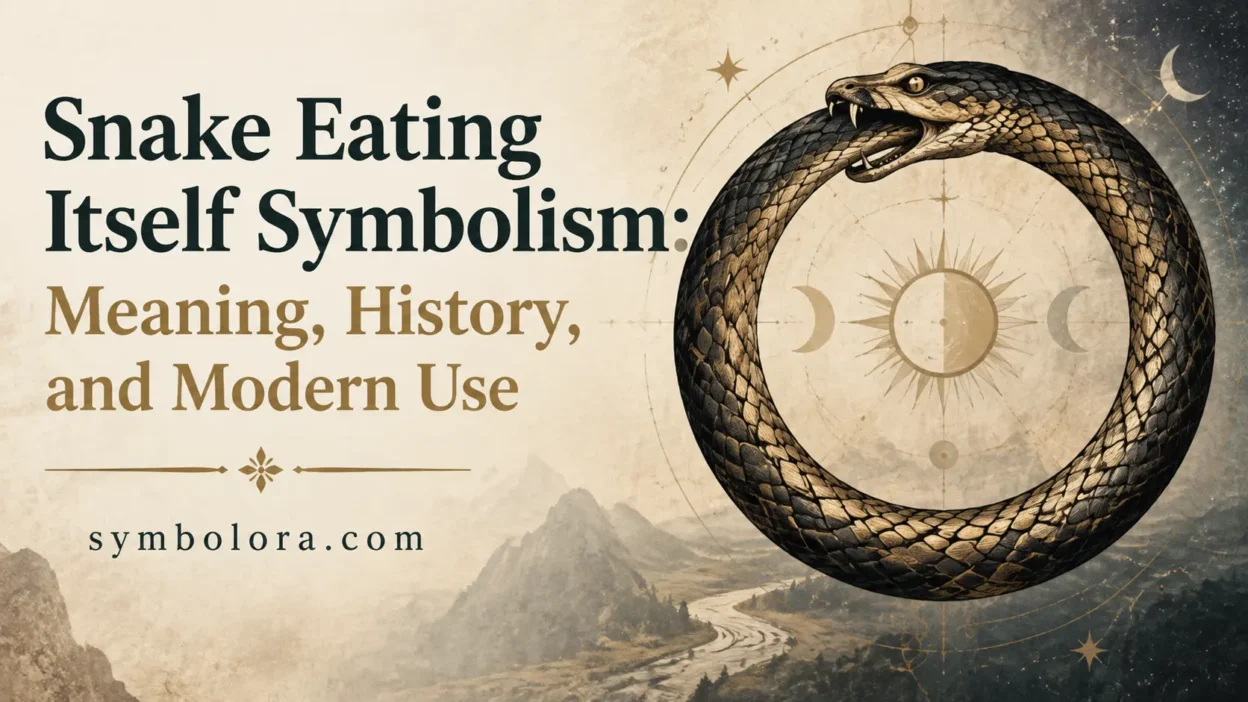
The symbol shows a snake or serpent arranged in a circular shape, with its mouth holding its own tail. Instead of moving forward in a straight line, the creature forms a complete circle. This circular design is the most important visual feature because circles are commonly associated with continuity, repetition, and wholeness.
The snake may appear realistic, with scales and a detailed body, or it may be drawn as a simple outline. Some versions show a snake, while others show a dragon-like creature. The details often change depending on the artist, culture, or purpose behind the design.
The symbol is usually called the ouroboros, a name derived from ancient Greek words meaning “tail” and “eating.” Although the word itself is Greek, the image existed earlier in Egyptian traditions and later traveled through different philosophical and religious systems.
Today, Americans may see this image on:
- Tattoo designs
- Rings and necklaces
- Fantasy artwork
- Book covers
- Video game symbols
- Meditation and spiritual artwork
- Historical illustrations
Its circular shape makes it visually appealing because it represents an idea without needing words.
The Core Meaning of the Symbol in Modern American Culture
In modern United States culture, the ouroboros is most commonly understood as a symbol of continuous change. Many people associate it with the idea that life moves through repeating stages rather than following a simple beginning-to-end path.
For some, the symbol represents:
- Personal transformation
- Starting over after hardship
- Learning from past experiences
- Accepting change
- Finding balance between opposite forces
A person choosing this image for a tattoo may see it as a reminder that difficult experiences can become part of personal growth. Someone recovering from a major life transition may use the symbol to represent rebuilding and renewal.
The meaning is not fixed, however. Some people choose it because they appreciate its historical importance, while others simply connect with its unusual appearance.
Ancient Roots and Early Historical Development
The earliest known examples of ouroboros imagery are connected to ancient Egypt. Egyptian traditions used serpent imagery in discussions about the universe, time, and the cycles of existence. One famous early depiction appeared in connection with royal burial imagery, including objects associated with the tomb of Tutankhamun.
Ancient Egyptians often viewed time as cyclical rather than purely linear. The movement of the sun, the flooding of the Nile River, and agricultural seasons all reflected patterns of disappearance and return. A snake consuming itself fit naturally into this worldview because it appeared to destroy and recreate itself at the same time.
The symbol later entered Greek philosophical and magical traditions. Greek thinkers and later writers connected it with ideas about unity, eternity, and the relationship between beginning and ending.
Over centuries, the ouroboros continued changing meaning as it moved through different cultures.
How Alchemy Changed the Symbol’s Meaning
During the medieval and early modern periods, the ouroboros became strongly connected with alchemy. Alchemists studied transformation, especially the symbolic transformation of materials and the search for deeper understanding of nature.
Within alchemical traditions, the snake consuming itself could represent:
- Transformation through destruction
- The cycle of matter changing forms
- The unity of opposing forces
- The process of creating something new from something old
The symbol matched alchemy’s interest in cycles because many alchemical ideas focused on breaking down substances before creating something different.
Rather than seeing destruction as only negative, alchemical interpretations often treated it as a necessary stage of change.
Ouroboros Symbolism in Mythology and Religion
Different cultures have interpreted serpent imagery in different ways. Snakes can represent wisdom, danger, healing, fertility, protection, or transformation depending on the tradition.
The ouroboros itself became connected with several philosophical and spiritual movements, including Gnostic traditions and Hermetic thought. Some interpretations viewed the symbol as representing the connection between the physical world and spiritual ideas.
In some traditions, the circular serpent represented the universe containing itself — a complete system with no clear beginning or end.
However, it is important to recognize that not every culture gave the snake the same meaning. In some religious contexts, snakes were associated with temptation or danger, while in others they represented protection and renewal.
Symbolism in the United States Today
In the United States, the ouroboros does not belong to one single cultural tradition. Instead, Americans often interpret it through personal identity, art, philosophy, and popular culture.
Common American interpretations include:
| Context | Meaning in the USA | Common Associations | Notes |
|---|---|---|---|
| Tattoos | Personal transformation | Growth, resilience, change | Often chosen after major life events |
| Jewelry | Identity and style | Individuality, history | Used as a meaningful design |
| Art | Philosophical ideas | Cycles, time, nature | Popular in fantasy and symbolic artwork |
| Spiritual communities | Inner development | Balance, renewal | Interpretations vary widely |
| Pop culture | Mystery and imagination | Fantasy, mythology | Often used visually |
Unlike traditional religious symbols, the ouroboros in America is often treated as a personal symbol. Its meaning depends heavily on the person displaying it.
Why People Choose the Ouroboros for Tattoos
The ouroboros is one of the more popular symbolic tattoo designs because its meaning can be adapted to personal experiences.
Some common reasons people choose it include:
Representing a New Beginning
Someone who has overcome a difficult period may see the symbol as evidence that life continues through change.
Accepting Life’s Cycles
The design can represent acceptance of natural changes such as aging, relationships, career shifts, or personal development.
Showing Self-Reflection
Because the snake turns back toward itself, some people connect it with examining their own thoughts, choices, and identity.
Expressing Individual Philosophy
The symbol does not communicate one simple message. This allows people to give it a personal meaning.
Tattoo interpretations are individual, so the same design may represent completely different experiences for different people.
Emotional and Psychological Interpretations
Psychologically, the ouroboros is often connected with ideas of wholeness and self-understanding. The circular form suggests a complete system where different parts belong together.
Some people interpret it as a symbol of:
- Self-awareness
- Personal integration
- Accepting contradictions
- Emotional growth
- Understanding repeating patterns
The image also raises questions about human behavior. People often repeat habits, relationships, and emotional patterns. The ouroboros can serve as a visual reminder to recognize those cycles and decide whether they should continue or change.
The symbol does not necessarily suggest that repetition is always positive. A cycle can represent renewal, but it can also represent being trapped in the same pattern.
Positive and Negative Interpretations of the Ouroboros
The meaning of the ouroboros depends largely on context. While many modern interpretations focus on growth and renewal, the symbol can also represent more complicated ideas about repetition, self-consumption, and limitation.
Positive Interpretations
Many people view the ouroboros as a symbol of:
Renewal:
The snake appears to recreate itself by consuming its own body. This can represent the ability to recover, rebuild, and begin again after change.
Balance:
The circular shape suggests harmony between opposing forces such as creation and destruction, beginnings and endings, or growth and decline.
Self-development:
The symbol can represent the lifelong process of learning, changing, and understanding oneself.
Continuity:
Because there is no obvious starting or ending point, the ouroboros often represents ongoing movement and the continuation of life.
More Challenging Interpretations
The same image can also communicate less positive ideas.
Being trapped in a cycle:
A snake repeatedly consuming itself can suggest repeating the same mistakes or remaining stuck in patterns that are difficult to escape.
Self-destruction:
Some interpretations focus on the idea that the snake harms itself while trying to continue existing.
Isolation:
Because the creature is turned inward, some people associate it with extreme self-focus or separation from the outside world.
These interpretations show why symbols rarely have only one meaning. The ouroboros can represent healthy transformation or unhealthy repetition depending on the person’s perspective.
Snake Symbolism Across Different Cultures
To understand the ouroboros fully, it helps to look at the broader symbolism of snakes. Serpents have appeared in myths, religions, and artwork around the world for thousands of years.
Ancient Egypt
In ancient Egypt, snakes had complex meanings. Some serpents represented protection and royal authority, while others represented dangerous forces that needed to be controlled.
The ouroboros fit into Egyptian ideas about cycles because Egyptians closely observed repeating natural events, including the movement of the sun and seasonal changes.
Ancient Greece
Greek traditions connected the ouroboros with ideas of eternity and unity. Philosophical interpretations often viewed the circle as a representation of completeness.
The snake was not only seen as an animal but also as an image connected with cosmic order and transformation.
Hindu and Eastern Traditions
Serpent imagery appears in several South Asian traditions. The serpent can represent spiritual forces, protection, wisdom, and transformation.
Although the ouroboros is not identical to these traditions, the shared use of serpent symbolism shows how different societies have used snakes to explore ideas about life, death, and renewal.
Indigenous and Other Cultural Traditions
Many Indigenous cultures around the world have their own interpretations of snakes. These meanings vary widely and may include connections to water, fertility, healing, ancestors, or natural forces.
It is important not to combine all snake symbolism into one universal meaning. Each culture developed its own relationship with the animal.
The Ouroboros in Philosophy and Human Thought
Beyond religion and mythology, the ouroboros has been used as a philosophical symbol. Its circular structure encourages people to think about questions that do not have simple answers.
The image raises ideas such as:
- Where do beginnings truly start?
- Can something create itself?
- Does every ending contain a new beginning?
- Are humans shaped by repeating patterns?
Philosophers and writers have used circular imagery to discuss time, existence, and human nature. The ouroboros remains interesting because it challenges the common idea that everything must move in a straight line from beginning to end.
Modern audiences often connect with this idea because many parts of life are cyclical. Careers, relationships, personal goals, and emotions often involve periods of change and renewal.
Color Meanings in Ouroboros Designs
Modern artists often change the appearance of the ouroboros by adding colors, which can influence how viewers interpret the symbol.
Black Ouroboros
A black ouroboros is often associated with mystery, introspection, and transformation. In tattoo culture, black designs are popular because they create a bold and timeless appearance.
Gold Ouroboros
Gold versions may suggest value, achievement, wisdom, or connection with historical traditions, especially because gold was important in alchemical symbolism.
Green Ouroboros
Green can connect the symbol with nature, healing, growth, and renewal.
Red Ouroboros
Red designs may emphasize passion, strength, energy, or intense personal change.
Color meanings are not universal rules. Artists and individuals often choose colors based on personal preference rather than traditional symbolism.
The Symbol in Modern Art, Fashion, and Pop Culture
The ouroboros continues to appear in modern creative fields because it communicates complex ideas visually.
Fantasy and Entertainment
Fantasy writers, filmmakers, and game designers often use serpent circles because they immediately suggest ancient knowledge, magic, mystery, and hidden histories.
The symbol frequently appears in fictional worlds involving:
- Ancient civilizations
- Magical systems
- Secret organizations
- Philosophical questions
- Transformation themes
Jewelry and Accessories
Ouroboros rings, necklaces, and bracelets are popular among people interested in historical symbols, alternative fashion, or personal meaning.
Many wear the symbol because it feels unique while still carrying a recognizable historical background.
Home Decor
Some people use ouroboros artwork in homes because they appreciate its connection with cycles, nature, and philosophical reflection.
Modern decor often treats the symbol as an artistic design rather than a religious object.
Common Misunderstandings About the Symbol
Because the ouroboros has been used by many different groups, some misunderstandings have developed around its meaning.
It Is Not Only a “Dark” Symbol
Some people assume the snake eating itself must represent something negative. However, many historical interpretations focus on renewal, continuity, and balance.
It Is Not a Single Religious Symbol
The ouroboros appears across different philosophical and cultural traditions. It is not limited to one religion or belief system.
It Does Not Always Mean Infinity
The symbol is sometimes described simply as an infinity symbol. While both ideas involve endless continuation, the ouroboros carries additional meanings related to transformation and cycles.
Modern Uses Do Not Always Match Historical Meanings
A person wearing an ouroboros tattoo may choose it because of personal experiences, artistic style, or emotional connection rather than ancient symbolism.
Understanding the context prevents oversimplified interpretations.
Controversies and Symbol Misuse
Like many old symbols, the ouroboros has sometimes been misunderstood or used in ways unrelated to its original meanings.
Some people associate serpent imagery with negative ideas because certain religious and cultural traditions portray snakes as dangerous or deceptive. However, this interpretation represents only one perspective.
The ouroboros has also appeared in modern subcultures and fictional settings where its meaning may be changed for storytelling purposes.
A responsible interpretation requires separating historical symbolism from modern associations. A symbol’s appearance in a particular group or context does not automatically erase its broader cultural history.
How the Meaning of the Ouroboros Has Changed Over Time
The ouroboros has never had only one fixed definition. Its meaning has evolved as different societies adapted it to their own beliefs.
A simplified timeline looks like this:
| Period | Interpretation | Main Ideas |
|---|---|---|
| Ancient Egypt | Cosmic cycles | Renewal, time, creation |
| Ancient Greece | Philosophical symbol | Unity, eternity, completeness |
| Medieval and Renaissance Europe | Alchemical image | Transformation, change, balance |
| Modern psychology | Personal symbolism | Self-awareness, growth |
| Contemporary America | Individual expression | Identity, tattoos, art |
This evolution shows how symbols remain relevant because people continue finding new ways to understand them.
Why the Ouroboros Still Matters Today
The continued popularity of the ouroboros comes from its ability to represent experiences that many people recognize.
Modern life includes constant transitions:
- Starting new careers
- Ending relationships
- Moving to new places
- Recovering from challenges
- Developing new identities
The ouroboros provides a visual way to express the idea that change does not always mean loss. Sometimes an ending creates the conditions for something different to begin.
At the same time, the symbol encourages reflection. It asks people to consider whether they are growing through cycles or simply repeating them.
Frequently Asked Questions
What does the snake eating itself symbolize?
The snake eating itself commonly symbolizes cycles, renewal, transformation, and the relationship between endings and beginnings. Historically, it has also represented ideas about eternity and the continuous nature of existence.
Is the ouroboros a positive symbol?
Yes, many people view the ouroboros as a positive symbol of growth, balance, and renewal. However, some interpretations focus on repetition or self-destruction, depending on the context.
What does an ouroboros tattoo mean?
An ouroboros tattoo often represents personal transformation, resilience, self-discovery, or acceptance of life’s changes. The meaning usually depends on the individual’s personal experience.
Is the ouroboros connected to religion?
The ouroboros has appeared in several religious and philosophical traditions, but it does not belong exclusively to one religion. Different cultures have interpreted it in different ways.
Does the ouroboros mean infinity?
The ouroboros can suggest endless continuation because of its circular shape, but its meaning is broader than a simple infinity symbol. It also represents transformation, cycles, and renewal.
Why is the snake used in this symbol?
Snakes have long been associated with change because they shed their skin. Their ability to appear renewed made them natural symbols for transformation in many cultures.
Is the ouroboros still used today?
Yes. The symbol appears in tattoos, jewelry, artwork, fashion, books, games, and popular culture. Many people use it as a personal symbol of change and identity.
Conclusion
The snake eating itself symbolism represents one of humanity’s oldest ways of expressing ideas about cycles, transformation, and renewal. From ancient Egyptian imagery to modern American tattoos and artwork, the ouroboros has remained meaningful because it reflects a common human experience: life is shaped by constant change.
Although interpretations vary, the central idea remains connected to movement between endings and beginnings. The symbol reminds people that growth often involves leaving behind one version of themselves while creating another.
Today, the ouroboros continues to serve as a personal and artistic symbol because it allows people to express their relationship with change, identity, and the repeating patterns that shape human life.


