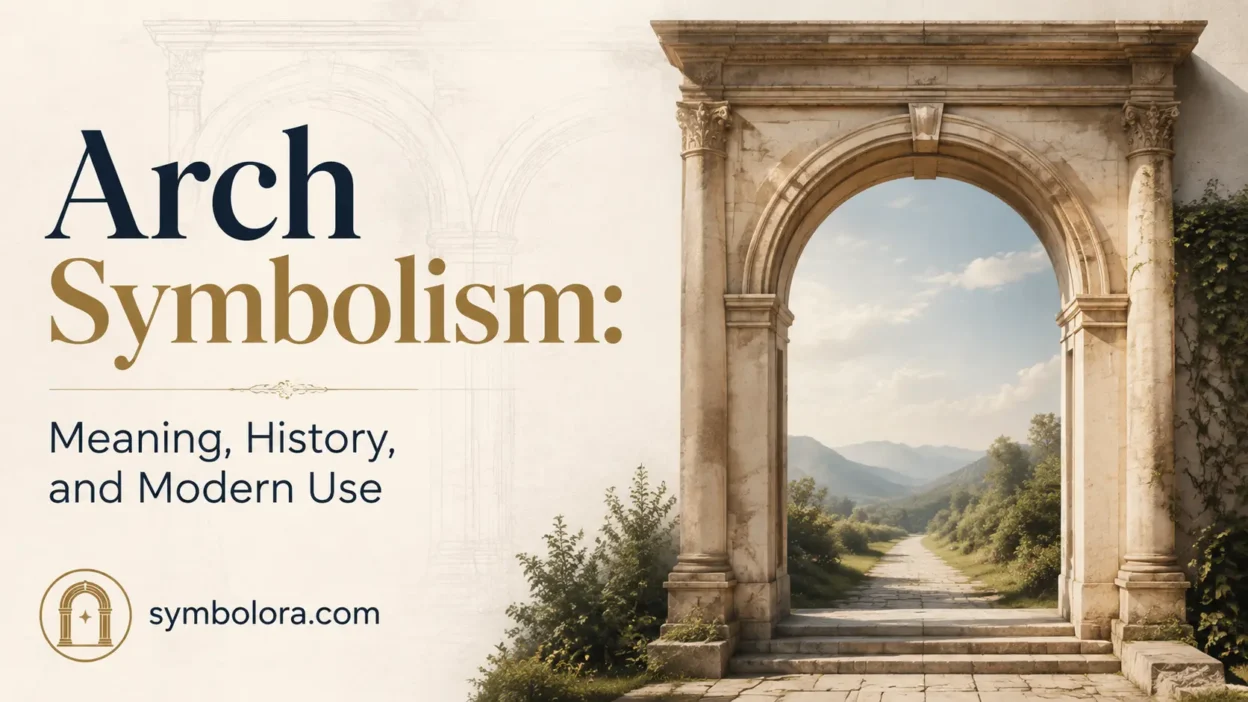
An arch symbolism often represents strength, transition, connection, and passage from one stage to another. From ancient gateways and religious buildings to modern architecture and personal designs, arches have carried meanings related to protection, achievement, welcome, and human progress.
People encounter arches in many everyday places across the United States, including homes, memorials, churches, universities, public buildings, and decorative designs. Their curved shape naturally draws attention because it suggests movement, openness, and a supported path forward.
The meaning of an arch comes from both its physical structure and the cultural ideas attached to it. An arch holds weight while creating an opening, which is why many societies connected it with endurance, opportunity, and important life moments.
Quick Answer
Arch symbolism commonly represents transition, strength, and new beginnings in modern American culture, especially in architecture, ceremonies, and personal design. Historically, arches have also symbolized power, protection, victory, and connection between spaces.
TL;DR
- Arches symbolize passage, strength, and transformation.
- Ancient civilizations used arches for power and permanence.
- Americans associate arches with homes, memorials, and achievements.
- Religious buildings use arches to express spiritual connection.
- Modern designs use arches for beauty and emotional meaning.
What an Arch Represents in Everyday Life
An arch is a curved structure that spans an opening while supporting weight above it. Unlike a simple doorway or straight beam, an arch creates a feeling of movement and balance.
In daily life, people often see arches as welcoming features. A front entrance with an arched doorway may suggest warmth and invitation. A stone arch at a park entrance can represent a transition from ordinary space into a special environment.
The shape itself influences its symbolism. The curve creates a visual journey from one side to another, making arches naturally associated with crossing boundaries and entering new experiences.
For many people, an arch represents a doorway between the familiar and the unknown. This idea appears in architecture, ceremonies, artwork, and personal expressions.
The Historical Origins of Arch Symbolism
The practical use of arches began thousands of years ago because builders needed structures that could support heavy loads while creating open spaces. Early examples appeared in ancient civilizations, including Mesopotamia, Egypt, and later Roman architecture.
The Romans greatly expanded the use of arches in bridges, roads, aqueducts, and public buildings. Because these structures represented engineering success and imperial achievement, arches became connected with authority and lasting accomplishment.
Roman triumphal arches were built to celebrate military victories and important leaders. These monuments transformed the arch from a practical construction method into a symbol of public memory, honor, and success.
Over time, different cultures adapted arches for their own purposes. Some used them in religious buildings, while others incorporated them into homes, palaces, and city entrances.
Ancient Civilizations and the Meaning of Arches
Different societies gave arches different interpretations based on their beliefs and needs.
In ancient Rome, arches often represented victory and national pride. A triumphal arch marked a significant achievement and preserved the memory of important events.
In Islamic architecture, arches became a major design element in mosques, palaces, and public spaces. They often contributed to feelings of harmony, beauty, and spiritual reflection.
In European medieval architecture, arches became closely connected with churches and cathedrals. Pointed arches in Gothic buildings helped create a sense of height and connection toward the heavens.
Although meanings differed, many cultures viewed the arch as a structure that connected two spaces. This physical connection often became a symbolic connection as well.
What Arch Symbolism Means in the United States
In the United States, arches commonly represent achievement, welcome, and important transitions.
Americans encounter arches in many meaningful settings:
- university entrances representing education and opportunity
- memorial arches honoring people or events
- wedding arches representing commitment
- neighborhood entrances creating a sense of community
- architectural designs expressing elegance and stability
One famous example is the Washington Square Arch, which reflects ideas of celebration and historical remembrance. Similar arches across the country often appear in civic spaces where communities preserve shared memories.
In American homes, arched windows and doorways are often chosen because they create a softer and more traditional appearance compared with sharp geometric designs.
Arch Symbolism in Architecture and Design
Architecture uses arches not only for structure but also for emotional effect.
A building with arches may appear:
- stable
- welcoming
- historic
- elegant
- balanced
Interior designers often use arches to create a sense of openness. Rounded doorways, wall niches, and mirrors with curved frames have become popular because they introduce softer visual shapes into modern spaces.
Unlike purely decorative elements, arches combine function and meaning. Their ability to support weight while creating openness makes them a natural symbol of balance.
Modern architecture sometimes uses simplified arches to create a connection between traditional craftsmanship and contemporary style.
| Context | Meaning in the USA | Common Associations | Notes |
|---|---|---|---|
| Homes | Welcome and comfort | Warmth, elegance, stability | Often used in entrances and interiors |
| Weddings | Life transition | Love, commitment, unity | Common in ceremony backdrops |
| Memorials | Remembrance | Honor, history, respect | Used in public monuments |
| Universities | Achievement | Growth, opportunity, success | Seen at campuses |
| Religious Buildings | Spiritual connection | Faith, reflection, devotion | Common in sacred architecture |
The Emotional and Psychological Meaning of Arches
The human response to curved shapes often influences how arches are interpreted.
Straight lines can feel organized and formal, while curves often appear softer and more inviting. Because an arch combines strength with a gentle shape, many people associate it with security and openness.
Psychologically, an arch can suggest movement forward. Walking through an arch feels like entering a new space, which is why people often connect arches with personal milestones.
Examples include:
- graduation ceremonies
- wedding celebrations
- home entrances
- award events
- public celebrations
The arch becomes meaningful because it marks a moment of change.
Religious and Spiritual Interpretations of Arches
Arches appear frequently in religious architecture because they create spaces designed for reflection and gathering.
In churches, arches may represent faith, connection, and a path toward spiritual understanding. Gothic pointed arches often draw attention upward, encouraging feelings of devotion and contemplation.
In Islamic architecture, decorative arches are common features that contribute to the beauty and organization of sacred spaces.
In Jewish, Christian, Islamic, and other traditions, the meaning of an arch depends on the specific design, location, and cultural context. The structure itself does not have one universal religious meaning.
Arch Symbolism in Weddings and Life Ceremonies
Wedding arches are among the most recognizable modern uses of arch symbolism.
In American weddings, couples often stand beneath an arch decorated with flowers, fabric, greenery, or lights. The arch creates a visual frame for the ceremony and represents the beginning of a shared journey.
The meaning comes from the idea of passing through a symbolic gateway. The couple moves from one stage of life into another while surrounded by family and friends.
Beyond weddings, arches appear in:
- graduation events
- retirement celebrations
- anniversary ceremonies
- cultural festivals
These uses reinforce the idea of transition and achievement.
Arch Symbolism in Tattoos and Personal Expression
Arches appear less frequently in tattoos than symbols like animals, flowers, or geometric shapes, but they can carry personal meanings.
Someone may choose an arch tattoo to represent:
- overcoming challenges
- entering a new chapter
- personal growth
- strength through difficult experiences
- connection between different parts of life
Some people combine arches with other symbols, such as mountains, doors, stars, or flowers, to create a more personal story.
The meaning depends heavily on the individual rather than a fixed interpretation.
Arch Symbolism in Art, Fashion, and Popular Culture
Modern artists and designers use arches because they create balance and visual interest.
Arched shapes appear in:
- logos
- jewelry designs
- furniture
- photography backgrounds
- fashion patterns
- digital graphics
The shape often communicates sophistication and stability. Brands and designers may use curved forms because they feel approachable while still suggesting reliability.
In popular culture, arches are sometimes used as visual symbols for journeys, discoveries, and important moments. A character walking through an arch can represent entering a new phase of life.
Cross-Cultural Interpretations of Arch Meaning
Although arches share some common ideas, their meanings change across cultures.
In Roman traditions, arches were strongly connected with victory and public achievement.
In European architecture, arches often became associated with religious devotion and artistic craftsmanship.
In many Asian architectural traditions, curved gateways and entrances can symbolize movement between different spaces or environments.
Across cultures, the most consistent idea is that arches create a connection. They separate one area from another while also providing a way to move between them.
Common Misunderstandings About Arch Symbolism
One misunderstanding is that every arch automatically carries a spiritual or mystical meaning. In reality, many arches exist simply because they are practical and visually appealing.
Another misconception is that arches always represent victory. While this connection comes from Roman triumphal arches, modern arches may represent many different ideas, including comfort, beauty, remembrance, or transition.
The meaning of an arch depends on its setting. A memorial arch, wedding arch, and home doorway may share the same shape but communicate different messages.
How Arch Meaning Has Changed Over Time
The symbolism of arches has evolved as societies changed.
Ancient civilizations often used arches to demonstrate engineering ability and political power. Religious communities later used them to shape sacred environments. Modern designers use arches for emotional warmth and visual balance.
Today, arches are less connected to empire and more connected to personal experiences. People often see them as symbols of entering opportunities, creating memories, and building connections.
The arch remains meaningful because it combines practical strength with a shape people naturally understand.
Frequently Asked Questions
What does an arch symbolize spiritually?
An arch can symbolize connection, transition, and movement toward a new stage. In religious architecture, its meaning depends on the tradition and the specific building where it appears.
What does an arch tattoo symbolize?
An arch tattoo may represent personal growth, overcoming obstacles, or entering a new chapter. The meaning usually comes from the person’s own experiences and the other elements included in the design.
Why are wedding arches meaningful?
Wedding arches symbolize the transition into marriage and create a visual gateway for the couple’s new life together. They also serve as a central gathering point during the ceremony.
Are arches symbols of strength?
Yes, arches are often associated with strength because their structure supports significant weight while maintaining an open space. This combination has influenced their symbolic connection with stability and endurance.
What do arches represent in American architecture?
In American architecture, arches often represent elegance, tradition, welcome, and achievement. They appear in homes, universities, monuments, and public buildings.
Do arches have the same meaning in every culture?
No. Different cultures interpret arches according to their history, religion, and architectural traditions. Some emphasize victory, while others focus on spirituality, beauty, or connection.
Why are arches popular in modern interior design?
Arches are popular because their curved shape creates a softer and more welcoming feeling than sharp architectural lines. Designers use them to add character, balance, and visual flow.
Conclusion
An arch carries meanings that come from both its structure and its cultural history. It represents ideas such as strength, transition, connection, and welcome because it creates a passage while remaining stable.
In modern America, arch symbolism appears in homes, ceremonies, monuments, and personal designs. While its meaning changes depending on context, the arch continues to represent moments when people move from one place, experience, or stage of life into another.
Its lasting appeal comes from a simple idea: an arch does not block the way forward—it creates an opening.


