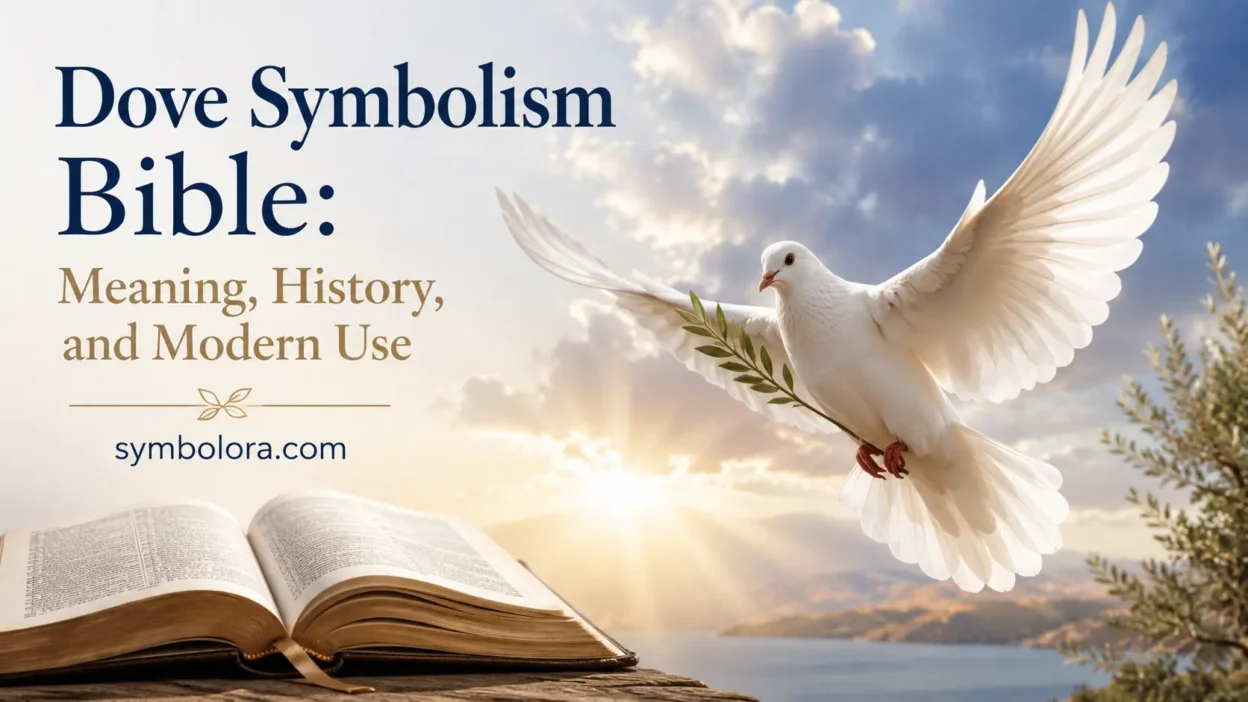
Doves appear in some of the Bible’s most recognizable scenes, from Noah searching for dry land after the Flood to the baptism of Jesus. Because of those passages, dove symbolism Bible interpretations commonly connect the bird with peace, hope, the Holy Spirit, innocence, renewal, and faithful devotion.
Yet the biblical picture is broader than the familiar white dove carrying an olive branch. Doves were also sacrificial birds, poetic images of beauty and longing, signs of vulnerability, and even metaphors for poor judgment in certain prophetic passages. Their meaning changes according to the text.
For American readers today, the dove often combines biblical tradition with centuries of Christian art and modern peace imagery. Understanding those layers helps separate what Scripture actually says from meanings that developed later.
Quick Answer
Dove symbolism Bible meanings most commonly include the Holy Spirit, hope, peace, renewal, innocence, and devotion. The associations come especially from Noah’s dove after the Flood and the Gospel accounts of the Spirit descending like a dove at Jesus’ baptism, while other biblical passages connect doves with sacrifice, love, vulnerability, and the desire for refuge.
TL;DR
- Noah’s dove represents renewed life and hope after judgment.
- The Gospels connect dove imagery directly with the Holy Spirit.
- Biblical doves also appear as accessible sacrificial offerings.
- Poetry uses doves for beauty, love, longing, and escape.
- Peace symbolism developed partly from Noah’s olive-leaf story.
- The Bible never says every dove has one fixed meaning.
What a Dove Most Commonly Means in the Bible
No single definition explains every biblical dove. Scripture uses the bird in narrative, worship law, poetry, prophecy, and the Gospels, and each setting adds a different association.
For most Christian readers in the United States, three meanings stand above the others: the Holy Spirit, hope after hardship, and peace. The first comes most directly from the baptism of Jesus. Hope and peace are strongly influenced by the Flood story, where a returning dove shows Noah that the waters are retreating and life can begin again.
Other meanings arise from separate passages rather than from a single symbolic system. Doves can suggest gentleness, vulnerability, romantic beauty, longing for safety, religious offering, or lack of discernment.
| Biblical Context | Main Meaning Today | Key Association | Important Note |
|---|---|---|---|
| Noah and the Flood | Hope and renewal | Olive leaf, dry land | Peace is a later extension |
| Jesus’ baptism | Holy Spirit | Spirit descending like a dove | The text says “like a dove” |
| Sacrificial law | Worship and accessibility | Doves and pigeons | Available to people of limited means |
| Biblical poetry | Love and beauty | Dove imagery | Often figurative rather than doctrinal |
| Psalms | Escape and rest | Wings of a dove | Expresses longing for refuge |
| Prophetic imagery | Vulnerability or foolishness | Easily deceived dove | Shows the symbol can be negative |
Noah’s Dove and the Meaning of Hope After the Flood
The dove first becomes especially memorable in Genesis 8. After the Flood, Noah sends birds from the ark to determine whether the water has receded enough for life on land to resume.
The dove initially returns because it cannot find a resting place. Noah later releases it again, and it comes back carrying a freshly plucked olive leaf. Noah understands from this that the waters have gone down. On a later release, the dove does not return, indicating that conditions outside the ark have changed.
In the story itself, the dove functions practically as a sign that dry ground and vegetation are returning. Symbolically, that made it well suited to represent hope after catastrophe, restoration, a new beginning, and the return of ordinary life.
The bird is therefore not merely a generic symbol of happiness. Its biblical setting involves survival after judgment and the gradual reappearance of a livable world.
Why the Dove and Olive Branch Became Symbols of Peace
The familiar image of a dove holding an olive branch comes directly from the visual details of Noah’s story, but its modern meaning goes somewhat beyond the wording of Genesis.
Genesis says the olive leaf tells Noah that the floodwaters have receded. It does not explicitly announce, “the dove represents peace.” The broader peace interpretation developed because the Flood crisis is ending and a restored relationship between God, humanity, and the earth follows the catastrophe.
Over time, Christian art reinforced this interpretation, and the dove-and-olive-branch combination became recognizable outside strictly religious settings as well.
The symbol received another major boost in the twentieth century. Pablo Picasso’s 1949 dove image became closely associated with international peace movements, helping turn an already familiar religious image into a widely understood secular peace emblem.
Today in the United States, a dove with an olive branch may appear in churches, memorial designs, nonprofit logos, political artwork, peace campaigns, jewelry, and social media graphics. Some uses are consciously biblical; others use the symbol without any religious intention.
The Dove as a Symbol of the Holy Spirit
For Christianity, the strongest explicitly biblical association with the dove comes from Jesus’ baptism.
Matthew describes the Spirit of God descending “like a dove” upon Jesus. Mark, Luke, and John preserve closely related imagery, making the scene one of the best-attested dove references in the New Testament. Luke adds that the Holy Spirit descended in bodily form like a dove.
This event shaped centuries of Christian imagery. Medieval and later artists commonly represented the Holy Spirit as a dove, especially in depictions of Christ’s baptism and scenes concerned with the Trinity or divine presence.
As a result, modern American Christians may see a dove on church banners, baptism certificates, stained glass, confirmation materials, ministry logos, or religious jewelry and immediately associate it with the Holy Spirit.
The connection is so established that the dove has become visual shorthand for divine presence, spiritual renewal, and God’s Spirit at work.
Does the Bible Say the Holy Spirit Is Literally a Dove?
No. This distinction matters.
The Gospel accounts use comparative language: the Spirit descends like a dove. The image describes the manifestation witnessed at Jesus’ baptism rather than defining the Holy Spirit as a bird.
Christian artwork later made the comparison visually concrete by depicting an actual dove. That convention is useful as religious symbolism, but it should not be confused with a biblical claim about the Holy Spirit’s permanent physical form.
This is one reason readers should distinguish between a biblical image and a later symbolic convention inspired by that image.
Doves as Sacrificial Birds and Symbols of Accessible Worship
Doves have another biblical role that modern symbolic discussions sometimes overlook: they were used as offerings.
Levitical law permits turtledoves or young pigeons in several sacrificial contexts. In some cases, they served as alternatives for people who could not afford more expensive animals. Leviticus 5, for example, allows two doves or pigeons when a person cannot afford a lamb.
That background also appears in the New Testament. Luke records that Mary and Joseph brought a pair of birds in connection with the prescribed purification rites after Jesus’ birth, reflecting the provisions found in the Law.
This does not mean the Bible formally declares the dove a symbol of poverty. Still, the passages give it associations with humble worship, ordinary households, religious obedience, and access to sacrificial worship for people with limited resources.
That layer is historically important because biblical doves were real animals within Israelite religious life before they became primarily decorative religious emblems.
Innocence, Gentleness, and the Teaching of Jesus
Doves also appear in one of Jesus’ memorable instructions to his disciples.
In Matthew 10:16, as Jesus prepares them for difficult circumstances, he contrasts the serpent with the dove. Depending on translation, the disciples are told to combine the prudence or shrewdness of serpents with the innocence of doves.
The point is balance. Innocence without judgment can become vulnerability, while cleverness without moral restraint can become manipulation.
From this passage comes much of the Christian association between the dove and innocence, harmlessness, sincerity, and gentle conduct.
In American Christian language, describing someone as “dove-like” can therefore suggest a peaceful or nonthreatening character. Yet Jesus’ comparison also warns that gentleness should not mean naivety.
Dove Imagery in Biblical Love Poetry
The Song of Songs gives the dove a very different role.
Here, dove imagery belongs to the language of romantic admiration. The beloved is compared with a dove, and references to dove-like eyes contribute to the poem’s descriptions of attractiveness, intimacy, and affection. The turtledove’s voice also appears among signs of the changing season.
These passages help explain why doves later became associated with romantic love, tenderness, courtship, and marital affection, although later Western customs added their own layers to those meanings.
For modern Americans, paired doves often appear in wedding decorations and anniversary designs. That use can harmonize with biblical love imagery, but the highly standardized “two doves equal lifelong marriage” formula is more cultural than scriptural.
The Bible uses dove imagery poetically; it does not establish a formal wedding symbol.
Dove Wings as a Symbol of Escape and Rest
Psalm 55 presents one of Scripture’s most emotionally recognizable dove images.
The speaker is overwhelmed by fear and conflict and wishes for the wings of a dove so he could fly away and find rest. The dove represents imagined distance from danger—a way to escape turmoil and reach safety.
That makes biblical dove imagery relevant not only to peace itself but also to the human longing for peace.
This distinction matters emotionally. A dove can symbolize a peaceful condition, but it can also express the desire to get away from pressure, conflict, grief, or danger.
That aspect helps explain why dove imagery often appears in memorial art. For grieving families, a flying dove may communicate release, rest, or the hope that suffering has ended, even when the exact design is not taken from a specific biblical verse.
The Dove Can Also Represent Vulnerability or Poor Judgment
Biblical symbols rarely have only one emotional tone, and the dove is no exception.
Hosea compares Ephraim to a dove lacking sense as the people shift their political dependence between powerful foreign nations. In that context, dove imagery is not praise. It communicates poor judgment and vulnerability.
Other prophetic passages use the sounds or movements of doves in scenes of fear, mourning, or displacement.
These passages prevent an overly simple interpretation. A reader cannot assume that seeing the word “dove” automatically means Holy Spirit, peace, or purity. Meaning depends on genre and context.
The positive modern symbolism remains valid as a cultural tradition, but careful biblical reading begins with the specific passage rather than a universal symbol dictionary.
Does a White Dove Have a Special Biblical Meaning?
White doves are closely associated today with purity, heaven, peace, and the Holy Spirit, but the Bible does not specify that Noah’s dove was white. Nor do the Gospel baptism accounts state that the dove-like appearance of the Spirit was white.
The familiar white bird largely reflects later Christian artistic convention and the broader Western association between white and ideas such as purity, innocence, light, and celebration.
That does not make white-dove symbolism meaningless. It simply means readers should identify it correctly as a later visual tradition built around biblical dove imagery, rather than a detail explicitly supplied by Scripture.
A gray, brown, or other naturally colored dove would not carry a different theological message merely because of its feathers.
What Dove Symbolism Means in American Christianity
In the United States, the dove occupies an unusual space because it works simultaneously as a biblical, Christian, emotional, and secular symbol.
Inside churches, it most commonly suggests the Holy Spirit. Dove imagery appears around baptism, confirmation, worship materials, sanctuary art, stained glass, religious education, and ministry branding.
At funerals and memorials, the emphasis often shifts toward peace, release, hope, and eternal rest. At weddings, paired doves can represent love, commitment, harmony, or a peaceful marriage.
Outside churches, the same bird may stand simply for nonviolence or reconciliation.
This overlap allows people with different beliefs to recognize the image while interpreting it differently. A Christian viewer may see Noah or the Holy Spirit; another viewer may see humanitarian peace; someone grieving may see emotional release.
Biblical Dove Symbolism in Tattoos and Jewelry
Dove tattoos are especially flexible because small design changes alter their emphasis.
A dove beside a cross usually communicates Christian faith or the Holy Spirit. A dove with an olive branch leans toward peace, reconciliation, or a new beginning. A flying dove with a name or date often serves as a memorial.
Some people choose a dove after surviving a difficult period because Noah’s story provides a natural image of life returning after devastation. Others connect the bird with baptism, conversion, forgiveness, or spiritual renewal.
Dove necklaces, pendants, bracelets, and rings tend to carry similar meanings but in a quieter form. In Christian jewelry, the silhouette itself may be enough to signal the Holy Spirit.
The wearer’s intention remains important. A dove is widespread enough that no single interpretation should automatically be assigned to someone’s tattoo or jewelry.
Dove Symbolism in Weddings, Funerals, and Memorials
American ceremonial use has expanded the biblical meanings considerably.
At weddings, dove designs communicate peace, unity, tenderness, and enduring affection. Biblical love poetry provides some religious background, while later Western wedding traditions strengthened the pairing of doves with romantic commitment.
At funerals, the bird more often represents departure, rest, heaven, peace, or hope beyond death. A dove flying upward may visually suggest release from earthly suffering.
These meanings are emotionally understandable, but not every one comes from an explicit biblical statement. For example, Scripture does not teach that a dove literally represents a deceased person’s soul leaving the body.
Ceremonial symbolism works best when understood as visual language shaped by faith, art, and cultural custom rather than as a substitute for biblical doctrine.
Dove Meaning Beyond the Bible
Doves already carried cultural associations in the ancient Mediterranean and Near Eastern world, so biblical readers were not living in a cultural vacuum.
In Greek and Roman religious art, for example, doves could be associated with Aphrodite, the goddess connected with love and sexuality. Surviving ancient objects depict Aphrodite together with a dove.
Ancient flood traditions outside the Bible also contain episodes in which birds are released to determine whether land has become habitable. A Mesopotamian flood account preserved in the Epic of Gilgamesh includes the release of a dove among its sequence of birds.
These parallels provide historical context, but they should not be used to erase the distinct theological purpose of the biblical stories. Similar animal imagery can carry different meanings in different religious systems.
Modern American dove symbolism draws most visibly from Jewish and Christian Scripture, later Christian art, European artistic traditions, and twentieth-century peace imagery.
Common Misunderstandings About Biblical Doves
One frequent mistake is assuming that the Bible formally defines the dove as “the universal symbol of peace.” The connection is understandable, especially because of Noah, but Scripture presents a narrative image rather than a dictionary definition.
Another mistake is treating every dove passage as a reference to the Holy Spirit. That interpretation fits the baptism narratives but not sacrificial laws, romantic poetry, psalms of distress, or prophetic criticism.
The white dove presents a similar issue. Its color has become culturally meaningful, yet the most important biblical dove passages do not depend on white feathers.
Finally, biblical symbolism should not be turned into prediction. Seeing a dove outside, dreaming about one, or encountering a dove repeatedly is not presented in Scripture as a guaranteed message about a future event.
A biblical interpretation should distinguish theological imagery from personal superstition.
How the Meaning of the Dove Evolved
Biblical dove imagery began with several practical and literary roles rather than one unified emblem.
Genesis provided the enduring picture of a bird returning after the Flood with evidence that the earth was becoming habitable again. Israelite worship incorporated doves as sacrificial animals. Biblical poets used them to describe beauty, migration, vulnerability, longing, and rest.
The New Testament then gave Christianity its most influential dove image through the baptism of Jesus. Christian artists converted that Gospel comparison into a recognizable visual representation of the Holy Spirit. Medieval art helped make the association familiar across generations.
Later peace movements broadened the symbol beyond churches. Picasso’s twentieth-century dove imagery helped reinforce its international secular identity as an emblem of peace.
The modern dove therefore carries several historical layers at once: biblical narrative, Christian theology, religious art, emotional symbolism, and secular hopes for peace.
Frequently Asked Questions
What does a dove symbolize spiritually in the Bible?
A dove can represent the Holy Spirit, hope, renewal, innocence, worship, or a longing for peace depending on the passage. The clearest Christian spiritual connection comes from the Spirit descending like a dove at Jesus’ baptism.
What does the dove symbolize in the story of Noah?
Noah’s dove signals that the floodwaters are receding and that vegetation has reappeared. Because of that scene, it later became associated with hope, restoration, fresh beginnings, and eventually peace.
Why is the Holy Spirit represented by a dove?
The image comes from the Gospel accounts of Jesus’ baptism, where the Spirit descends like a dove. Christian art later adopted an actual dove as a standard visual symbol for the Holy Spirit.
Does a dove always mean peace in the Bible?
No. Doves appear in contexts involving sacrifice, love poetry, escape, vulnerability, and even foolishness as well as hope and peace. Readers need to interpret the bird according to the individual passage.
What does a dove with an olive branch symbolize?
It usually symbolizes peace, reconciliation, hope, or the end of conflict. The image grows from Genesis, where Noah’s returning dove carries an olive leaf showing that the Flood waters have receded.
Is a white dove specifically mentioned as a biblical symbol?
The Bible does not say that Noah’s dove was white, and the Gospel baptism accounts do not make whiteness part of the dove imagery. The white dove became especially prominent through later religious art and cultural symbolism.
Is seeing a dove a sign from God?
The Bible records particular occasions when birds were part of meaningful events, but it does not establish a rule that every dove someone encounters is a personal divine message. Christians may find spiritual reminders in nature, but claims of specific supernatural guidance require more caution than simply applying a symbolism chart.
Conclusion
Dove symbolism Bible meanings are best understood as a collection of related biblical images rather than one fixed definition. The dove can point toward the Holy Spirit at Jesus’ baptism, renewed life in Noah’s story, humble worship in sacrificial law, innocence in Jesus’ teaching, beauty in love poetry, or the desire to escape suffering in the Psalms.
Later Christian art and modern culture brought many of those themes together, especially peace, purity, hope, and divine presence. That is why the dove remains immediately recognizable in American churches, memorials, weddings, tattoos, jewelry, artwork, and peace imagery.
Its lasting usefulness comes from something more specific than a generic idea of goodness: across its major biblical appearances, the dove repeatedly appears at moments when people are searching for restoration, guidance, refuge, or a reason to believe that conflict and hardship will not have the final word.


