The King of Hearts is one of the most recognizable court cards in a standard deck. In modern American culture, king of hearts symbolism usually combines the heart’s association with love and emotion with the king’s associations with authority, maturity, confidence, and responsibility.
That combination explains why the card appears far beyond poker tables. People use it in tattoos, couple designs, artwork, clothing, jewelry, and romantic imagery. Its unusual artwork has also produced one of playing-card culture’s best-known nicknames: the “Suicide King.”
Yet some popular explanations go much further than the historical evidence allows. The card was not originally designed as a mystical lesson about sacrifice, and claims that it unquestionably depicts Charlemagne or directly descends from tarot’s King of Cups oversimplify a much more interesting history.
Quick Answer
In modern American culture, king of hearts symbolism most commonly represents romantic devotion, emotional maturity, compassion, and leadership guided by feeling rather than force. Historically, it belongs to the French-suited playing-card tradition, while its famous “Suicide King” appearance developed through centuries of changes to an older card design rather than from an intentional image of self-destruction.
TL;DR
- Hearts connect the card with love, affection, and emotional life.
- The king adds maturity, authority, responsibility, and protective leadership.
- French card designs eventually shaped today’s familiar international deck.
- The “Suicide King” appearance developed through repeated copying of older artwork.
- Americans use the card in tattoos, couple art, fashion, and gaming imagery.
- Cartomancy adds interpretive meanings that are separate from documented card history.
What the Card Looks Like—and Why Its Details Matter
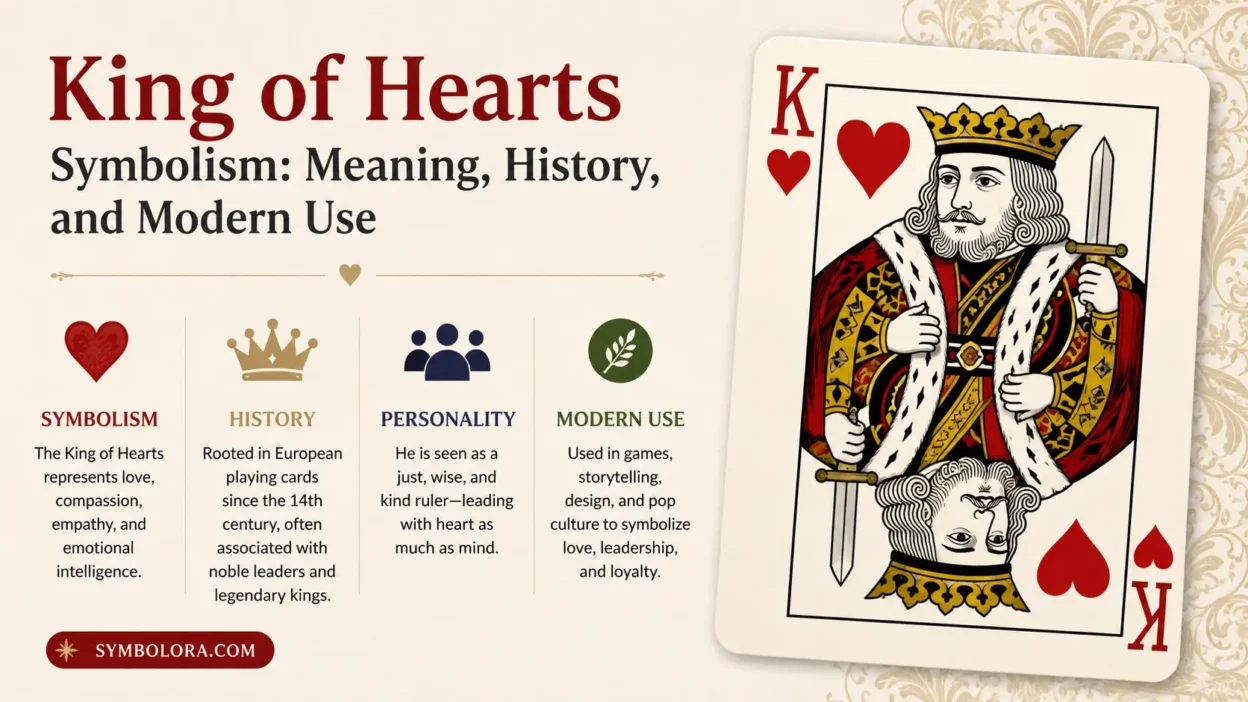
In a typical American deck, the King of Hearts is marked with a red K and heart symbols in opposite corners. The court figure wears elaborate royal clothing and appears twice because modern court cards are double-headed, allowing players to recognize them from either direction.
What makes this king memorable is the weapon positioned beside or behind his head. At a glance, the blade can appear to pass directly into his skull. He also traditionally appears without the prominent mustache found on several other kings.
Those odd features are important because much of the card’s later symbolism grew from people trying to explain what they saw.
The design did not begin as a deliberate portrait of a distressed ruler. Earlier versions show a more coherent royal figure carrying an axe. As generations of cardmakers copied and simplified the design, parts of the weapon and facial details changed. The axe eventually became something resembling a sword, while the king’s mustache disappeared.
That distinction separates historical design evolution from meanings people have added afterward.
What It Commonly Means in the United States
Most Americans do not encounter the card as an ancient religious emblem. They encounter it through ordinary playing cards, poker imagery, casinos, games, Valentine-style designs, tattoos, and popular culture.
Because the heart already communicates affection in everyday American visual language, placing a king within that suit creates an intuitive idea: someone who rules the emotional realm.
That interpretation can be romantic, but it does not have to be.
| Context | Common U.S. Meaning | Typical Association | Important Note |
|---|---|---|---|
| Romance | Devoted love | Partner, husband, boyfriend | Usually a modern interpretation |
| Leadership | Compassionate authority | Wisdom, maturity, responsibility | Combines king and heart imagery |
| Tattoo culture | Personal loyalty or identity | Love, resilience, partnership | Meaning depends on the wearer |
| Couple designs | Committed partnership | King and Queen of Hearts | Common romantic pairing |
| Card reading | Emotionally mature person | Adviser, partner, protector | Comes from cartomancy traditions |
| Gaming imagery | Royal status and risk | Poker, luck, strategy | Meaning depends on the game |
The central idea is usually not simply love. It is love combined with status, maturity, or command.
Someone choosing an ordinary heart might want to communicate affection. Someone choosing a crowned king of that suit may be communicating affection mixed with strength, confidence, loyalty, or adult responsibility.
How the Card Developed from French and English Traditions
The familiar hearts, diamonds, clubs, and spades did not exist in the earliest European playing cards.
European decks once used several different suit systems. In parts of Italy and Spain, cards featured cups, coins, swords, and batons or clubs. German traditions developed symbols such as hearts, leaves, bells, and acorns.
Around the late 15th century, French cardmakers established the four suit marks now familiar to Americans: hearts, diamonds, clubs, and spades. The simple red-and-black symbols were easier to reproduce than more detailed earlier designs, which helped French-style cards spread widely. The heart suit itself appears to have been adapted from an existing German heart symbol rather than invented as a deliberate mystical substitute for tarot cups.
A major printing center developed in Rouen, France. Cards associated with the Rouen pattern reached England, where the court figures were repeatedly copied and modified.
The standard English or International court-card pattern ultimately descended from these Rouen designs. Surviving examples show that the basic pattern was established by the early 16th century.
English cards later became highly influential in North America. As a result, an American holding a modern King of Hearts is looking at the distant descendant of a Renaissance European printing tradition, even though generations of redesign have transformed many details.
Is the King of Hearts Charlemagne—or Someone Else?
One of the most repeated claims about the King of Hearts is that he represents Charlemagne.
The historical evidence is more complicated.
Some traditional French court-card patterns did assign names to their kings, queens, and jacks. In the well-known Paris pattern, the King of Hearts was labeled Charles, generally associated with Charlemagne.
However, the familiar English-American court cards did not simply preserve those Paris figures unchanged.
The English pattern developed primarily from Rouen, and its court figures did not traditionally carry names. Playing-card historians therefore caution against treating a modern American King of Hearts as a literal portrait of a specific monarch. Comparative attempts to identify Rouen figures have even associated its heart king with Alexander, showing why simple one-name explanations can be misleading.
So the most accurate answer is:
Charlemagne belongs to one important French naming tradition, but the modern American King of Hearts cannot confidently be identified as a portrait of Charlemagne.
That matters because modern symbolism should not be built on a historical certainty that does not actually exist.
The Truth Behind the “Suicide King” Nickname
The card’s strangest feature has produced its most dramatic nickname.
Modern decks make the king appear to hold a sword directly against or through his head. This led players to call him the “Suicide King.”
The image, however, is not evidence that medieval or Renaissance cardmakers intended to portray suicide.
Earlier examples of the English-pattern ancestor show the king holding an axe. During centuries of hand carving, block printing, copying, and redrawing, portions of that axe became distorted. Eventually its head disappeared from the recognizable design, while the remaining shaft evolved into the sword-like object seen today.
The nickname therefore came after the visual distortion.
Modern tattoo artists and illustrators sometimes reinterpret the image as representing sacrifice, inner conflict, heartbreak, survival, destructive love, or rebellion. Those can be valid personal artistic readings, but they are later interpretations, not the documented reason the card was originally drawn that way.
That difference prevents an accidental printing-history quirk from being mistaken for an ancient symbolic code.
Love, Partnership, and Compassionate Authority
Remove the unusual weapon for a moment, and the card’s modern appeal becomes easier to understand.
A king traditionally suggests command, seniority, sovereignty, confidence, protection, or responsibility. A heart suggests love, attachment, care, emotional connection, and intimacy in contemporary Western imagery.
Combine them, and the card naturally lends itself to the idea of authority governed by affection.
This is why one of its strongest modern readings is compassionate leadership.
Instead of the ruler who dominates through fear, the heart king can represent the person who remains decisive while recognizing other people’s feelings. In relationships, the same symbolism becomes emotional steadiness: someone capable of loving without surrendering judgment, boundaries, or responsibility.
It can therefore represent:
devotion without dependence, confidence without coldness, and authority without cruelty.
Those meanings are cultural interpretations rather than fixed rules. Nevertheless, they explain why the card works so effectively as an emblem of a respected partner, father figure, mentor, or emotionally grounded leader.
Emotional and Psychological Meaning
Psychologically, the card often expresses an ideal of emotional self-command.
That does not mean suppressing emotion. It suggests being able to experience affection, anger, grief, loyalty, or vulnerability without allowing any single feeling to control every decision.
For some people, the image represents a man who is secure enough to show tenderness without treating tenderness as weakness.
For others, particularly in darker artwork, the damaged-looking king represents a conflict between power and vulnerability. His crown signals rank and control, while the sword-like object creates an image of danger close to the mind.
That contrast can make the card useful for artwork about:
- love and heartbreak
- strength and vulnerability
- responsibility and emotional pressure
- loyalty after disappointment
- maintaining composure during difficult relationships
None of these interpretations is mandatory. Personal symbolism works because people select the part of an image that fits their own experience.
Cartomancy, Spiritual Readings, and Religious Claims
Playing cards have also been used for cartomancy, or divination with cards.
In many modern cartomancy systems, the King of Hearts represents a warm, dependable, affectionate, emotionally mature, or supportive man. Depending on the reading, he might represent a partner, father, adviser, friend, or a set of qualities the reader believes should be developed.
These interpretations belong to a later divinatory tradition.
Playing cards were originally developed primarily for games, and ordinary-card cartomancy appears in Europe considerably later than the first playing-card decks. Tarot itself was also used for card games for centuries before occult systems became widely attached to it.
This also corrects another common claim: the King of Hearts is not securely documented as a direct transformation of tarot’s King of Cups carrying the same ancient spiritual meaning. French hearts developed within a broader European suit system, with strong historical connections to German heart signs.
Does it have a Christian meaning?
There is no standard Christian doctrine assigning a special religious meaning to the King of Hearts.
A person can certainly interpret king through ideas of divine kingship or heart through Christian themes of love, charity, and devotion. However, combining those ideas into a specific sacred meaning for this playing card is a modern interpretive choice rather than an established biblical tradition.
That distinction is useful whenever symbolic interpretation moves from documented history into personal spirituality.
Tattoos, Jewelry, Fashion, and Couple Designs
The card translates especially well into tattoo art because it already has a recognizable portrait, crown, letter, suit symbol, and dramatic weapon.
A King of Hearts tattoo may represent loyal love, masculine affection, emotional control, fatherhood, confidence, or commitment. A darker version may emphasize heartbreak, risk, mortality, betrayal, or surviving an emotionally difficult period.
Context changes everything.
A clean red-and-black card tattoo can feel playful or romantic. A version surrounded by flames, skulls, roses, or daggers may emphasize danger or resilience. Adding a date, initials, or another card can turn the same image into a personal memorial or relationship symbol.
The King and Queen of Hearts pairing is particularly common in couple imagery. Rather than representing literal royalty, the pair usually communicates chosen partnership: two people treating one another as their most valued partner.
Jewelry, clothing, wall art, and graphic design use the same principle. The card offers a convenient visual shorthand for romance with confidence.
Pop Culture and American Visual Language
Playing-card royalty has long functioned as more than game equipment.
In the United States, playing cards became familiar enough to appear in advertising, illustration, political satire, decorative art, and collectible ephemera. American commercial prints from the late 19th century already used the King of Hearts as a recognizable visual subject.
Literature reinforced the idea of a literal card kingdom. Lewis Carroll’s Alice’s Adventures in Wonderland includes the King and Queen of Hearts, turning playing-card court figures into characters. Later American artists reused that imagery for purposes far removed from card games.
One striking example is Walt Kelly’s Pogo adaptation of the Wonderland trial, which cast a political figure as the King of Hearts while satirizing the Army-McCarthy hearings. The image worked because audiences already understood the absurd royal world of playing cards.
Today, the card remains visually useful because Americans can read several ideas almost instantly: royalty, games, chance, romance, risk, and personality.
The precise meaning depends on which of those ideas the designer emphasizes.
How the Meaning Changed Over Time
The King of Hearts did not begin with one permanent symbolic definition.
Its meaning accumulated in layers.
First, it was a game piece within a European court-card hierarchy. Its king represented rank within a suit more than a philosophical lesson.
Then printing traditions standardized recognizable visual features. As French-derived cards spread through England and eventually into the English-speaking world, the design became familiar even as its original artistic details deteriorated.
Next came interpretation. The heart shape increasingly worked as an instantly recognizable sign of romantic affection in popular Western culture. That made the heart king especially suitable for romantic language and imagery.
Cartomancy contributed another layer by treating court cards as personality types or people.
Modern tattoo and design culture added still more meanings: emotional resilience, loyalty, masculine vulnerability, rebellion, commitment, and tragic romance.
So there is no contradiction in saying that the card means something today that its original makers may never have intended.
Symbols often work that way. History creates the object; culture keeps rewriting what the object communicates.
Common Misunderstandings About the Card
Several attractive stories about the King of Hearts are repeated so often that they can sound like established history.
“He is intentionally stabbing himself”
No. The apparent sword-through-the-head pose developed as an older axe-bearing design was repeatedly copied and altered.
“He definitely represents Charlemagne”
Not in every deck. Charles belongs to a French named-court tradition, but the standard English-American pattern does not securely portray a specific historical king.
“The heart suit was created from tarot cups”
That is too simple. French hearts were part of a suit system established around the late 15th century and appear closely related to earlier German heart signs.
“The card has one universal spiritual meaning”
It does not. Cartomancy traditions, tattoo culture, artists, and individual users can interpret it differently.
“The nickname proves the card symbolizes death”
The “Suicide King” name describes how the later artwork looks. Death, sacrifice, heartbreak, or rebirth are modern symbolic readings rather than demonstrated original meanings.
Recognizing those distinctions does not make the card less interesting. It makes its story more credible.
Frequently Asked Questions
What does the King of Hearts symbolize in love?
In romantic settings, it commonly represents devotion, loyalty, mature affection, and a dependable partner. The king element gives the heart’s ordinary love symbolism a stronger sense of commitment, confidence, or responsibility.
Is the King of Hearts a positive symbol?
It is generally interpreted positively when it represents compassionate leadership, emotional maturity, loyalty, or committed love. Darker meanings usually come from modern reinterpretations of the unusual sword-like design rather than from a fixed traditional definition.
What does a King of Hearts tattoo mean?
A tattoo can symbolize love, loyalty, emotional strength, masculine vulnerability, leadership, or commitment. Designs emphasizing the apparent sword may instead focus on heartbreak, sacrifice, conflict, or surviving painful experiences.
What does the King and Queen of Hearts symbolize together?
Together they usually represent romantic partnership, mutual loyalty, and two people viewing each other as equals or chosen partners. The pairing is especially common in couples’ tattoos, clothing, artwork, and personalized gifts.
Is the King of Hearts supposed to be Charlemagne?
Not necessarily. Some French cards named the heart king Charles, associated with Charlemagne, but the familiar English-American pattern came through Rouen and does not reliably portray a named historical person.
Is the King of Hearts the same as the King of Cups in tarot?
No. They are separate cards from different deck traditions, although modern readers may compare their emotional interpretations. Historically, the French heart suit should not simply be described as tarot cups renamed or converted into hearts.
Why does the King of Hearts have no mustache?
Earlier versions did show facial hair. As cardmakers repeatedly copied and simplified older printing designs, details were lost, including the heart king’s mustache and parts of his original axe.
Conclusion
King of hearts symbolism in modern American culture centers most naturally on love joined with maturity, confidence, loyalty, and compassionate authority. That makes the card an appealing emblem for committed relationships, emotionally grounded leadership, tattoos, personal identity, and artistic designs.
Its historical story is equally important. The familiar image grew out of European cardmaking traditions, passed through French and English designs, and changed dramatically through centuries of reproduction. The famous “Suicide King” appearance is therefore better understood as design evolution that later inspired symbolism, not as proof of an original message about death or sacrifice.
The card’s continuing appeal comes from that mixture of meanings. It can represent a ruler, a lover, a player, or an emotionally mature person—and the context determines which king the viewer sees.


