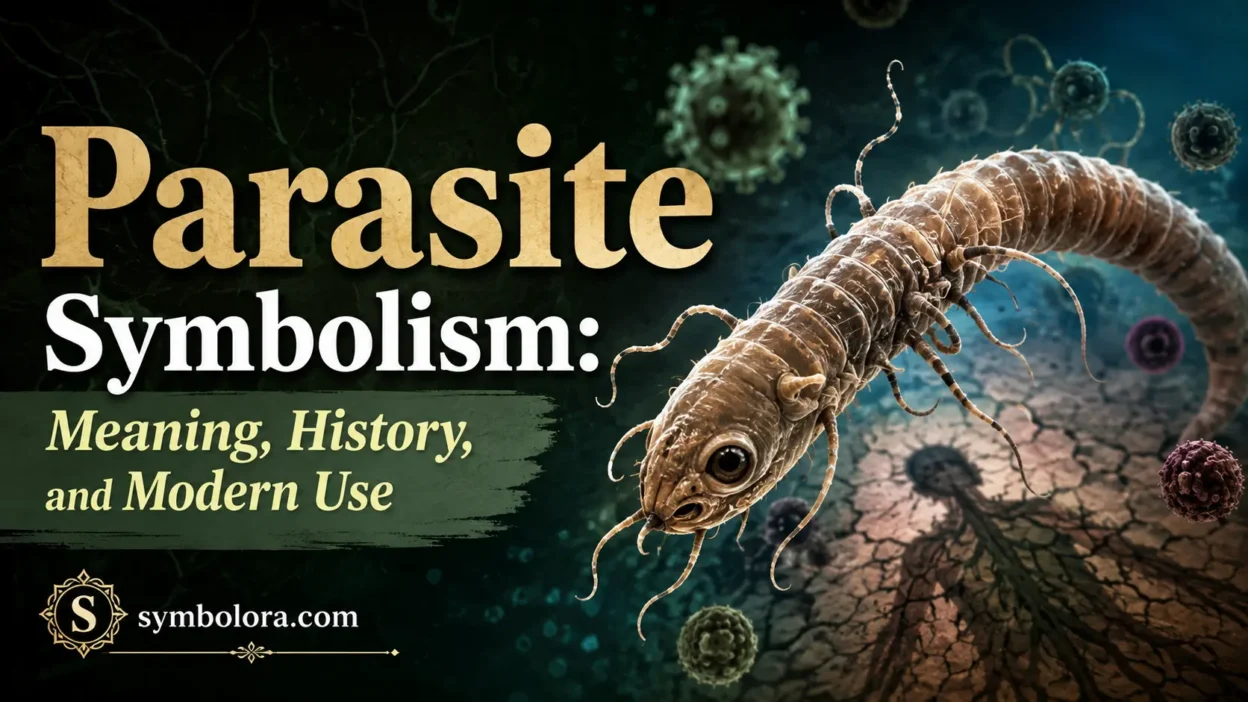
A parasite survives by taking resources from a host, often while harming that host in the process. Because that relationship is naturally unequal, parasite symbolism has become closely associated with exploitation, unhealthy dependence, manipulation, intrusion, and relationships in which one side continually takes more than it gives.
People encounter parasites literally in medicine and nature, but the idea also appears constantly in everyday language. Someone may describe an unfair person, organization, or relationship as “parasitic.” Horror stories use parasitic creatures to represent invasion of the body, while social commentary uses them to discuss wealth, labor, and dependency. What makes the symbol especially interesting is its history — the word originally described a human social role long before English speakers regularly used it as a biological term, and over time, the scientific meaning reinforced an already negative social metaphor.
Quick Answer
Parasite symbolism most commonly represents exploitation, unhealthy dependency, hidden harm, intrusion, and taking from someone without giving enough in return. Historically, the image grew from an ancient social term for someone who lived at another person’s expense and later gained additional force from biological parasitism.
At a glance:
- Parasites usually symbolize exploitation and one-sided dependence
- Their imagery can suggest hidden threats and violated boundaries
- The word began as a social description, not a scientific one
- American culture often applies the metaphor to unhealthy relationships and systems
- Horror uses parasites to represent bodily invasion and lost control
- Calling people parasites can become dehumanizing and politically dangerous
What a Parasite Is and Why Its Biology Matters
In biology, a parasite is an organism that lives on or inside another organism, called its host, and obtains resources from that relationship at the host’s expense. Human parasites include organisms as different as certain protozoa, worms, and ectoparasites such as lice. That basic arrangement provides nearly everything needed for the later metaphor — there’s a host, something being taken, and an unequal exchange, where the parasite benefits while the host bears at least some cost. Unlike an obvious predator that attacks and leaves, many parasites maintain an ongoing relationship with their hosts instead.
Symbolically, this creates several recurring ideas: dependence without equal contribution, gradual depletion rather than sudden destruction, concealed harm, and the invasion of personal or physical boundaries. The metaphor works because people can easily transfer these features from biology to human behavior — a draining friendship, exploitative workplace, or corrupt institution can all be described as “parasitic” even though no biological parasite is actually involved.
Core Meanings in Modern American Culture
In everyday American usage, the parasite is overwhelmingly a negative symbol. It describes something that survives, grows, or prospers by drawing value from something else.
| Context | Meaning in the USA | Common Associations | Notes |
|---|---|---|---|
| Relationships | Unequal dependence | Emotional draining, manipulation | Usually describes persistent one-sided taking |
| Work and money | Exploitation | Profit, unpaid effort, dependency | May criticize people or systems |
| Psychology | Intrusive influence | Loss of control, unhealthy attachment | Usually metaphorical rather than clinical |
| Horror | Bodily invasion | Contamination, transformation, fear | Often connected with loss of autonomy |
| Politics | Social exploitation | Burden, corruption, outsiders | Can become dehumanizing when applied to groups |
| Art and tattoos | Personal struggle | Survival, toxicity, control | Meaning depends heavily on the individual |
The key idea isn’t simply dependence — human beings depend on one another constantly, and mutual dependence can be perfectly healthy. What makes the parasite metaphor negative is asymmetry: one party receives the main benefit while the other absorbs the cost.
Ancient Roots: From Table Guest to Insult
The history of the word complicates the assumption that people first noticed biological parasites and then compared unpleasant humans to them. The opposite actually happened. English “parasite” ultimately comes through Latin from the Greek parasitos, formed from elements connected with being beside food or grain. In the ancient Mediterranean world, the term became associated with a person who ate at another person’s table — a parasite later became a recognizable comic figure who entertained, flattered, or served a wealthy patron in exchange for meals.
This early meaning was social rather than zoological. The figure represented dependence mixed with calculation — he stayed close to someone who possessed resources and made himself useful enough to remain welcome, which gave the word associations with flattery and living at another’s expense. English speakers were using “parasite” for this type of person centuries ago, and the biological sense developed later, making this an unusual case in which the social metaphor helped shape the scientific vocabulary rather than simply resulting from it. That history explains why exploitation remains central to the symbol today.
How Biology Changed the Symbol
Once “parasite” became established as a biological concept, the metaphor gained a more physical and unsettling character. A social hanger-on could be annoying, but a biological parasite could live inside a body, consume nutrients, reproduce, remain unnoticed, and sometimes cause disease — the metaphor expanded well beyond laziness or dependency and began to suggest infiltration instead.
Something parasitic might look harmless at first, becoming attached gradually and weakening a system without destroying it immediately. This distinction matters symbolically. A parasite usually doesn’t represent open confrontation — it more often represents a problem that becomes embedded within something else, which is exactly why parasite imagery fits stories about corruption particularly well. Corruption works from inside an institution; manipulation develops inside a relationship; a harmful habit becomes integrated into everyday life. In each case, the danger is already attached before its full cost becomes obvious.
Parasites as Metaphors for Unhealthy Relationships
One of the most recognizable modern interpretations concerns relationships in which emotional, financial, or practical support flows mainly in one direction. A person might informally describe a relationship as parasitic when one individual repeatedly demands attention, money, or emotional reassurance while offering little support in return.
The symbolism usually communicates three things at once. First comes attachment — the harmful dynamic requires continued access to the other person. Second comes depletion — the person providing support may feel increasingly exhausted or restricted. Third comes difficulty separating, since just as biological parasites are adapted to remain connected to hosts, an unhealthy interpersonal pattern may persist because of guilt, fear, or dependency.
Still, the metaphor should be used carefully. Temporary dependence doesn’t make a person parasitic — children depend on adults, partners support one another during illness, and friends sometimes need more help than they can immediately return. The symbol becomes appropriate only when describing a genuinely one-sided pattern, not ordinary human vulnerability.
Class, Labor, and Social Dependency
The parasite metaphor has long been used in arguments about wealth and labor because it asks a provocative question: who is benefiting from whose work? Different political traditions have answered that question in completely different ways. Some writers have labeled wealthy rentiers or exploitative employers parasitic because they profit from labor performed by others, while other movements have directed the same accusation at unemployed people or anyone considered economically “unproductive” instead.
That contradiction reveals something important about the symbol — calling someone a parasite doesn’t objectively prove who is exploiting whom. Instead, it frames one side as productive and the other as an unjustified burden. Historical discussions of “social parasitism,” including those in twentieth-century Europe and the Soviet sphere, sometimes turned judgments about productivity into moral or legal judgments about particular citizens. In modern American conversations, similar language may appear when people discuss corporations, landlords, welfare, or political elites — the specific targets vary, but the underlying symbolic structure stays remarkably consistent: somebody is accused of extracting resources without making a fair contribution.
Horror, Body Invasion, and Loss of Control
Parasites are especially effective horror symbols because they threaten one of the most basic human boundaries: the distinction between my body and something else. A monster standing across the room is separate from its victim — a parasite may already be inside, and that changes the emotional effect entirely.
Parasitic horror can involve implantation, infection, transformation, or a creature controlling a host from within, and academic discussions of American body horror identify parasitism as one of the genre’s recurring ways of exploring bodily limits. Symbolically, these stories often involve loss of autonomy (the host can no longer control everything happening inside its own body), contamination (something foreign crosses a boundary that should have remained protected), and identity anxiety (the victim may wonder whether they’re still fully themselves). These fears explain why fictional parasites overlap so often with alien-invasion stories, possession narratives, and zombies. The specific creature changes, but the underlying fear stays the same: something else has gained access to the self.
Emotional and Psychological Meaning
Used symbolically rather than medically, a parasite can represent something that occupies mental or emotional space while steadily taking more than it contributes — and that “something” doesn’t have to be another person. An obsessive fear can feel parasitic because it feeds on attention; an unhealthy habit may require increasingly more time or money while reducing a person’s freedom.
This imagery often communicates drain more effectively than outright destruction — the host is still functioning, but with fewer resources than before. That makes the metaphor useful for describing experiences that feel exhausting rather than catastrophic, since a harmful influence can persist quietly enough that a person adapts to it before realizing how much it’s actually costing them. There’s also a strong boundary theme here. People drawn to parasite imagery may be thinking about who or what receives access to their time, money, or attention — the central psychological question becomes: what am I sustaining that is weakening me? That interpretation stays metaphorical, of course, not a medical diagnosis.
Cross-Cultural Meaning and Political Misuse
There’s no single worldwide tradition in which parasites carry one fixed symbolic meaning. Instead, the metaphor has traveled through language, politics, and popular culture — its ancient Mediterranean history emphasized the dependent dinner guest, later European political writing expanded the idea into arguments about social productivity, and modern entertainment has used it to discuss everything from bodily invasion to inequality.
A particularly influential contemporary example is Bong Joon Ho’s South Korean film Parasite, whose story of wealthy and poor families made the title a vehicle for thinking about class dependency. The film’s impact in the United States became unusually broad after it won Best Picture, Directing, International Feature Film, and Original Screenplay at the 2020 Academy Awards. But the metaphor has a much darker political history as well. Calling an entire population “parasites” changes an argument about individual behavior into a claim that a category of human beings is inherently harmful — Nazi propaganda, for example, portrayed persecuted groups through images of parasites and vermin as part of a wider system of dehumanization. That’s exactly why modern use requires context: criticizing an exploitative practice as parasitic is one thing, but describing an ethnic, religious, or other human population as parasites carries the history and logic of dehumanizing propaganda.
Tattoos, Art, Fashion, and Digital Culture
Parasite imagery is far less standardized than familiar tattoo symbols such as roses or skulls, which makes personal context especially important here. Someone choosing a leech, worm, or fictional parasite as body art might be expressing survival after an exploitative relationship, or a period when something seemed to control their life — others may simply appreciate biological or horror-inspired art without any deeper metaphor at all.
In illustration and fashion, parasites can create an intentionally uncomfortable contrast between attraction and disgust, with artists exaggerating tendrils or host-and-parasite combinations to show attachment visually. Digital culture uses the metaphor more casually still — people may jokingly call software, subscriptions, or unwanted habits parasitic when they seem to attach themselves to something useful and continuously extract attention or money. The metaphor works particularly well in digital settings because many unwanted processes remain invisible until users notice their effects.
Positive and Ambiguous Interpretations
The parasite is primarily a negative symbol, but modern interpretation doesn’t have to stop there. Real parasitism is part of ecology, not a moral failure — parasites participate in food webs and contribute to evolutionary pressures, organisms surviving through strategies shaped by natural selection rather than villains making ethical choices.
That biological reality allows artists to reinterpret parasite imagery in less conventional ways. A parasite may symbolize adaptability, since it survives within another organism’s environment, or persistence, since successful parasites often depend on maintaining access to a host. It may also represent uncomfortable interdependence, reminding viewers that living systems are rarely as independent as they appear. These interpretations shouldn’t be mistaken for ancient traditional meanings, though — they’re modern readings created by looking at parasitic biology from a different angle. There’s another useful reversal worth naming, too: the host isn’t always passive. Hosts evolve defenses, immune systems respond, and populations adapt — so a parasite image can represent not only exploitation but the discovery of something harmful and the effort required to resist it.
Common Misunderstandings About the Symbol
The first misunderstanding is that a parasite simply means dependence. It doesn’t — dependence can be mutual, temporary, or loving, while parasitic symbolism specifically implies that the relationship imposes an unfair cost on the host. Another mistake is treating every parasite as a symbol of death; many biological parasites depend on keeping their hosts alive long enough to feed or reproduce, so symbolically the image is often more closely connected with prolonged depletion than immediate destruction.
Parasite imagery shouldn’t automatically be interpreted as demonic or religious, either. Unlike formal sacred symbols with established meanings, parasite imagery usually derives its significance from biology, social metaphor, horror, or personal interpretation. And it’s inaccurate to treat every use of the word as equally serious — calling a computer program “parasitic” is an analogy, calling a frustrating friend a parasite is an insult, and calling an entire population parasitic can become dehumanizing political language. The same metaphor changes significantly according to its target.
Frequently Asked Questions
What does a parasite symbolize spiritually?
There’s no broadly standardized spiritual meaning for parasites. In personal spiritual interpretation, someone might use the image to represent draining influences, unhealthy attachments, or the need to establish stronger boundaries.
Is a parasite always a negative symbol?
Usually, but not necessarily. Its traditional metaphorical associations center on exploitation and unequal dependence, while some modern interpretations emphasize adaptation, persistence, or ecological complexity instead.
What does a parasite tattoo mean?
A parasite tattoo has no universal meaning. Depending on the design, it may represent escaping a toxic relationship, confronting addiction, surviving exploitation, or simply an interest in horror imagery.
What does a parasite symbolize in relationships?
It usually represents a relationship where one person continually benefits while the other loses energy, money, or emotional resources. The metaphor suggests an ongoing unequal exchange rather than an occasional need for help.
Why are parasites common in horror stories?
They threaten bodily boundaries in a uniquely intimate way because the danger may live inside the victim. This makes parasite imagery effective for stories about contamination, forced transformation, infection, and loss of physical autonomy.
Can parasites symbolize toxic people?
They can, but the label should describe behavior rather than a person’s entire identity. It’s more precise to describe a relationship or pattern as exploitative than to reduce someone permanently to a dehumanizing biological comparison.
What is the difference between parasite and symbiosis as symbols?
parasite represents an unequal relationship in which one participant benefits at another’s expense. Symbiosis is broader and can include relationships that benefit both organisms, so it more easily represents cooperation or mutual support instead.
Conclusion
Parasite symbolism centers on unequal exchange: something survives or grows by remaining attached to a host while imposing a cost. From interpersonal relationships to horror stories and political language, the image communicates exploitation, hidden intrusion, depletion, and weakened boundaries.
Its history also makes the symbol more complicated than it first appears. The word described dependent human behavior before it became established as a scientific biological term, and later political movements showed how easily the metaphor could shift from criticism into dehumanization.
Used thoughtfully, the parasite is less a symbol of simple evil than a way of asking who benefits, who pays the cost, and what happens when an unhealthy attachment is allowed to remain.


