
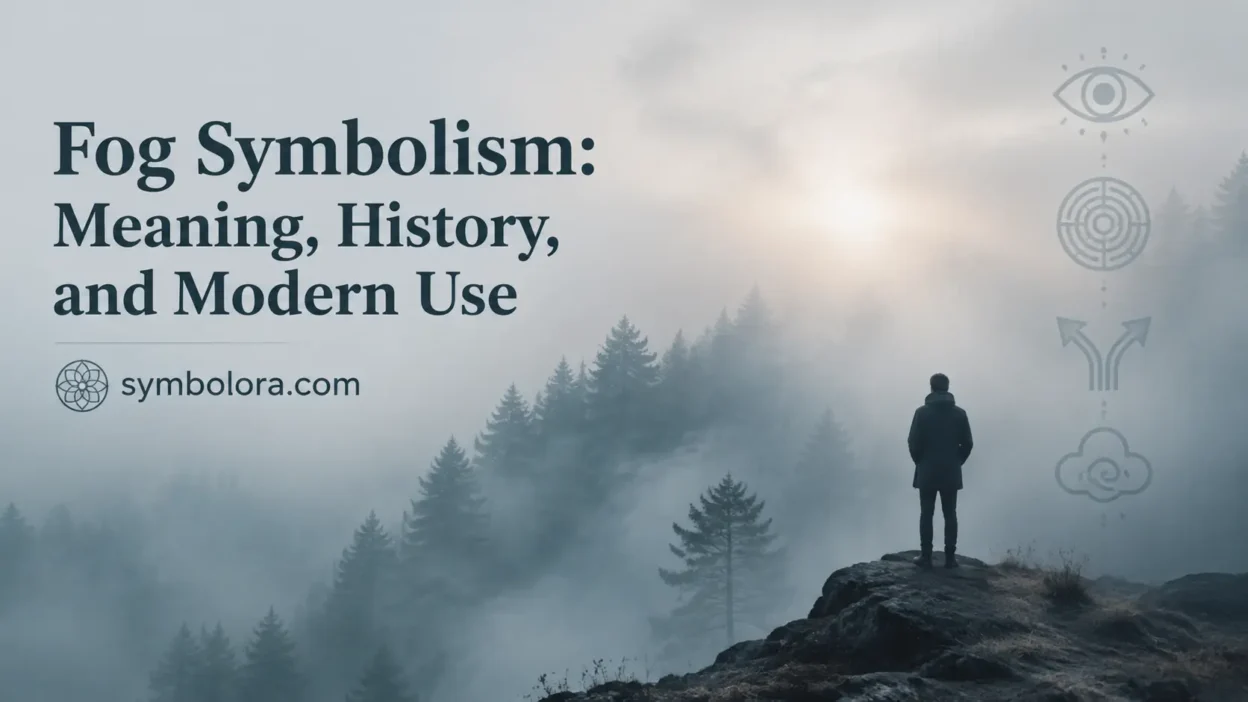
Fog is ordinary weather with an unusual effect on perception. It can erase a skyline, hide the end of a road, soften familiar buildings, and make nearby objects seem strangely distant. Because it changes what people can see without changing what is actually there, fog symbolism often develops around uncertainty, concealment, isolation, and the limits of human knowledge.
Those associations are especially familiar in American books, movies, photography, and everyday speech. A character walking into fog may be entering danger, emotional confusion, or a period when the future cannot yet be understood.
Fog does not always signal something negative, however. It can also suggest privacy, quiet, imagination, temporary separation from ordinary life, or a transitional moment before conditions become clear again.
Quick Answer
Fog symbolism commonly represents uncertainty, confusion, hidden truth, isolation, and transition in modern American culture. In literature, religion, and visual art, fog or mist can also suggest impermanence, limited human perception, secrecy, contemplation, and the boundary between what is visible and what remains unknown.
TL;DR
- Fog most often represents uncertainty and limited perception.
- Hidden landscapes make it a natural image for secrets.
- American horror frequently connects fog with unseen danger.
- Religious mist imagery can emphasize life’s temporary nature.
- East Asian art often uses mist to shape partial visibility.
- Clearing fog can represent renewed understanding or direction.
What Fog Is and Why It Becomes Symbolic
Fog consists of tiny water droplets suspended near Earth’s surface. Unlike an ordinary cloud high overhead, it surrounds people at ground level and reduces how far they can see.
That physical experience explains much of its symbolic usefulness.
A mountain does not disappear when fog covers it. A road still continues beyond the visible stretch. A person standing farther away still exists even when the viewer cannot see them clearly. Fog therefore creates a gap between reality and perception.
Writers and artists can use that gap to represent situations in which the truth exists but cannot yet be understood. The problem is not necessarily that there is no answer. The answer may simply be hidden.
This makes fog different from darkness. Darkness usually removes visible information through lack of light. Fog allows light to remain while interfering with distance and definition. Symbolically, that distinction often makes fog better suited to ambiguity than complete ignorance.
What It Commonly Means in the United States
For American readers and viewers, fog usually suggests some combination of uncertainty, confusion, mystery, isolation, and concealed danger.
Everyday English reinforces these associations. A person can describe being “in a fog” when feeling mentally confused or unable to think clearly. Dictionaries recognize this figurative sense alongside the weather meaning.
The basic symbolic pattern can be summarized this way:
| Context | Common Meaning in the USA | Typical Association | Tone |
|---|---|---|---|
| Road or journey | Uncertain future | Limited direction | Cautious |
| Hidden landscape | Mystery or secrecy | Unseen information | Ambiguous |
| Horror scene | Unknown danger | Threat beyond sight | Negative |
| Solitary figure | Emotional distance | Isolation or grief | Somber |
| Fog lifting | Understanding | Truth becoming visible | Hopeful |
The surrounding scene matters. Morning fog over a peaceful lake communicates something different from heavy fog covering an abandoned highway.
For that reason, fog should usually be interpreted as a condition affecting another symbol, rather than as an object with one fixed meaning.
Uncertainty and the Limits of Knowledge
Uncertainty is probably fog’s clearest modern symbolic meaning.
When visibility drops, people must move without knowing exactly what lies ahead. A driver slows down. A hiker checks the trail. A person near the coast may hear something before seeing where it came from.
The same structure works metaphorically.
A character facing an uncertain career, troubled relationship, unresolved diagnosis, or difficult decision can be described as moving through fog because the next stage exists but cannot yet be evaluated clearly.
This symbolism is especially effective when a story refuses to give characters complete information. Fog makes that limitation visible.
It can therefore represent the difference between not knowing and knowing that something is there but being unable to identify it yet.
Concealment, Secrets, and Hidden Truth
Fog also works as a veil.
People, buildings, roads, mountains, and even entire landscapes can remain physically present while disappearing from view. That makes fog a useful symbol for information that has been obscured rather than destroyed.
In mystery stories, it may surround a secret.
In psychological fiction, it can suggest denial: a person senses the truth but avoids seeing it clearly.
In family dramas, the image can represent things people refuse to discuss. The facts remain nearby, yet the characters keep one another at an emotional distance.
This symbolic use becomes particularly effective when the fog eventually clears. The change in weather can parallel disclosure, recognition, confession, or the discovery of something that had always been present.
Transition, Thresholds, and Uncertain Change
Fog often appears between recognizable states.
It commonly forms or becomes noticeable during particular combinations of changing temperature and moisture. Visually, it can also transform a familiar environment into a temporary version of itself.
That quality makes it useful for representing transition.
A person entering fog may be leaving an understandable situation without yet arriving at the next one. This can symbolize adolescence, relocation, grief, separation, personal reinvention, or any period in which an old identity no longer fits but a new one has not fully formed.
The important idea is not necessarily transformation itself. Fog represents the unclear interval during transformation.
That is why it works well in journey imagery. The road continues, but the traveler cannot see very far ahead.
Isolation and Emotional Distance
Dense fog can reduce the visible world to only a few yards.
That experience easily becomes a metaphor for isolation. A person may be surrounded by a larger world while feeling confined to a small psychological space.
American playwright Eugene O’Neill used fog prominently in Long Day’s Journey into Night, where critics have long connected it with withdrawal, confused relationships, isolation, and attempts to escape painful reality.
The image works because emotional withdrawal often resembles reduced visibility. People can occupy the same house, family, or relationship while no longer seeing one another clearly.
Fog can therefore symbolize loneliness without literal physical separation.
It may also represent emotional self-protection. Hiding inside metaphorical fog can feel safer than confronting a painful truth.
Why Fog Works So Well in American Horror
Horror relies heavily on the difference between what an audience knows and what it suspects.
Fog creates that difference naturally.
A monster shown clearly can be evaluated. Its size, location, movement, and appearance become known. A threat hidden twenty feet away in thick fog gives the imagination far more room to work.
American horror has repeatedly used this effect. John Carpenter’s The Fog turns an advancing coastal fog into the carrier of supernatural danger, while Stephen King’s The Mist and its screen adaptation place ordinary people behind a barrier that hides terrifying threats outside.
The symbolic meaning goes beyond monsters.
Fog can represent fear of consequences that have not yet arrived, danger produced by the past, social panic, or the unsettling realization that people may behave unpredictably when reliable information disappears.
In that sense, fog does not merely hide the frightening thing. Not being able to see clearly becomes part of the fear itself.
Fog in American Poetry and Drama
American literature has also used fog without turning it into outright horror.
Carl Sandburg’s famous short poem Fog, published in Chicago Poems in 1916, presents the weather as something that arrives quietly, watches the harbor and city, and moves away. His comparison gives fog an almost animal-like presence without making it explicitly evil.
That treatment highlights another quality: quiet movement.
Fog can enter unnoticed, alter an environment, and disappear without explanation. As a literary device, it may therefore suggest forces that influence human experience without announcing themselves.
O’Neill uses it differently. In his family drama, fog becomes closely connected with emotional withdrawal and the desire to escape painful awareness.
Together, these examples show why no single literary interpretation should be treated as universal. One writer may make fog gentle and observant; another may make it psychologically suffocating.
Spiritual and Biblical Meanings
Fog itself does not have one universal Christian meaning, and it should not be treated as a fixed biblical code.
However, mist and vapor appear in biblical imagery in ways that influence later symbolic interpretations.
James 4:14 compares human life to something briefly visible that soon disappears. English translations variously use terms such as mist, vapor, or morning fog. The point is human mortality and the uncertainty of tomorrow, rather than a supernatural message hidden in weather.
Other biblical passages include clouds, mist, storms, and obscured vision in different contexts, so these images cannot all be assigned the same meaning.
For modern Christian interpretation, fog may therefore serve as a personal metaphor for temporary life, incomplete knowledge, dependence on faith, or uncertainty about what comes next. Those meanings come from context rather than from the idea that encountering real fog predicts an event.
Mist and Partial Visibility in East Asian Art
Fog and mist have important visual roles in several East Asian artistic traditions, but their meaning should not be reduced to a single spiritual definition.
Chinese and Korean landscape painting developed sophisticated ways of using clouds and mist to create depth, separation, atmosphere, and shifting relationships between visible and obscured forms. Museum collections preserve numerous landscapes in which mountains emerge from or disappear into mist.
Japanese art also uses partial visibility to strong effect. Traditional discussions of yūgen, an aesthetic idea involving subtle suggestion and what cannot be completely expressed, sometimes use images such as fog-covered landscapes and disappearing paths to illustrate the relationship between the seen and unseen.
That does not mean “fog equals yūgen” in every Japanese artwork.
Instead, mist can help create an aesthetic experience in which incomplete visibility invites contemplation. What is omitted or obscured becomes as important as what the viewer can see.
Fog, Romantic Art, and the Sublime
European Romantic art gave mist and clouds another influential set of associations.
Artists including Caspar David Friedrich used mountains, clouds, and fog to contrast human scale with enormous natural environments. In works such as Wanderer above the Sea of Fog, the viewer encounters both solid landscape and shifting atmosphere. Modern museum interpretation connects Friedrich’s mountain imagery with the Romantic sublime: a mixture of beauty, danger, awe, and human smallness before nature.
Fog contributes something important to that experience.
It hides the lower landscape while revealing distant peaks. The viewer sees enough to recognize the world but not enough to master it visually.
It can therefore communicate humility and limitation rather than simple confusion.
A person looking across fog-covered mountains may appear uncertain, but they can also seem contemplative—aware that the world extends beyond what one viewpoint can reveal.
Psychological Meaning: Confusion, Grief, and Detachment
Modern language frequently turns fog into a description of mental experience.
Confusion, fatigue, shock, and emotional overload can all make thinking feel less precise. The familiar expression “in a fog” reflects this association between reduced physical visibility and reduced mental clarity.
Symbolically, the image works particularly well for grief.
Grief does not always feel like dramatic sadness. It may involve detachment, altered concentration, disrupted routines, or a sense that ordinary surroundings have become strangely distant.
Fog can visually communicate that altered relationship with the world.
It is also useful for portraying indecision. Someone may know that action is necessary but feel unable to see which direction is safest.
Importantly, this is metaphorical language. A fog image in art or a dream should not be treated as evidence of a psychological disorder.
Positive Meanings: Quiet, Privacy, and Possibility
Because so much fiction uses fog for danger, its positive associations are sometimes overlooked.
Fog can quiet a landscape.
Distant distractions disappear. Colors become muted. Familiar surroundings may feel temporarily private. In photography and painting, this can create simplicity rather than fear.
Fog may therefore suggest solitude chosen willingly instead of loneliness imposed on someone.
It can also represent possibility. When the distance is hidden, the future has not yet been visually defined. For some people, that uncertainty feels threatening; for others, it creates room for imagination.
A clearing fog strengthens the positive reading. Gradually returning visibility can represent recovering confidence, understanding a problem, emerging from grief, or discovering a direction after uncertainty.
Tattoos, Photography, Decor, and Digital Culture
Fog rarely appears as a tattoo symbol completely by itself. More often, it surrounds another image.
A foggy forest may communicate uncertainty, solitude, wilderness, or an attraction to atmospheric imagery. Mountains emerging through mist can suggest perspective, endurance, or a destination that remains partly hidden. A road disappearing into fog may represent an unknown future.
In photography, fog simplifies complicated environments by reducing distant detail. That makes it popular for forests, mountains, streets, bridges, coastlines, and minimalist landscapes.
Interior art uses similar imagery for a quieter effect. Mist-covered trees or mountains can create visual softness without requiring the viewer to interpret the picture as sad or ominous.
On social media, foggy landscapes often support reflective, eerie, cinematic, or melancholy moods. The meaning comes from the full composition—the color, location, caption, lighting, and subject—not from the weather alone.
Common Misunderstandings About Fog
One common mistake is treating fog as a universal warning of death or disaster.
Folklore, horror, dreams, and fictional storytelling can certainly connect it with danger, but ordinary fog has no predictive symbolic power.
Another mistake is assuming all cultures interpret it identically.
Japanese landscape aesthetics, biblical mist imagery, American horror, Romantic painting, and modern psychological metaphors developed in different settings. Similar visual features may produce overlapping ideas, but those traditions should not be collapsed into a single ancient doctrine.
It is also misleading to claim that fog always represents negativity.
Context can shift it toward privacy, contemplation, impermanence, imagination, or the gradual arrival of understanding.
The strongest interpretation usually asks a simple question: What is the fog doing in this particular scene? Is it hiding something, separating people, changing a familiar place, or beginning to clear?
How the Meaning Has Changed Over Time
Fog did not acquire one meaning at one moment.
Its symbolic history developed from repeated human experiences with obscured vision and temporary atmosphere. Religious texts could use mist to express life’s brevity. Landscape artists could use it to organize visible and invisible space. Romantic painters could place it between the observer and overwhelming nature.
American poets and dramatists later adapted the image to urban observation, memory, alienation, and troubled relationships. Horror fiction and film emphasized what might be hiding beyond the visible boundary.
Contemporary usage keeps all of those possibilities available.
Today, fog may indicate mental confusion in ordinary speech, threat in horror, peaceful solitude in photography, or uncertainty in personal art.
What remains consistent is its relationship with incomplete perception. People know a larger reality exists, but they cannot see all of it at once.
Frequently Asked Questions
Is fog a positive or negative symbol?
It can be either. Heavy fog hiding danger usually carries negative associations, while mist clearing from a landscape can suggest understanding, renewal, privacy, or peaceful solitude.
What does fog represent spiritually?
Spiritual interpretations often connect fog with limited knowledge, impermanence, contemplation, or uncertainty during a period of change. Christianity does not assign ordinary fog one fixed supernatural meaning, although biblical mist imagery can emphasize life’s brevity.
What does a fog tattoo mean?
A fog tattoo may represent uncertainty, mystery, solitude, transition, or an unknown future. Its meaning depends strongly on accompanying images such as mountains, forests, roads, figures, or water.
Why is fog associated with mystery?
Fog allows nearby reality to remain present while hiding its details. That creates uncertainty about people, objects, or dangers beyond the visible area, making it naturally useful in mystery and suspense.
Does fog symbolize death?
Fog can accompany death imagery in horror or mourning art, but death is not its universal meaning. It more commonly represents obscurity, uncertainty, separation, impermanence, or something temporarily hidden.
What does clearing fog symbolize?
Clearing fog commonly suggests returning clarity. In a story or artwork, it can mark recognition, recovered direction, emotional improvement, disclosure of a secret, or the end of uncertainty.
Conclusion
Fog has become such an effective symbol because its physical behavior already resembles several human experiences: we lose distance, familiar shapes become uncertain, and things we know are present slip temporarily from view.
Across American literature, horror, everyday language, religious imagery, and global visual traditions, fog symbolism most consistently centers on limited perception, uncertainty, concealment, emotional distance, and transition. Yet it can also represent contemplation, privacy, impermanence, and the possibility that greater clarity will eventually return.
Fog does not necessarily mean that something terrible lies ahead. Sometimes its most fitting message is simpler: the path still exists even when you cannot see very far down it.


