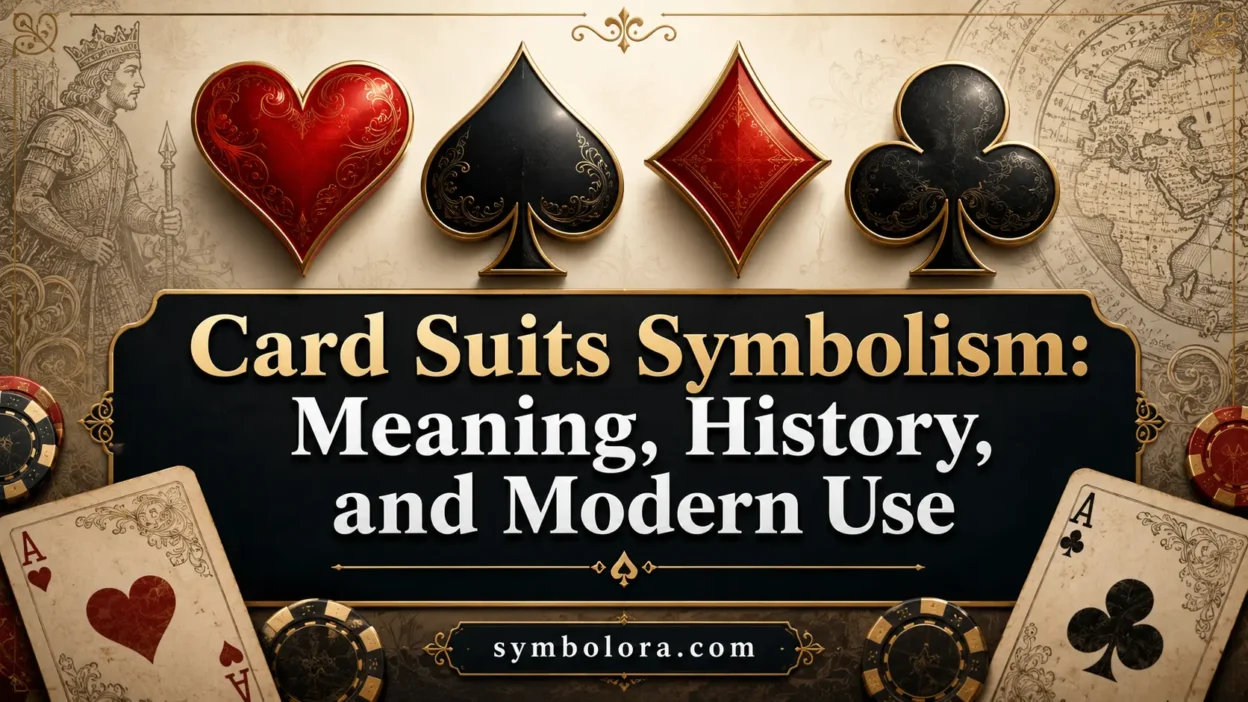
A standard deck of playing cards looks ordinary, yet its four familiar shapes carry associations far beyond the games printed cards were designed to play. Card suits symbolism commonly connects hearts with love, diamonds with wealth, clubs with action or effort, and spades with challenge, power, or mortality.
Those meanings are not one ancient system preserved unchanged for centuries. The familiar suits developed in late medieval France from earlier European card traditions, while many of the meanings Americans recognize today grew through card games, fortune-telling, art, military imagery, tattoos, and popular culture.
Understanding that distinction matters. A heart already carries a strong emotional meaning outside playing cards, while a diamond suggests value because of its connection with gemstones and wealth. Clubs and spades require more context, and their interpretations vary considerably between games, cartomancy, design, and personal symbolism.
Quick Answer
Card suits symbolism commonly represents four areas of life in modern American interpretation: hearts suggest love and emotion, diamonds suggest wealth and value, clubs suggest action and effort, and spades suggest challenge, intellect, power, or endings. Historically, however, the four symbols began as practical French playing-card suits rather than a proven symbolic code.
TL;DR
- Hearts commonly represent love, relationships, compassion, and emotional life.
- Diamonds suggest money, value, ambition, luxury, and material success.
- Clubs often symbolize action, work, growth, effort, or conflict.
- Spades can represent intellect, adversity, power, endings, or mortality.
- Modern meanings developed after the suits themselves were created.
- No universal symbolic system governs every game, tattoo, or card reading.
What the Four Card Suits Actually Are
The modern American deck normally contains four suits: hearts ♥, diamonds ♦, clubs ♣, and spades ♠. Hearts and diamonds are traditionally printed in red, while clubs and spades appear in black.
Each suit contains thirteen ranks in a standard 52-card deck. The visual system is so familiar in the United States that the symbols appear outside card games on clothing, jewelry, casino signs, tattoos, logos, graphics, emojis, and decorative objects.
The American deck belongs to the French-suited card tradition. France developed the recognizable suits called cœurs for hearts, carreaux for tiles or diamonds, trèfles for clovers or clubs, and piques for pikes or spades. These designs became internationally dominant partly because their simple shapes were easier to reproduce than many elaborate earlier suit symbols.
| Suit | Common Modern U.S. Meaning | Frequent Associations | Important Note |
|---|---|---|---|
| ♥ Hearts | Love and emotion | Romance, family, compassion | Strongly influenced by the heart symbol itself |
| ♦ Diamonds | Value and material success | Money, status, ambition | Often linked with wealth and possessions |
| ♣ Clubs | Action and effort | Work, growth, struggle, initiative | Meaning varies strongly by system |
| ♠ Spades | Challenge and power | Intellect, conflict, endings, death | Especially intense around the Ace of Spades |
What the Four Suits Commonly Mean in the United States
When Americans interpret the suits symbolically rather than simply as game categories, they often treat them as four contrasting areas of experience.
Hearts concern feelings and relationships. Diamonds concern material value and achievement. Clubs tend to suggest activity, effort, work, or forward movement. Spades often carry the most serious associations, including hardship, mental strength, conflict, death, or transformation.
These interpretations are especially common in modern cartomancy and symbolic design. They should not be treated as official definitions. Different card-reading traditions assign somewhat different meanings, and games themselves often give suits no symbolic meaning at all. Contemporary cartomancy sources, for example, consistently associate hearts with relationships and diamonds with finances, while interpretations of clubs and spades vary more widely.
How the Familiar Suits Developed
Playing cards were present in Europe by the late 1300s, but early European decks did not all use the same suit signs. Different regions developed distinct systems.
Italian and Spanish traditions became associated with cups, coins, swords, and batons or clubs. German decks used symbols such as hearts, bells, leaves, and acorns. French cardmakers eventually developed the much simpler system that became hearts, diamonds, clubs, and spades.
The familiar French signs appeared around the late fifteenth century. Their simplicity mattered commercially: shapes that could be reproduced quickly with stencils made card production less expensive and more efficient. French suits then spread widely, eventually becoming the standard familiar to English and American players.
This history makes one point especially important: there is little basis for treating the modern symbolic meanings as the original purpose of the suits. The shapes came first as part of an evolving card-design tradition. Later cultures layered additional meanings onto them.
Hearts: Love, Emotion, and Human Connection
Among the four suits, hearts have the least ambiguous symbolism for most Americans.
The heart shape already functions as an independent sign of love, affection, compassion, romance, emotional attachment, and care. Seeing the same shape on a playing card naturally carries those associations into the deck.
In card reading, hearts commonly relate to relationships, home life, friendship, emotional fulfillment, family, reconciliation, and affection. A positive heart card may therefore suggest connection or emotional satisfaction, while a difficult combination may be interpreted as disappointment, jealousy, separation, or vulnerability.
Outside divination, a heart card can communicate warmth or romantic luck. The Ace of Hearts in particular is sometimes used visually to represent a new relationship, emotional beginning, or wholehearted commitment.
The suit does not always mean romantic love. Depending on context, it can represent loyalty to family, friendship, kindness, empathy, or simply choosing emotion over calculation.
Diamonds: Wealth, Value, and Ambition
Diamonds usually carry the clearest material association.
In modern American culture, diamonds are closely connected with money, luxury, valuable possessions, success, status, engagement jewelry, and high social value. The card symbol is technically derived from the French carreau, meaning a tile or square-shaped object, rather than from a literal gemstone. Over time, however, the English name “diamond” encouraged a much stronger association with wealth.
For that reason, diamonds in symbolic readings often concern finances, business, possessions, employment, transactions, achievement, or practical opportunities.
The suit can express aspiration as well as wealth. A diamond image in fashion or tattoo design may communicate ambition, success, independence, expensive taste, or the desire to create something valuable.
There is also a less flattering side. Because material value can become excess, diamonds can sometimes suggest greed, status anxiety, superficiality, or judging worth mainly through money.
Context determines which interpretation fits.
Clubs: Action, Work, Effort, and Growth
Clubs are less immediately symbolic to modern Americans because the ♣ shape does not resemble what English speakers normally picture when hearing the word “club.”
Its French name, trèfle, means clover. The shape is therefore closer to a stylized three-leaf plant than to a wooden weapon. The symbol appears to have developed partly from earlier European suit forms rather than from a literal modern club.
Modern symbolic systems frequently connect clubs with activity, initiative, labor, creativity, effort, competition, and growth. In cartomancy systems that compare ordinary playing cards with tarot, clubs are often paired with wands or batons, encouraging associations with fire, movement, will, and creative action.
That makes clubs a natural symbol for getting things done rather than merely thinking or feeling.
Their symbolism can also include conflict. Effort means confronting resistance, competing, practicing, building, or defending a position. As a result, clubs may suggest productive work in one interpretation and struggle in another.
Spades: Challenge, Intellect, Power, and Mortality
Spades have acquired the darkest symbolic reputation of the four suits.
In modern readings they are frequently associated with obstacles, difficult decisions, mental pressure, conflict, authority, endings, danger, or death. Some systems also emphasize intellect and truth because spades are commonly paired with the sword suit of tarot.
The history of the name is more complicated than the modern garden-tool image suggests. The French suit is pique, meaning a pike or pointed weapon, while the English name “spade” is historically connected with older sword-suit terminology. The result is a symbol that visually and linguistically accumulated associations with sharpness, weapons, labor, and death.
No card demonstrates this better than the Ace of Spades.
In American and Western imagery, that card has become associated with danger, death, military toughness, rebellion, and high-stakes risk. During the Vietnam War, some U.S. troops deliberately used Ace of Spades cards as psychological-warfare imagery because Americans believed the card would frighten enemy soldiers. Contemporary records confirm the practice, although the belief that the card possessed a universal Vietnamese meaning was culturally questionable.
That episode shows how symbolism can be created or intensified through use rather than inherited unchanged from ancient tradition.
Why Red and Black Change the Emotional Tone
The two-color structure of modern cards adds another symbolic layer.
Red suits — hearts and diamonds — often appear warmer and more favorable. They can suggest affection, vitality, pleasure, attraction, abundance, or opportunity.
Black suits — clubs and spades — tend to appear more serious. In symbolic readings they may suggest effort, uncertainty, authority, conflict, obstacles, or consequences.
This contrast is partly psychological. Red naturally attracts attention and is widely associated with blood, passion, heat, and urgency. Black can suggest formality, strength, mourning, danger, or the unknown.
Yet card color should not be treated as a fixed moral division between “good” and “bad.” A black card can represent discipline or intellectual strength, while a red card can represent jealousy, financial obsession, or emotional turmoil.
How Cartomancy Changed Suit Meanings
Cartomancy is the practice of using cards for divination. It played a major role in turning ordinary suits into categories of human experience.
One widely used modern correspondence pairs:
- Hearts with Cups — feelings and relationships
- Diamonds with Coins or Pentacles — money and material matters
- Clubs with Wands or Batons — activity and creative will
- Spades with Swords — thought, conflict, decisions, and difficulty
Such correspondences help explain why contemporary symbolism often divides life into emotional, material, active, and intellectual or challenging domains.
However, this system should not be projected backward as the historical origin of French suit design. Playing cards and tarot evolved through overlapping European traditions, and divinatory interpretations came later. The earliest tarot cards themselves were produced primarily for games rather than fortune-telling.
Modern readers may use the system meaningfully, but its significance is interpretive rather than scientifically established.
What Suits Mean in American Card and Casino Culture
For many Americans, card suits first suggest chance, competition, strategy, gambling, and risk rather than spirituality.
Poker imagery is especially influential. A cluster of cards on a shirt, casino logo, motorcycle graphic, tattoo, or poster can suggest confidence under pressure, willingness to take risks, or the idea that life depends partly on how well a person plays the hand they receive.
Importantly, poker does not generally establish a permanent symbolic hierarchy in which one suit is inherently superior to another. Suit ranking depends on the game. Some games rank suits for specific purposes, while others treat them equally.
This matters when interpreting designs. A spade is not automatically “better” than a heart because it may rank higher in a particular game rule.
In broader American imagery, the entire deck can symbolize uncertainty: everyone receives circumstances they did not completely choose, yet skill still affects what happens next.
Tattoos, Jewelry, Fashion, and Personal Identity
Card suits work particularly well in personal design because each shape is compact and instantly recognizable.
A heart tattoo may emphasize love, loyalty, family, or emotional openness. A diamond may represent ambition, financial independence, endurance, or personal worth. Clubs can suggest persistence, action, and resilience. Spades often project toughness, risk, mortality, rebellion, or a willingness to confront difficult experiences.
A tattoo containing all four suits may mean something broader: a love of cards, gambling culture, acceptance of chance, a complete range of human experience, or simply appreciation of playing-card design.
There is no universal tattoo dictionary. The same spade tattoo can mean gambling to one person, military identity to another, and nothing more than visual style to someone else.
That caution is especially important with claims that particular suit symbols always indicate criminal, prison, sexual, or gang affiliations. Meanings can vary by place and subculture, so assumptions based on a symbol alone are unreliable.
Card Suits in Art, Media, and Digital Culture
The suits have become a visual vocabulary.
Film and advertising often use hearts to signal romance, diamonds to suggest luxury, and spades to create a darker or more dangerous mood. Casino-themed imagery combines all four to represent gambling and probability.
Designers can also exploit contrasts within the deck. A heart beside a spade may represent love versus death, emotion versus logic, tenderness versus hardness, or attachment versus separation.
Digital culture makes the symbols even easier to reuse. Unicode versions of ♥ ♦ ♣ ♠ can appear in usernames, captions, gaming identities, profile designs, and decorative text without any connection to an actual card game.
Their meaning in those settings is usually chosen by the user rather than imposed by tradition.
Different Cultures Use Different Suit Systems
The French four-suit deck is internationally widespread, but it is not the only traditional card system.
Italian and Spanish decks commonly preserve variations of cups, swords, coins, and batons. Traditional German decks may use hearts, bells, leaves, and acorns. Swiss traditions have their own regional suit patterns as well.
That diversity makes sweeping claims about “the ancient meaning of the four card suits” unreliable.
Even within Europe, card symbols changed according to region, manufacturing methods, local games, and artistic convention. The French system eventually became especially influential in Britain and the United States, helping the hearts-diamonds-clubs-spades design become globally recognizable.
Cross-cultural comparison therefore shows that suit symbolism is partly inherited and partly constructed.
The Four Social Classes Theory
One of the most repeated stories claims that the suits were deliberately designed to represent four medieval social classes.
Versions of the story usually assign hearts to clergy, spades to nobility or warriors, diamonds to merchants, and clubs to peasants or farmers.
It is an appealing interpretation because older European suit objects — swords, coins, cups, and batons — can easily be connected with social occupations. But card historians do not treat this neat four-class scheme as securely established evidence for why the French suits were created. Historical card systems were far less uniform than the story suggests.
The safest way to present the class theory is as later symbolism or folklore rather than proven design history.
It can still be meaningful as an interpretation. It simply should not be confused with documented origin.
Do the Four Suits Represent the Four Seasons?
Another popular claim says the deck is a calendar in disguise.
According to this interpretation, four suits represent four seasons, 52 cards represent 52 weeks, and thirteen cards per suit correspond to the approximate number of weeks in each season. Other versions assign meaning to the twelve face cards or the numerical total of the deck.
The arithmetic is memorable, but historians generally regard the calendar explanation as later folklore, not the reason the deck was originally structured this way. European decks historically appeared with different numbers of cards, court structures, and suit systems, which undermines the idea of a single planned calendar code.
The calendar reading can still function as modern symbolic storytelling. It just should not be presented as settled historical fact.
How the Meaning of Card Suits Evolved
The history of card suits shows how symbols acquire meaning in layers.
Their earliest purpose was practical: distinguish groups of cards so games could function. Regional cardmakers developed different visual systems, and French manufacturers created particularly simple suit signs that became commercially successful.
Once those designs became familiar, people began reading additional ideas into them.
The heart already suggested affection. The English word “diamond” encouraged associations with wealth. Older weapon and sword connections reinforced the severity of spades. Cartomancy organized the four suits into categories of emotional, material, active, and intellectual experience. Gambling culture added chance and risk. Military and entertainment imagery further strengthened the darker reputation of certain cards.
Modern symbolism is therefore cumulative.
The suits mean what they do today not because one designer assigned four eternal definitions, but because centuries of games, language, folklore, visual culture, and personal interpretation built associations around four simple shapes.
Frequently Asked Questions
What do the four card suits symbolize?
Hearts usually symbolize love and emotion, diamonds material value and success, clubs action and effort, and spades challenge, intellect, power, or endings. These are common modern interpretations rather than universal historical definitions.
What does a four-suit tattoo mean?
A tattoo containing all four suits can represent gambling, chance, risk, balance, or the many sides of life. Personal meaning matters most, so the design should not automatically be assigned one fixed interpretation.
Which card suit symbolizes love?
Hearts are the clearest symbol of love because the heart shape already represents affection and emotional attachment in Western culture. Within card readings, the suit can also include family bonds, friendship, compassion, and home life.
Which card suit represents money?
Diamonds are most commonly connected with money, possessions, business, value, and material achievement. The association is especially natural in English because the suit shares its name with a valuable gemstone.
Why are spades associated with death?
Spades accumulated associations with weapons, conflict, difficulty, dark coloring, and later cartomantic ideas involving endings or hardship. The Ace of Spades became particularly connected with death imagery through military and popular culture, including its use by some U.S. troops during the Vietnam War.
Are card-suit meanings the same as tarot suits?
Not exactly. Modern readers often pair hearts with cups, diamonds with coins or pentacles, clubs with wands, and spades with swords, but these are interpretive correspondences between related card traditions rather than proof that the French suits were designed from tarot symbolism.
Do card suits really represent medieval social classes?
The idea is widely repeated, but it is better treated as a symbolic theory or legend than established historical fact. Actual European suit systems changed considerably between regions, and the familiar French symbols were strongly shaped by practical cardmaking concerns.
Conclusion
Card suits symbolism works best when understood as an evolving cultural language rather than a secret code built into the first deck. Hearts now speak most naturally about emotion, diamonds about material value, clubs about effort and activity, and spades about difficulty, intellect, power, or mortality.
Those meanings grew from several sources: the shapes themselves, older European card traditions, English suit names, fortune-telling systems, gambling culture, warfare, art, and personal design.
A card suit can therefore carry real symbolic weight without having one permanent definition. Its meaning comes from the history attached to the symbol, the setting in which it appears, and what the person using it intends to communicate.


