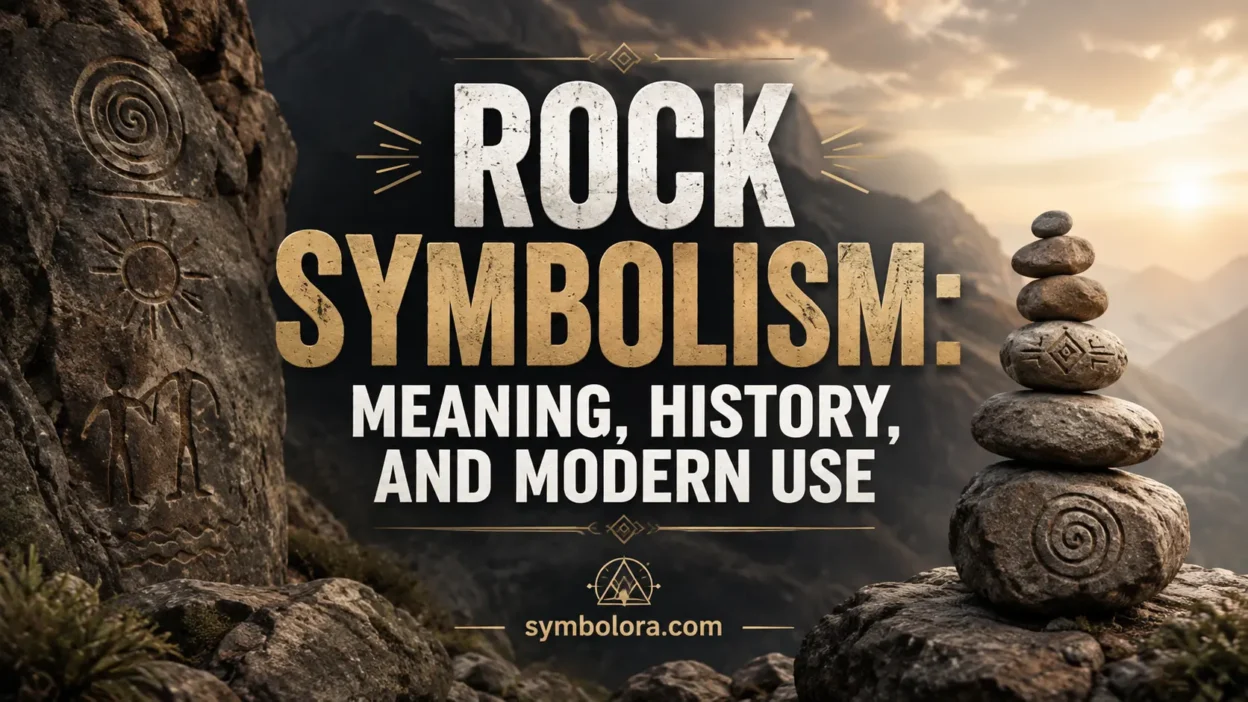
Rocks are ordinary parts of the landscape, yet people often use them to express ideas that are much larger than the objects themselves. Rock symbolism commonly centers on strength, stability, endurance, protection, and a firm foundation. Those associations make sense because rocks appear solid, resist weather, and can remain in place far longer than a human lifetime.
Still, a rock does not carry one universal message. A boulder in a memorial, a stone in a religious story, a cairn on a hiking trail, and a small rock kept as a personal reminder can communicate very different things.
In the United States, rock imagery appears in religious language, memorial architecture, tattoos, home decor, outdoor culture, family metaphors, and everyday expressions such as “rock-solid” and “my rock.” Understanding the symbol means looking at both its physical qualities and the cultural traditions that gave those qualities meaning.
Quick Answer
Rock symbolism most commonly represents strength, stability, endurance, dependability, and a secure foundation in modern American culture. Historically, rocks and stones have also represented sacred presence, permanence, memory, protection, mountains, ancestors, and spiritual or moral foundations in different traditions.
TL;DR
- Rocks commonly represent strength, stability, endurance, and reliability.
- Religious traditions often connect rock imagery with faith and protection.
- Memorial stones can represent memory, permanence, and public remembrance.
- American language uses rocks as metaphors for dependable people and foundations.
- Cairns may be trail markers, not universal spiritual symbols.
- Modern tattoos often use rocks to express resilience or grounded identity.
What a Rock Is and Why Its Physical Nature Matters
In geological terms, a rock is a naturally occurring mass made from one or more minerals or related mineral material. Granite, basalt, limestone, and sandstone are familiar examples.
That physical reality helps explain many symbolic associations.
A rock feels solid. It can support weight. Large formations survive storms, heat, cold, erosion, and generations of human activity. Unlike flowers or leaves, rocks do not visibly grow and die on a human timescale.
These characteristics naturally lend themselves to metaphors of firmness and endurance.
At the same time, rocks can break, erode, move, or be reshaped. That makes them useful symbols not only of permanence but also of gradual transformation. A smooth river stone, for example, can suggest how persistent pressure changes something without destroying its basic identity.
What Rocks Commonly Mean in the United States
For many Americans, the strongest symbolic association is reliability.
Calling someone “a rock” usually means that person can be depended on during difficult circumstances. The expression does not imply that the person is literally hard or emotionless. Instead, it presents them as stable when everything around them feels uncertain.
Several related meanings follow from that basic idea:
| Context | Meaning in the USA | Common Associations | Notes |
|---|---|---|---|
| Personal relationships | Dependability | Loyalty, support, trust | “My rock” describes a reliable person |
| Religion | Secure faith | God, foundation, protection | Especially familiar in Christianity |
| Memorials | Permanence | Memory, legacy, respect | Stone survives longer than many materials |
| Tattoos | Resilience | Strength, survival, stability | Meaning depends on the design |
| Nature imagery | Grounding | Wilderness, stillness, endurance | Common in outdoor and wellness imagery |
| Obstacles | Difficulty | Hardship, resistance, limitation | Rocks can also symbolize barriers |
This range matters because the object can express either security or obstruction. Context decides which meaning is intended.
Why Rocks Represent Strength and Endurance
The connection between rocks and strength is largely based on observation rather than a single ancient symbolic system.
A cliff remains after a storm. A boulder can seem immovable. Stone can form the foundation of a building. Even when erosion changes a rock, the process may take years, centuries, or much longer.
Because of these qualities, rock imagery works especially well when someone wants to communicate survival.
A person who has endured grief, financial hardship, illness in a family, a difficult childhood, or another major challenge may choose a rock image as a private reminder: hardship applied pressure, but the person remained standing.
This does not mean that rocks always signify toughness in an aggressive sense. More often, their symbolism suggests quiet durability—the ability to remain steady without needing to appear dramatic.
Rocks as Symbols of Stability and Foundation
The foundation meaning is especially important because rock is not simply hard; it is something people have historically built upon.
That connection survives strongly in everyday American English.
“Rock-solid” means extremely reliable. “Bedrock” can describe the essential foundation of an idea, institution, belief, or relationship. Someone described as the “rock of the family” is the person others depend on.
The opposite image is instability: weak ground, shifting sand, or something without a firm base.
This contrast helps explain why rock imagery appears so often in discussions of trust, commitment, leadership, faith, marriage, and personal principles. A rock represents something expected to remain dependable while other conditions change.
Rock Imagery in Christianity and the Bible
Rock imagery has an especially recognizable place in Jewish and Christian scripture.
In the Hebrew Bible, God is repeatedly described through rock imagery connected with faithfulness, protection, justice, and security. Deuteronomy 32, for example, uses “Rock” as a title for God and connects it with reliability and righteousness.
The New Testament develops foundation imagery as well. In Matthew 7, Jesus compares a person who hears and follows his teachings to someone who builds a house on rock rather than unstable ground. The point is not the material itself but the security produced by a trustworthy foundation.
Matthew 16 also uses the language of Peter and rock in connection with the church, a passage that has received different theological interpretations within Christianity.
Because biblical language has had a major influence on American culture, these associations continue to appear in church names, hymns, memorial inscriptions, religious artwork, jewelry, and devotional designs.
Sacred Rocks and Stones Across Cultures
Rocks should not be assigned one generic “ancient spiritual meaning.” Different cultures have understood particular stones, mountains, caves, and rock formations in their own ways.
In some Japanese religious traditions, natural features can be associated with kami, and rocks and mountains may serve as sacred natural forms rather than merely decorative objects.
Chinese artistic traditions developed another relationship with stone. Carefully selected scholar’s rocks were valued for unusual shapes, textures, and their ability to evoke the larger forces and landscapes of nature. Rock arrangements in traditional Chinese gardens can suggest mountains and caves in miniature.
Large stone monuments in other parts of the world could serve ceremonial, funerary, communal, political, or religious purposes. Stonehenge, for instance, changed in meaning and function over a long history rather than representing one simple “rock symbol.”
The safest interpretation is therefore specific: particular rocks become meaningful through the traditions surrounding them.
Rocks, Memory, and Memorials
Stone has long been useful for memorials because it combines practical durability with symbolic permanence.
A name carved into stone appears intended to outlast the generation that created it. That makes stone suitable for graves, monuments, plaques, civic memorials, battlefield markers, and commemorative architecture.
American public memorials frequently make deliberate use of this association.
One clear example is the Martin Luther King, Jr. Memorial in Washington, D.C. Its design turns the relationship between a “Mountain of Despair” and a “Stone of Hope” into a physical part of the monument, using stone itself to communicate struggle, hope, and historical memory.
In a personal setting, a small stone placed beside a photograph or kept after visiting a meaningful location may serve a similar purpose on a much smaller scale. The value comes from memory attached to the object, not from the rock having a fixed meaning of its own.
Emotional and Psychological Associations
Rocks often communicate emotional steadiness.
Someone drawn to rock imagery may identify with being calm, practical, loyal, self-controlled, or difficult to shake. A stone carried in a pocket can work as a tactile reminder to stay present during a stressful moment.
This is best understood as personal symbolism rather than proof that rocks possess psychological powers.
Rock imagery can also carry a less positive emotional meaning. Describing a person as “stone-hearted” or emotionally “hard” suggests coldness, distance, or an unwillingness to respond to other people.
The same physical property—hardness—therefore creates two interpretations.
In one context, hardness means resilience.
In another, it means emotional resistance.
Rock Symbolism in Tattoos
Rock tattoos tend to communicate stability more often than literal geology.
A single boulder may represent endurance or surviving a difficult period. A rock supporting another object can emphasize foundation or responsibility. Stones combined with water may represent remaining grounded while life continues to move around them.
Cairn tattoos can carry additional meanings such as direction, milestones, balance, remembrance, or progress along a personal path.
Those meanings should be treated as modern personal interpretations rather than universal definitions. Real cairns have practical and culturally specific functions, and many were created as markers rather than spiritual objects.
Rock imagery can also be combined with mountains, trees, waves, dates, names, or religious symbols. In those designs, the surrounding elements often determine the tattoo’s meaning more clearly than the rock itself.
Rocks in Jewelry, Decor, and Personal Objects
Small stones have become common in minimalist decor, jewelry, garden design, desk displays, and keepsake collections.
In American interiors, rough stone can suggest nature, simplicity, permanence, or an outdoors-oriented lifestyle. Smooth stones often create a different impression: calmness, order, and restraint.
People also keep rocks from beaches, hikes, childhood homes, vacations, or important life events. Such objects function almost like physical bookmarks. Their symbolic value comes from the story attached to them.
Rocks should also be distinguished from crystals and gemstones. A gemstone may have a specialized cultural, commercial, birthstone, or spiritual tradition that does not automatically apply to ordinary rocks.
Claims that a particular stone can medically heal a person or scientifically alter emotions require evidence beyond symbolism. Personal ritual and cultural meaning are different from demonstrated medical effects.
Cairns and Stacked Rocks: Meaning Versus Reality
Stacks of balanced stones have become popular visual symbols online. Photographs often present them as signs of peace, balance, mindfulness, or spiritual alignment.
Historically and practically, however, rock piles can serve very different purposes.
Cairns have been used to mark routes and locations. In some protected landscapes, maintained cairns still help hikers identify trails. Building additional stacks can therefore create confusion by making unofficial piles look like legitimate navigation markers.
The issue can also involve environmental and cultural respect. National parks may instruct visitors not to move, add, remove, or stack rocks, and rules differ according to the landscape. In some locations, disturbing rocks can affect cultural resources or violate park regulations.
So a photograph of stacked stones should not automatically be interpreted as an ancient universal symbol of Zen, balance, or spirituality.
Sometimes a cairn is simply a trail marker.
Rock Imagery in American Language and Popular Culture
Everyday language reveals how strongly rocks are associated with firmness.
Calling an idea “rock-solid” suggests that it can survive scrutiny. Referring to a principle as “bedrock” means it is fundamental. Calling someone “your rock” signals trust.
Other expressions reveal the less comfortable side of the symbol.
“Rock bottom” represents the lowest point in a situation. Being “between a rock and a hard place” means facing difficult alternatives. A “rocky” relationship suggests instability or repeated problems.
These phrases seem contradictory only at first.
The rock itself remains associated with hardness. Sometimes hardness provides support; sometimes it becomes an obstacle.
That dual meaning gives rock imagery more emotional range than simple ideas of strength alone.
When a Rock Represents an Obstacle or Burden
Not every rock symbolizes security.
A rock blocking a road can represent a problem that stops progress. A heavy stone can suggest responsibility, guilt, emotional weight, or something difficult to carry.
Large cliffs and barren rocky landscapes may also communicate isolation, danger, harshness, or exposure depending on the setting.
This negative interpretation frequently appears in storytelling and visual design. A character climbing over rocks can represent struggle. Moving a boulder can suggest overcoming an apparently impossible task. Being trapped by stone can communicate restriction.
The physical characteristics have not changed. The relationship has.
A rock beneath someone provides support.
A rock in front of someone becomes an obstacle.
Rocks as Symbols of Grounding and Connection to Nature
“Grounding” is one of the most common modern meanings attached to natural stones.
In this context, the idea usually refers to feeling mentally settled, present, or connected with the physical environment. The symbolism comes partly from the fact that rocks belong literally to the ground and appear stable compared with moving water, wind, vegetation, and animals.
This meaning is especially common in wellness imagery, outdoor photography, nature-inspired interiors, meditation spaces, and personal rituals.
It does not require a supernatural interpretation.
Someone may hold a smooth stone simply because its weight and texture provide a concrete sensory focus. Another person may place a stone on a desk as a reminder to remain patient during a difficult project.
The symbolism works because the physical object reinforces the intended idea.
How the Meaning of Rocks Has Evolved
Rock meanings did not develop along one straight historical path.
Early communities encountered stones as building materials, tools, landscape features, burial materials, boundaries, landmarks, sacred locations, and artistic surfaces. Religious traditions later developed their own metaphors around foundations, sacred mountains, particular stones, caves, and enduring structures.
As permanent architecture expanded, stone also became closely connected with authority, monuments, graves, and public memory.
Modern culture added more individualized meanings.
Today, a rock may become a tattoo for resilience, a keepsake from a meaningful trip, an object used during meditation, part of a memorial garden, a symbol in a wedding ceremony, or a photograph representing balance on social media.
The shift is important. Earlier meanings were often connected with community, religion, place, or public memory. Many contemporary uses emphasize personal identity and private experience.
Common Misunderstandings About Rock Meaning
One common mistake is assuming that every stone arrangement has a spiritual purpose.
Another is treating “rock,” “stone,” “crystal,” and “gemstone” as interchangeable symbolic categories. They overlap, but their traditions are not identical.
It is also misleading to claim that every ancient culture understood rocks as symbols of strength. Some particular rocks were sacred, others were markers, tools, monuments, graves, artistic subjects, or parts of landscapes. Their meanings came from context.
A final misunderstanding involves modern rock stacking. Building a new cairn may look harmless or meaningful in a photograph, but in protected landscapes it can interfere with navigation or violate conservation guidance.
Meaning does not remove responsibility toward the place where the object is found.
Why Rock Imagery Still Feels Relevant
Modern life changes rapidly, which makes visual symbols of stability easy to understand.
A rock requires almost no explanation when it represents a reliable friend, strong principle, permanent memory, or ability to withstand hardship. Its physical qualities make the metaphor immediately recognizable.
Yet its usefulness comes from contrast as much as strength.
Water moves around stone. Plants grow beside it. Weather reshapes it. People build upon it, carve into it, climb over it, and sometimes struggle to move it.
That makes a rock capable of representing both resistance and security.
Its meaning depends on whether firmness is helping us stand or preventing us from moving.
Frequently Asked Questions
What does a rock symbolize spiritually?
A rock can represent faith, permanence, protection, sacred presence, or a stable spiritual foundation. The exact interpretation depends on the religious or cultural tradition rather than on a universal spiritual definition.
What does a rock symbolize in Christianity?
Christian rock imagery commonly represents God’s reliability, protection, faith, and a secure foundation for life. Biblical passages also use rock and foundation imagery when discussing obedience, faith, and the church.
What does a rock tattoo mean?
A rock tattoo often represents resilience, stability, endurance, or remaining grounded during change. If the design includes water, mountains, plants, names, or stacked stones, those additional elements can substantially change the meaning.
Are rocks positive symbols?
Usually, but not always. Rocks can represent dependable strength and protection, yet they can also symbolize emotional hardness, burdens, barriers, isolation, or obstacles that must be overcome.
What do stacked rocks symbolize?
Modern imagery often associates stacked rocks with balance, progress, calmness, or personal milestones. Real cairns may instead be practical route markers or culturally significant structures, so they should not automatically be treated as spiritual symbols.
Does finding a rock have a spiritual meaning?
There is no universal rule saying that finding a particular rock predicts an event or carries a fixed message. A person can still give the object personal meaning because of where it was found, what happened that day, or what the rock reminds them of.
Conclusion
Rock symbolism is centered most clearly on stability, endurance, dependable strength, foundation, and permanence. Those meanings arise largely from the physical character of stone, but religion, memorial traditions, art, landscape design, language, and personal experience have expanded the symbol far beyond simple toughness.
A rock can represent the person who supports a family, the belief someone builds a life upon, a memory meant to endure, an obstacle that must be crossed, or a quiet reminder to remain grounded.
That range is what makes the symbol useful: the rock itself is firm, while its meaning changes according to what people build on it, carry with it, remember through it, or encounter in their path.