Japanese dragons are among the most recognizable figures in East Asian art: long, scaled bodies twisting through clouds, waves, and rain rather than winged creatures guarding treasure. Japanese dragon symbolism centers especially on water, natural power, protection, authority, wisdom, and good fortune, although individual myths can portray dragons as dangerous as well as helpful.
For American audiences, the image often appears first through tattoos, anime, manga, video games, fashion, and Japanese-inspired artwork. That modern visibility can make the dragon seem like a general symbol of strength, but its traditional meaning is more specific. Japanese dragons developed within a cultural world shaped by the sea, agriculture, rainfall, religious practice, Chinese artistic influence, and Buddhist ideas.
Understanding those origins changes how the image reads. A dragon rising through storm clouds is not simply a fantasy monster. It can suggest rain, transformation, command over unstable forces, or a protective presence connected with water.
Quick Answer
Japanese dragon symbolism commonly represents strength, wisdom, protection, good fortune, and mastery of powerful natural forces in modern American use. Historically, Japanese dragons were especially connected with water, rainfall, seas, rivers, dragon deities, and religious traditions influenced by both native Japanese belief and broader East Asian culture.
TL;DR
- Japanese dragons are strongly associated with water, rain, and natural power.
- They often represent protection, wisdom, authority, and good fortune.
- Chinese and Buddhist traditions strongly influenced Japanese dragon imagery.
- American culture commonly encounters dragons through tattoos, art, anime, and fashion.
- Japanese dragons are not automatically benevolent; some stories emphasize danger.
- Context matters more than simplified rules about colors, claws, or direction.
What a Japanese Dragon Looks Like
The traditional Japanese dragon, often called ryū or tatsu, differs noticeably from the familiar European dragon.
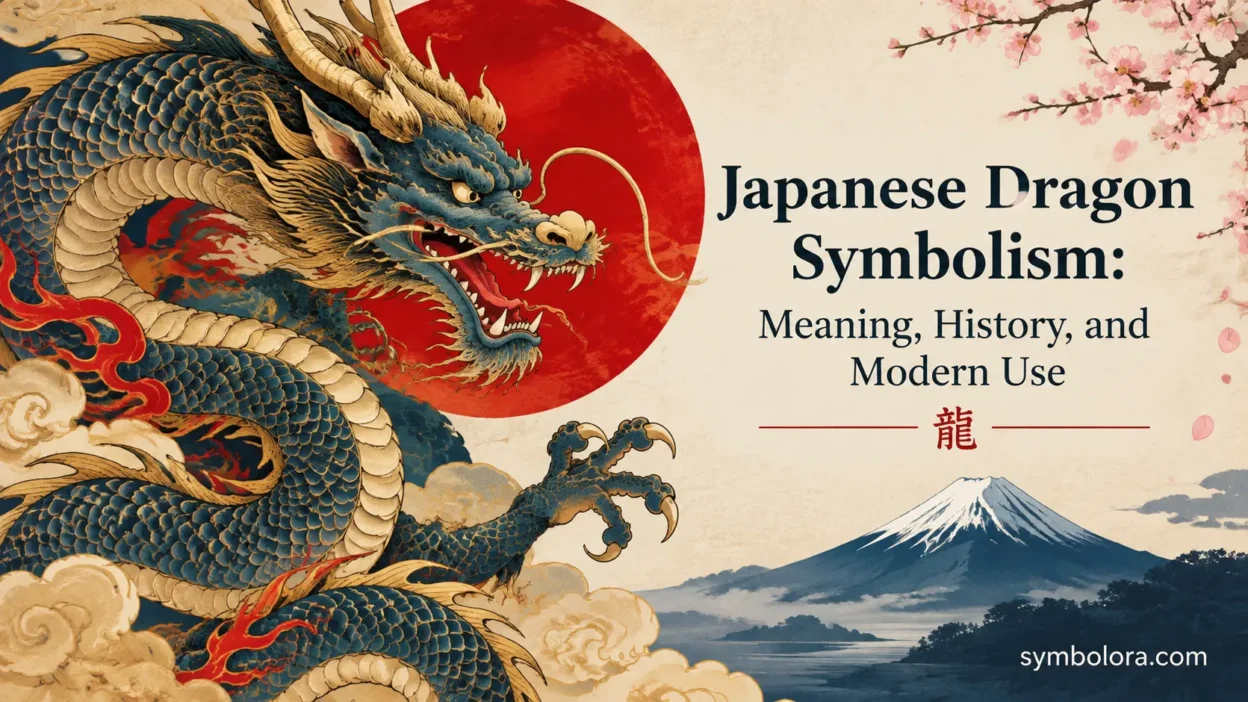
It is usually shown with a long, snake-like body, scales, clawed legs, horns, whiskers, and a dramatic face. Wings are generally unnecessary because the creature can move through the sky and clouds without them. Artists frequently place dragons beside waves, waterfalls, mist, rain, or storm clouds, reinforcing their relationship with water.
Some depictions include a jewel or pearl-like object. Others show only part of the dragon emerging from clouds or spray, which can make the animal seem larger than the visible picture.
Japanese artists did not follow one perfectly fixed anatomical formula. Features changed according to period, school, medium, and artistic influence. Claims that every authentic Japanese dragon must have exactly one specific number of claws should therefore be treated cautiously.
The Core Meanings of the Japanese Dragon
Several meanings repeatedly surround dragon imagery, but they are closely connected rather than random symbolic traits.
| Context | Common Meaning in the USA | Traditional Association | Notes |
|---|---|---|---|
| Water and waves | Adaptability, strength | Seas, rivers, rainfall | One of the oldest associations |
| Clouds and storms | Power, change | Weather and rain | Often shown emerging from clouds |
| Protective imagery | Guardianship | Dragon deities and sacred spaces | Context determines the exact meaning |
| Tattoos | Strength, wisdom, resilience | Traditional Japanese visual culture | Meaning depends on full composition |
| Zodiac imagery | Confidence, vitality, fortune | Twelve-animal calendar cycle | Also shared across East Asia |
| Art and decor | Authority, movement, good fortune | Painting and decorative arts | Often used for visual drama |
Power is perhaps the easiest modern interpretation, but Japanese dragon power is usually different from brute-force aggression. It comes from being able to command or embody forces that humans cannot easily control: storms, oceans, rain, and changing weather.
That helps explain the associations with authority and wisdom. The dragon does not merely fight nature. It belongs to nature.
Why Water Is Central to the Meaning
Water is one of the most important clues to understanding the Japanese dragon.
Japan’s geography made oceans, rivers, rainfall, fishing, and agriculture fundamental parts of everyday life. Water could provide food and fertile fields, but it could also bring floods, storms, dangerous seas, and destruction. A supernatural creature associated with water therefore represented both benefit and overwhelming force.
Traditional East Asian dragons frequently appear among clouds because clouds bring rain. In Japanese paintings, dragons may emerge from turbulent waves, coil beside waterfalls, or disappear into mist.
This association explains why it is misleading to describe the Japanese dragon simply as Japan’s version of a fire-breathing Western monster. Its elemental environment is much more often water and weather than fire.
Symbolically, that produces a useful modern reading: strength combined with adaptability. Water changes shape yet remains forceful, making the dragon especially suitable for people who interpret it as resilience rather than aggression.
Chinese Influence and the Dragon’s Arrival in Japanese Art
Japanese dragon traditions did not develop in isolation.
Many visual and symbolic features came through centuries of interaction with Chinese culture, often with Korean intermediaries as well. Chinese dragons already had long associations with rain, waterways, cosmic forces, auspiciousness, and authority.
Chinese paintings and religious imagery entering Japan helped establish the long-bodied dragon familiar in Japanese art. Japanese artists then adapted the subject to local stories, aesthetics, religious environments, and landscape imagery.
A well-known artistic pairing is the dragon and tiger. In traditions originating in China, the two could represent complementary forces, with the dragon connected to the heavens and dynamic forces while the tiger belonged to the earthly realm. Japanese painters adopted and reinterpreted this pairing.
Calling the Japanese dragon merely a copy of the Chinese dragon would therefore miss centuries of cultural adaptation. The better description is an East Asian tradition that took distinctive forms within Japan.
Dragons in Shinto-Related Belief and Japanese Folklore
Japanese religion has historically allowed different beliefs to overlap rather than fitting every supernatural figure into a single rigid category.
Dragons became associated with water kami, seas, rainfall, fishing, and local bodies of water. One of the best-known figures is Ryūjin, the Dragon God or Dragon King of the sea.
Stories describe Ryūjin as a ruler of an underwater realm and a being connected with the tides. He illustrates a recurring idea in Japanese mythology: the sea is not empty space but a domain with its own supernatural authority.
Dragon traditions were particularly meaningful to communities dependent upon sufficient rain, navigable water, or successful fishing.
This does not mean every dragon in Japanese folklore is a friendly guardian. Water itself can nourish or destroy, and dragon stories preserve that ambiguity.
Buddhist Dragon Kings and Religious Protection
Buddhism added another major layer to dragon imagery.
As Buddhism traveled from India through Central and East Asia into Japan, stories surrounding nāgas and dragon kings were translated and transformed within East Asian religious traditions. Dragons became associated with Buddhist protectors, sacred teachings, rain, and supernatural beings inhabiting watery realms.
Figures such as Zennyo Ryūō, a dragon king connected with rain traditions, demonstrate how dragon imagery could exist within explicitly Buddhist settings.
Japanese temple art frequently uses dragons in paintings, screens, sculptures, and architectural decoration. In that environment, a dragon may suggest more than generic luck. It can point toward guardianship, religious authority, elemental power, or control over rain and water.
Because Japanese religious history includes extensive interaction between Buddhist and native traditions, neatly labeling every dragon as either “Shinto” or “Buddhist” can oversimplify the subject.
Ryūjin and the Meaning of the Dragon King
Ryūjin provides one of the clearest examples of how Japanese dragon symbolism works through mythology.
He is associated with the sea, tides, underwater realms, and supernatural control of water. In traditional stories, the Dragon King’s palace beneath the sea belongs to a world beyond ordinary human experience.
The symbolic point is larger than the literal story. Ryūjin personifies the idea that the sea possesses order and authority despite appearing unpredictable from the human shore.
That makes the Dragon King a useful image of controlled power. He does not simply symbolize chaos. He rules a realm that humans cannot rule.
Modern interpretations often turn that into ideas such as self-command, leadership, protection, and confidence, although those personal-development meanings are newer applications rather than literal translations of ancient mythology.
Yamata no Orochi and the Dragon’s Dangerous Side
Not every serpentine monster in Japanese mythology should automatically be placed into the same category as a benevolent dragon god.
The famous Yamata no Orochi is an enormous eight-headed and eight-tailed serpent defeated by the deity Susanoo. From its body comes the sword later associated with the imperial regalia.
Modern illustrations sometimes make Orochi look dragon-like, and Western-language descriptions may simply call it an eight-headed dragon. More precisely, the old myth describes a monstrous serpent.
The distinction matters because it prevents a common misconception: that every Japanese dragon story teaches the same lesson about luck or protection.
Japanese mythology includes water deities, dragon kings, serpentine monsters, guardians, and dangerous supernatural beings. Their appearances may overlap, but their narrative roles do not.
The Japanese Dragon and the Zodiac
The dragon is also one of the twelve animals of the traditional East Asian zodiac cycle, which Japan adopted historically.
In Japanese zodiac terminology, the dragon is associated with tatsu, represented in the calendrical system by the character 辰. Zodiac dragons can carry ideas of vitality, confidence, ambition, fortune, and extraordinary ability, although personality descriptions found in modern horoscope material should not be mistaken for universal ancient doctrine.
The dragon stands out in the zodiac because it is the only obviously mythical creature among the twelve animals.
That distinction contributes to its aura of exceptionality. In modern designs, zodiac dragon imagery may communicate boldness, aspiration, or an uncommon identity, especially for people born in a Dragon year.
American audiences often encounter this meaning during Lunar New Year celebrations, although zodiac customs differ across Asian cultures and should not all be treated as interchangeable.
Japanese Dragon Symbolism in the United States
In the United States, Japanese dragons live in a different cultural setting from the one in which their traditional meanings developed.
Americans most often encounter the image through Japanese tattooing, museum collections, martial-arts imagery, anime, manga, games, streetwear, imported decor, and Japanese-inspired graphic design.
As a result, several older meanings have blended with American ideas of personal identity. Someone wearing a dragon design may intend it to represent:
- Resilience after hardship
- Personal authority
- Protection of family
- Wisdom gained through experience
- Confidence without recklessness
- Respect for Japanese art
- Adaptability during major change
These readings are not necessarily incorrect, but they are modern interpretations. Historically, the connection to water and rain is more firmly established than many highly specific personality meanings found on contemporary symbolism charts.
Why Japanese Dragons Are Popular in Tattoos
The dragon is especially suited to large-scale tattoo composition because its flexible body can move naturally across the back, chest, shoulder, arm, or leg.
Traditional Japanese tattoo imagery developed strong connections with Edo-period popular art, including woodblock prints depicting legendary heroes, warriors, monsters, flowers, and dramatic scenes. Dragons became part of that broader visual vocabulary.
In modern American tattoo culture, a Japanese-style dragon often represents strength guided by intelligence, rather than uncontrolled violence.
Waves can reinforce the creature’s relationship with water. Clouds emphasize its movement between sky and earth. Flowers may introduce seasonal or emotional contrast.
A tattoo should therefore be interpreted as a composition rather than a code. A dragon beside peonies does not necessarily communicate exactly the same idea as one surrounded by crashing waves.
The wearer’s intention also matters. Traditional imagery provides context, but tattoos inevitably become personal once placed on an individual body.
What Dragon Colors Really Mean
Online symbolism guides often assign extremely precise meanings to dragon colors: black for wisdom, blue for compassion, red for courage, green for nature, gold for wealth, and so on.
Some of these associations are reasonable modern interpretations, but they should not be presented as a single ancient Japanese color code.
Traditional Japanese art uses color according to many factors, including artistic style, available pigments, religious imagery, decorative convention, contrast, and the requirements of a larger composition.
A gold dragon can naturally communicate prestige or splendor because gold itself carries visual associations with value. Red can feel active and intense. Blue and green may reinforce connections with water or the natural world.
Yet the complete design is more informative than color alone.
Anyone choosing a tattoo because a website claims that one dragon color has one permanent meaning should treat that claim cautiously.
Emotional and Psychological Meaning
The Japanese dragon works especially well as an identity symbol because it combines qualities that seem contradictory.
It is forceful without needing to be physically bulky. It can rise into the sky while remaining tied to water. It may appear protective in one context and terrifying in another. It can represent movement while also suggesting control.
Psychologically, this makes the dragon attractive to people who want an image of contained strength.
Rather than “I can destroy my enemies,” the message may be closer to: I can move through unstable circumstances without losing command of myself.
That interpretation is particularly compatible with images of dragons moving through waves or storms. The surrounding environment is difficult, but the dragon belongs there.
This helps explain the symbol’s appeal in tattoos and personal art centered on recovery, confidence, maturity, or major life transitions.
Dragons in Japanese Painting and Decorative Arts
Dragon imagery has appeared across Japanese visual culture for centuries.
Artists placed dragons on hanging scrolls, folding screens, ceramics, lacquerware, sword fittings, temple interiors, and other decorative objects. Edo-period masters produced dramatic dragons disappearing into ink clouds or emerging from water.
The subject gave painters an unusual artistic opportunity. Because no one could observe a real dragon, artists were free to suggest rather than document it.
Mist might hide most of the body. A claw could emerge from a cloud. A twisting shape could disappear behind waves.
This partial visibility became part of the dragon’s visual effect. The viewer senses something larger than the portion that can be seen.
In modern interiors, clothing, prints, and digital art, that same visual language continues to communicate movement, authority, and connection with traditional Japanese aesthetics.
Japanese Dragons in Anime, Games, and Digital Culture
Modern entertainment has greatly expanded how Americans recognize Japanese dragons.
Anime, manga, fantasy games, trading-card art, and social media illustration frequently borrow the serpentine body, whiskers, horns, clouds, magical jewels, and water imagery associated with East Asian dragons.
Some fictional dragons remain close to older traditions. Others combine Japanese, Chinese, European, and entirely invented characteristics.
This means a dragon appearing in a Japanese video game is not automatically an authentic representation of traditional mythology.
Pop culture has nevertheless preserved one important difference for many American viewers: an East Asian dragon does not have to be a villain. It may be an ally, deity, guardian, teacher, summoned being, or force of nature.
That distinction has helped broaden the American idea of what a dragon can represent.
Common Misunderstandings and Cultural Misuse
Several claims about Japanese dragons are repeated so often online that they can appear more certain than the evidence allows.
One is the belief that claw count provides a foolproof way to identify a dragon’s nationality. Claw conventions changed according to period, artistic exchange, region, and context. They are useful art-historical clues in some cases, not universal identity tags.
Another is that every Japanese dragon symbolizes good luck. Many dragons have auspicious or protective associations, but Japanese stories also contain frightening and destructive supernatural beings.
Tattoo direction is another source of invented rules. Claims such as “an upward dragon always means this” and “a downward dragon always means that” should not be treated as universal law unless they are tied to a particular artistic tradition or composition.
Cultural respect also matters. Japanese religious images, tattoo conventions, Chinese-derived motifs, and modern fantasy designs are related but not interchangeable.
The safest approach is to identify the specific dragon, story, artwork, or tattoo tradition before assigning a detailed meaning.
How the Meaning Has Evolved
The Japanese dragon has never had only one function.
Early beliefs surrounding water and supernatural beings interacted with imported Chinese dragon imagery and Buddhist dragon traditions. Religious communities associated dragons with rainfall, bodies of water, deities, and protection. Artists turned them into dramatic subjects for painting and decorative arts.
During the Edo period, dragons became highly visible in popular visual culture and eventually in elaborate tattoo imagery.
Modern mass media pushed the image much farther. Today a person in the United States may encounter a Japanese dragon on a museum screen one day, a tattoo sleeve the next, and a video-game character that evening.
With each transition, the meaning expands.
Yet the oldest thread remains visible: the dragon is a creature of forces larger than ordinary human control, especially water, weather, and the changing natural world.
Frequently Asked Questions
Are Japanese dragons good or evil?
Japanese dragons cannot be divided neatly into good and evil. Many are connected with water, protection, rain, divine authority, or beneficial forces, while other dragon-like or serpentine beings can be dangerous, destructive, or hostile.
What does a Japanese dragon tattoo symbolize?
A Japanese dragon tattoo commonly expresses strength, wisdom, resilience, protection, or authority today. Traditional meaning depends on the dragon’s surrounding waves, clouds, flowers, other creatures, and the overall tattoo composition.
What is the difference between Japanese and Western dragon symbolism?
Japanese dragons are traditionally serpentine, usually wingless, and closely connected with water and weather. European traditions more often depict winged dragons associated with fire, treasure, dangerous wilderness, or an enemy that a hero must defeat, although both traditions contain exceptions.
Is the Japanese dragon a religious symbol?
It can be. Dragon kings and water dragons appear in Buddhist and Japanese religious traditions, but dragons also function as folklore characters, decorative motifs, zodiac figures, tattoo subjects, and modern fantasy creatures.
Does a Japanese dragon symbolize good luck?
Good fortune is one common interpretation, especially because East Asian dragons often have auspicious associations. However, water, rainfall, natural authority, and protection are more historically specific than simply saying every Japanese dragon means luck.
What does a Japanese dragon with waves mean?
Waves reinforce the dragon’s traditional connection with oceans, rivers, rainfall, and water power. In a modern personal design, the combination may also suggest resilience, adaptability, or remaining strong while circumstances change.
Do different Japanese dragon colors have fixed meanings?
Not universally. Modern guides often assign personality traits to individual colors, but historical Japanese art does not operate according to one simple dragon-color dictionary; the full artistic and cultural context matters more.
Conclusion
The most reliable way to understand Japanese dragon symbolism is to begin with water. The dragon’s connection with seas, rivers, rainfall, clouds, and storms explains much of its association with strength, protection, authority, wisdom, and forces beyond ordinary human control.
Chinese artistic influence, Buddhist traditions, Japanese water beliefs, folklore, painting, tattoo culture, and modern entertainment have all added new layers to the image. In the United States, those traditions now coexist with personal meanings such as resilience, confidence, transformation, and self-command.
A Japanese dragon is therefore more than a generic emblem of strength. Its most distinctive message comes from power that moves with nature rather than standing outside it.


