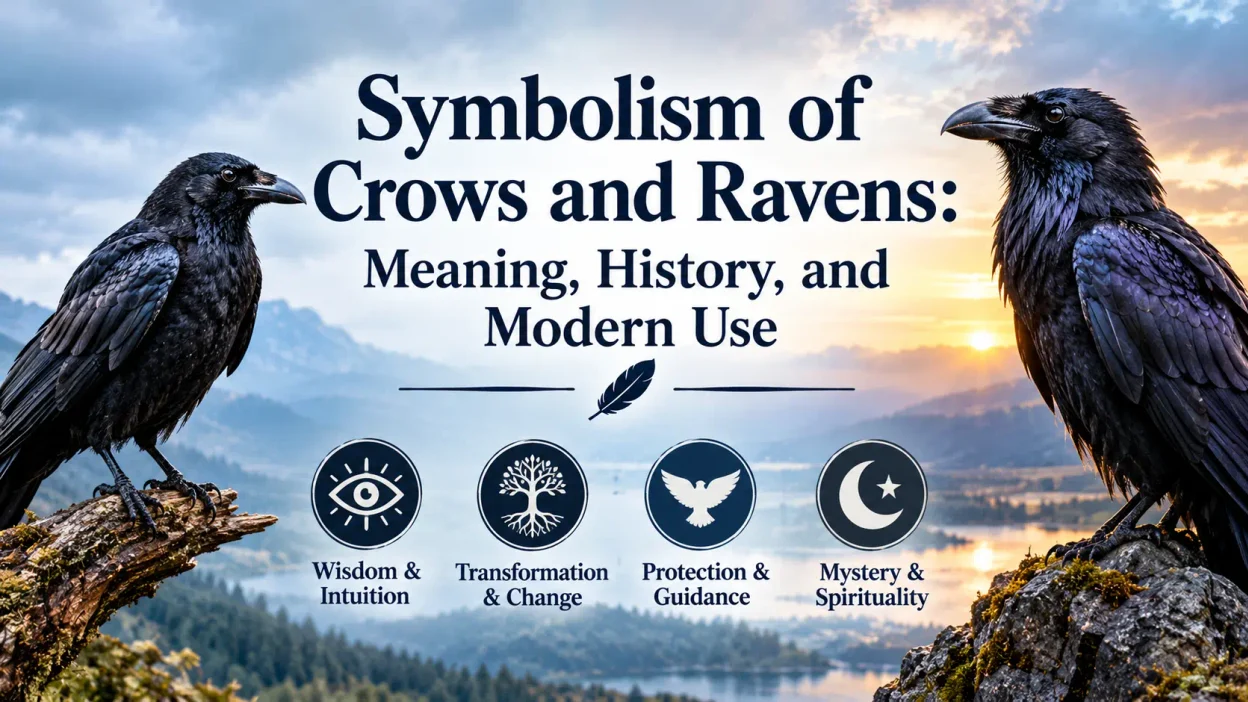
The symbolism of crows and ravens reflects the way people interpret intelligence, death, mystery, and survival in the natural world. In the United States, these black birds often appear in Halloween decorations, gothic art, tattoos, literature, and stories about omens. Yet their meanings extend far beyond darkness or bad luck. Across different cultures, crows and ravens have also represented wisdom, creation, memory, adaptability, and the ability to cross boundaries between familiar and unfamiliar worlds.
Although people often mention the two birds together, crows and ravens are different species with distinct physical characteristics. Their symbolic meanings sometimes overlap, but particular myths and traditions give them different roles. Norse mythology, for example, connects ravens with Odin’s knowledge, while several Indigenous traditions of the Pacific Northwest feature Raven as a creator, transformer, or trickster.
Understanding these differences makes the symbolism more useful. A crow appearing in a modern painting does not automatically mean death, just as a raven in an ancient story does not always represent evil. Context, cultural history, and the artist’s intention all shape the meaning.
Quick Answer
The symbolism of crows and ravens commonly represents intelligence, mystery, transformation, and the relationship between life and death in modern American culture. Historically, these birds have also appeared as divine messengers, creators, tricksters, and keepers of knowledge in different mythologies and cultural traditions.
TL;DR
- Crows and ravens often symbolize intelligence, adaptability, mystery, and change.
- Norse mythology connects Odin’s ravens with thought, memory, and knowledge.
- Some Indigenous traditions feature Raven as a creator or transformative trickster.
- American Halloween imagery reinforces associations with death, darkness, and the supernatural.
- Black feathers alone do not make these birds universal symbols of evil.
- Tattoos and artwork use corvid imagery to express individuality and personal transformation.
What Crows and Ravens Look Like and Why the Difference Matters
Crows and ravens belong to the corvid family, which also includes jays and magpies. Both birds have dark feathers, strong bills, and remarkable problem-solving abilities. Their similar appearance explains why artists, storytellers, and casual observers sometimes treat them as interchangeable symbols.
However, common ravens are generally larger than American crows. Ravens have heavier bills, shaggy throat feathers, and wedge-shaped tails, while American crows tend to have slimmer bills and fan-shaped tails. Their calls also differ: crows commonly produce a familiar caw, whereas ravens can make deeper, rougher sounds.
These distinctions can influence artistic interpretation. A large raven perched alone against a stormy sky may suggest isolation or solemnity, while a group of crows gathering on a fence may communicate community, vigilance, or collective intelligence.
Biology does not dictate symbolism, but it helps explain why certain images feel convincing. Both birds are opportunistic feeders, social in many circumstances, and capable of learning from their surroundings. Their ability to survive near human settlements has made them familiar participants in everyday life as well as mythological stories.
The Core Symbolic Meanings of Crows and Ravens
Several recurring themes appear in modern interpretations of these birds, although no single meaning applies across every culture.
Intelligence and observation: Corvids learn from experience, solve problems, and respond to changing conditions. These traits make them natural symbols of awareness, strategy, and careful observation.
Mystery and the unknown: Their dark plumage, distinctive calls, and frequent appearance in dramatic landscapes have helped associate them with hidden knowledge and unfamiliar experiences.
Death and transition: Both birds feed on carrion, a behavior that has connected them with battlefields, mortality, and the aftermath of death in some cultural traditions.
Transformation and change: In myths where Raven alters the world or challenges established rules, the bird becomes an agent of change rather than simply a sign of danger.
Adaptability and survival: Their ability to live in forests, agricultural areas, and cities can make them symbols of resourcefulness and persistence.
These meanings overlap, but context determines which one matters most. A raven in a story about Odin emphasizes knowledge and divine observation, while a crow in a contemporary horror film may establish an unsettling atmosphere. The bird is the same kind of animal; the cultural setting changes its interpretation.
Ancient Origins of Crow and Raven Symbolism
People have observed crows and ravens for thousands of years. Their presence around settlements, fields, hunting grounds, and places where animals died made them highly visible in the human environment.
Several natural behaviors contributed to their symbolic reputation. Their intelligence made their actions seem deliberate, their calls attracted attention, and their scavenging brought them into contact with death. Their ability to fly between the ground and sky also made them useful figures in stories connecting different parts of existence.
Ancient symbolism did not develop along one universal path. Some societies interpreted these behaviors as signs of danger, while others emphasized the birds’ knowledge, usefulness, or creative abilities.
Written myths preserve only part of this history. Many traditions were transmitted orally before being recorded, and the surviving accounts may reflect changes that occurred over generations.
It is therefore misleading to assume that all ancient people feared crows and ravens or that the birds originally had one shared spiritual meaning. Their reputations emerged from different environments, religious ideas, and storytelling traditions.
Ravens in Norse Mythology: Odin’s Thought and Memory
Ravens hold a prominent place in Norse mythology through their association with Odin, a god connected with wisdom, knowledge, war, and death.
Odin’s two ravens are named Huginn and Muninn, commonly translated as Thought and Memory. In the mythological tradition, they travel across the world and return to report what they have observed. Their role extends Odin’s awareness beyond the places where he is physically present.
This relationship gives ravens a clear association with information, perception, and the preservation of knowledge. They are not merely ominous birds accompanying a god of war. They serve as observers whose reports help Odin understand events beyond his immediate reach.
The names also invite reflection on the relationship between thinking and remembering. Thought allows a person to interpret what happens, while memory preserves experience. Modern readers may find this pairing especially relevant in an age shaped by information, observation, and the difficulty of distinguishing reliable knowledge from rumor.
Norse-inspired art frequently depicts Odin with two ravens on his shoulders or flying nearby. Such imagery can communicate wisdom, vigilance, and the pursuit of knowledge without suggesting that ravens always predict death or misfortune.
Raven as Creator and Trickster in Indigenous Traditions
Raven occupies an important place in the stories of several Indigenous peoples, particularly among communities of Alaska and the Pacific Northwest. In some traditions, Raven helps bring light into the world, transforms the environment, or changes the conditions under which people live.
In Tlingit, Haida, and Tsimshian traditions, Raven appears in culturally specific stories with different details and purposes. Some narratives present Raven as a creator or transformer, while others emphasize cleverness, mischief, greed, or the unintended consequences of an action.
The trickster role is especially important to understand. A trickster is not simply a villain or a humorous troublemaker. Such a figure may challenge rules, expose weaknesses, disrupt an established order, and bring about change. The results can benefit some characters while creating problems for others.
These stories should not be reduced to a single pan-Indigenous meaning. Indigenous nations have distinct histories, languages, and cultural traditions, and Raven’s role varies among them.
For a modern American audience, the broader lesson is that a black bird can represent creation and transformation rather than darkness alone. Any interpretation of a specific Indigenous Raven story should preserve the identity and context of the people whose tradition it belongs to.
Crows and Ravens as Symbols of Death and the Afterlife
Death is one of the most familiar associations attached to crows and ravens in Western popular culture. Their scavenging behavior can bring them to places where animals have died, and their dark appearance has made them effective figures in stories about mortality.
In historical settings, ravens and crows could be seen around battlefields and carcasses. Observers connected the birds with death partly because they appeared where death had already occurred. Over time, this association could shift from describing what the birds did to suggesting that their presence predicted what would happen.
That distinction matters. A bird feeding on a carcass is responding to food, not necessarily announcing a future tragedy.
Some religious and folkloric traditions also connect ravens with the boundary between the living and the dead. In literature, a raven may function as a messenger, witness, or reminder of human mortality. These roles differ from the claim that the bird itself causes misfortune.
In modern American culture, this association remains visible in cemetery imagery, gothic illustrations, horror stories, and Halloween decorations. Yet death symbolism can also represent grief, remembrance, and the recognition that life is finite, rather than evil or fear alone.
Why Black Feathers Became Associated With Mystery and Bad Luck
The dark feathers of crows and ravens contribute to their visual symbolism, but color alone does not explain their cultural reputation. Black has carried different meanings across societies, including mourning, authority, elegance, protection, and the unknown.
In European folklore, Christian-era interpretations and popular stories helped strengthen the association between black birds and ominous events. Their presence around dead animals reinforced these impressions, while their harsh calls and unfamiliar behavior made them memorable figures in tales about supernatural warnings.
American literature later gave this imagery a recognizable form. Edgar Allan Poe’s 1845 poem The Raven portrays a raven whose repeated response intensifies the speaker’s grief over a lost loved one. The bird’s role in the poem is closely tied to mourning, obsession, and the difficulty of accepting loss.
The poem helped establish the raven as a familiar figure in American gothic literature, although its meaning is more specific than a simple prediction of death. The bird becomes part of a psychological struggle in which grief gives an ordinary encounter an increasingly haunting significance.
Black feathers can therefore communicate mystery or mourning in a particular artwork without making the bird inherently unlucky. The surrounding story determines whether the image suggests danger, sorrow, dignity, or something unknown.
Crow and Raven Symbolism in Modern American Culture
In the United States, crows and ravens appear in wildlife photography, literature, films, seasonal decorations, fashion, and everyday encounters with nature. Their meanings often depend on whether they appear in a natural setting, a religious or mythological scene, or a deliberately unsettling work of art.
Crows are common in many American neighborhoods and agricultural areas. Their visibility, social behavior, and adaptability make them familiar symbols of observation and resourcefulness. They also appear in scarecrows, Halloween displays, and stories about mysterious happenings.
Ravens are often presented as more dramatic figures in American popular culture. Their size, deep calls, and association with gothic literature make them effective symbols of solitude, foreboding, and hidden knowledge. However, these are cultural tendencies rather than fixed distinctions between the two birds.
The American interpretation also reflects an ongoing relationship with wildlife. Birdwatchers may admire corvid intelligence, homeowners may find their behavior inconvenient, and artists may use their silhouettes to establish a particular mood. Each response comes from a different experience of the same animals.
This variety explains why crows and ravens remain useful in contemporary storytelling. They are recognizable enough to carry familiar associations, yet open-ended enough to support new meanings.
What Crows and Ravens Represent in Dreams and Spiritual Interpretations
People who dream about crows or ravens may interpret the experience through personal memories, cultural beliefs, or current concerns. A bird appearing in a dream might remind someone of a loss, a difficult decision, an experience in nature, or a story that left a strong impression.
Some contemporary spiritual traditions treat these birds as symbols of intuition, transition, protection, or messages from the unseen. Others associate them with shadow work, a practice of examining uncomfortable emotions, fears, or neglected parts of oneself.
These interpretations can offer a framework for reflection, but they are not universal facts about dreams. There is no reliable evidence that dreaming about a crow predicts a death or that seeing a raven guarantees a supernatural message.
A practical way to explore such a dream is to consider its details. Was the bird threatening, calm, vocal, or simply passing overhead? Did the encounter produce fear, curiosity, comfort, or sadness? Those emotional responses may reveal more about the dreamer’s personal associations than a generic dictionary of symbols.
The same caution applies to seeing a crow repeatedly in daily life. Corvids often gather where food is available, follow familiar routes, and return to useful locations. A meaningful personal reflection does not require assuming that the encounter predicts the future.
Crows and Ravens in Tattoos, Jewelry, and Personal Style
Crows and ravens are popular choices for tattoos and accessories because their shapes are distinctive and their cultural associations are varied. A black bird can be rendered as a realistic portrait, a simple silhouette, or an elaborate mythological figure.
<AsyncImageGroup query={[“black raven perched on branch fine line tattoo design”,”pair of ravens Norse mythology Huginn Muninn illustration”,”minimalist black crow silhouette tattoo art”]} aspectRatio=”5:4″ layout=”bento” size=”lg”/>
Common design interpretations include:
- A raven with wings spread: May express freedom, independence, or a willingness to face uncertainty.
- Two ravens together: Can reference Huginn and Muninn, suggesting thought, memory, and the pursuit of knowledge.
- A crow perched on a branch: May communicate patience, observation, solitude, or an appreciation of wildlife.
- A raven with a skull: Often combines mortality, remembrance, and gothic aesthetics.
- A crow in flight: May represent movement, change, or a personal transition.
These interpretations are possibilities, not a standardized symbolic code. Someone might choose a raven tattoo simply because they admire the bird or connect with Poe’s poetry.
Cultural context matters when a design draws on a specific Indigenous tradition. A Raven figure from a Northwest Coast story may carry meanings that cannot be captured by treating it as generic gothic artwork. Identifying the particular tradition and understanding its significance helps prevent cultural imagery from becoming a decorative stereotype.
The Emotional and Psychological Appeal of Corvids
Crows and ravens often evoke mixed reactions. Their intelligence can make them seem perceptive, their calls can feel startling, and their ability to survive in changing environments can inspire admiration.
The contrast between familiarity and uncertainty is part of their appeal. Crows may be everyday visitors to a neighborhood, yet their behavior can seem unexpectedly deliberate. Ravens often inhabit a similar space in the imagination: recognizable animals that appear unusually watchful or dramatic.
Artists can use these qualities to suggest a character’s state of mind. A raven beside a grieving figure might reinforce isolation, while a crow observing a scene from above could imply vigilance or the presence of an unnoticed detail.
For individuals, these birds may also represent traits they value, such as independence, cleverness, adaptability, or a willingness to question assumptions. Others connect them with mourning because they encountered a crow or raven during a difficult period of life.
Symbolic associations can help people express feelings, but they should not be used to diagnose personality. Choosing a raven as a personal emblem does not establish that someone is secretive, pessimistic, unusually intuitive, or drawn to the supernatural.
Common Misunderstandings About Crow and Raven Symbolism
Several popular assumptions make these birds seem more uniform in meaning than they really are.
Misunderstanding 1: Both birds always symbolize bad luck. Their connection with death and ominous events is well known, but other traditions portray them as intelligent helpers, creators, or agents of change.
Misunderstanding 2: Crows and ravens have identical meanings everywhere. They sometimes overlap in folklore, but individual stories distinguish between species or give particular birds different roles. Biological identification and cultural context both matter.
Misunderstanding 3: Every encounter is a supernatural sign. People may find personal meaning in seeing a crow or raven, but the birds also behave according to ordinary ecological needs. An encounter alone cannot establish a prediction or message.
Misunderstanding 4: Indigenous Raven stories all tell the same story. Different Indigenous nations preserve distinct traditions. Treating them as one belief system removes the cultural context that gives each narrative meaning.
Misunderstanding 5: Black birds represent evil because black represents evil. Black has many associations, and its meaning varies across settings. The same color can suggest mourning in one image, elegance in another, and authority in a third.
These distinctions allow readers to appreciate the symbolism without confusing folklore, personal spirituality, and historical evidence.
How Crow and Raven Symbolism Continues to Change
The cultural reputation of crows and ravens has never remained fixed. Stories, religious traditions, literature, and people’s experiences with wildlife have continually shaped how the birds are understood.
In some historical settings, their presence around battlefields and carcasses reinforced associations with death. Norse mythology placed ravens close to Odin and connected them with knowledge, while several Indigenous traditions gave Raven roles in creation and transformation.
American literature and popular entertainment later strengthened the raven’s gothic reputation. Poe’s poem became a major reference point, and horror films, illustrations, and Halloween imagery repeatedly used black birds to suggest suspense or unease.
More recently, wildlife observation and public interest in animal cognition have provided another perspective. Research on corvids has documented impressive learning and problem-solving abilities, helping explain why these birds inspire more than fear.
Digital culture also encourages people to share photographs, stories, and personal interpretations of encounters with crows and ravens. Online spirituality may describe a bird as a guide or sign of transformation, while wildlife enthusiasts may focus on its behavior and habitat.
Neither approach needs to erase the other. People can appreciate personal symbolism while recognizing that a bird’s historical meaning depends on its cultural setting and that its behavior has a natural explanation.
Comparing Crow and Raven Symbolism at a Glance
| Context | Common symbolic association | Why it appears |
|---|---|---|
| Norse mythology | Thought, memory, knowledge | Odin’s ravens observe the world and report back |
| Indigenous traditions of the Pacific Northwest | Creation, transformation, trickery | Raven plays varied roles in culturally specific narratives |
| American gothic literature | Grief, mystery, mortality | Literary portrayals, including Poe’s raven |
| Modern tattoos and fashion | Independence, change, identity | Personal interpretation and distinctive bird imagery |
| Wildlife and nature imagery | Intelligence, adaptability, survival | Corvid behavior and their ability to thrive in varied habitats |
The table summarizes common associations, not universal rules. A specific story, artwork, or cultural tradition may give either bird a different role.
Frequently Asked Questions
What is the main difference between crow and raven symbolism?
Both birds can symbolize intelligence, mystery, death, and adaptability. Ravens have a particularly prominent role in Norse mythology through Odin’s companions, while crows often appear in modern American imagery associated with everyday wildlife, Halloween, and clever observation.
Are crows and ravens considered good or bad omens?
Neither bird is universally considered a good or bad omen. Their interpretation depends on the cultural tradition, the story, and the observer’s beliefs rather than on the bird’s presence alone.
What does it mean when a crow or raven appears in a dream?
A dream featuring one of these birds may bring up personal associations with change, grief, intelligence, or uncertainty. There is no established rule that such a dream predicts a particular event, so its emotional context is more useful than a fixed interpretation.
What do two ravens symbolize?
Two ravens may represent thought and memory when they reference Huginn and Muninn from Norse mythology. In other designs, two birds may symbolize companionship, balance, or shared experience, depending on the creator’s intention.
Why are crows and ravens associated with Halloween?
Their dark feathers, calls, and established roles in gothic stories make them effective symbols for Halloween decorations. Their connection with death and the supernatural also fits the holiday’s themes, although neither bird is inherently frightening.
Can a crow or raven symbolize transformation?
Yes, particularly in modern symbolic interpretations and traditions where Raven changes the world or challenges an established order. The meaning is strongest when the surrounding story supports change rather than when transformation is assumed from the bird alone.
Are crows and ravens sacred in Indigenous cultures?
Raven holds significant cultural and spiritual roles among several Indigenous peoples, especially in Alaska and the Pacific Northwest. The meanings differ among nations, so it is important to identify the specific tradition rather than describing all Indigenous beliefs as identical.
Conclusion
The symbolism of crows and ravens brings together intelligence, mystery, mortality, transformation, and survival. Their dark appearance and scavenging behavior help explain their association with death in some traditions, while Norse mythology connects ravens with thought and memory, and several Indigenous traditions feature Raven as a creator or transformative figure.
In modern American culture, these birds appear in gothic literature, tattoos, Halloween imagery, wildlife photography, and personal spiritual interpretations. Their meaning depends on the context in which they appear, not simply on their black feathers. Looking beyond superstition reveals a more accurate picture: crows and ravens are adaptable animals whose cultural roles reflect the many ways people understand nature, uncertainty, and change.