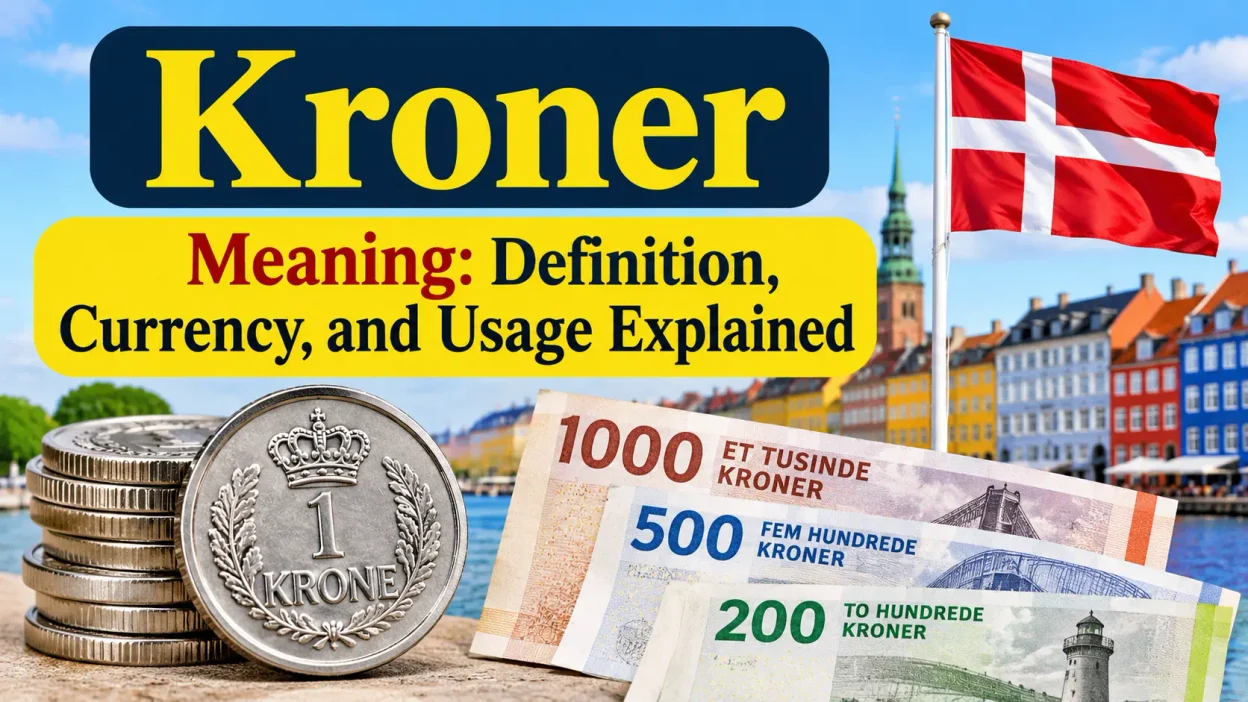
The word kroner refers to the plural form of krone, a monetary unit used in several Nordic countries. You may encounter it when reading international prices, traveling in Scandinavia, shopping on European websites, or learning about foreign currencies. Understanding the kroner meaning helps clarify how money is counted and described in countries such as Denmark and Norway. Although the word is closely related to other Nordic currency names, it is not interchangeable with every Scandinavian monetary term.
Quick Answer: What Does Kroner Mean?
Kroner is the plural of krone, a currency unit used in Denmark and Norway. It refers to more than one unit of that currency. For example, 100 kroner means 100 units of money. The word is associated with the Danish krone (DKK) and Norwegian krone (NOK).
What Is a Krone?
A krone is a unit of money used in Denmark and Norway. The word comes from the Danish and Norwegian word for crown, connecting the currency’s name to a traditional symbol of royal authority.
The plural form is kroner. This means:
- One krone = a single unit of currency.
- Two kroner = two units of currency.
- One hundred kroner = one hundred units of currency.
The word is a noun, specifically a countable currency noun.
Where Are Kroner Used?
The term is associated with different Nordic currencies. Although Denmark and Norway share the same currency name, their monetary systems are separate.
1. Danish Krone (DKK)
The Danish krone is the official currency of Denmark. Its international currency code is DKK.
Examples include:
- 10 kroner
- 50 kroner
- 100 kroner
- 1,000 kroner
One Danish krone is divided into 100 øre.
The Faroe Islands and Greenland also use the Danish krone currency system.
2. Norwegian Krone (NOK)
The Norwegian krone is the official currency of Norway. Its international currency code is NOK.
Norwegian prices and financial transactions commonly use the word kroner.
Examples include:
- 20 kroner
- 100 kroner
- 500 kroner
- 2,000 kroner
One Norwegian krone is divided into 100 øre.
Important: Danish kroner and Norwegian kroner are not the same currency. They have separate currency codes and exchange rates.
What Is the Difference Between Krone and Kroner?
The main difference is grammatical number. Krone is singular, while kroner is plural.
| Word | Meaning | Example |
|---|---|---|
| Krone | One currency unit | One krone |
| Kroner | More than one currency unit | Five kroner |
| Danish krone | Denmark’s currency | 100 Danish kroner |
| Norwegian krone | Norway’s currency | 100 Norwegian kroner |
Correct usage:
- The ticket costs one krone.
- The ticket costs 50 kroner.
- She exchanged dollars for Norwegian kroner.
In English, use krone when referring to one unit and kroner when referring to multiple units.
Kroner vs. Other Nordic Currencies
Several Nordic countries have currency names that come from the same historical word for crown. However, their spellings and currency codes differ.
| Currency | Country or region | Currency code | Plural form |
|---|---|---|---|
| Danish krone | Denmark | DKK | Kroner |
| Norwegian krone | Norway | NOK | Kroner |
| Swedish krona | Sweden | SEK | Kronor |
| Icelandic króna | Iceland | ISK | Krónur |
These names are related, but they are not interchangeable.
For example, Swedish money is called kronor, not Danish or Norwegian kroner. Similarly, Icelandic currency uses the spelling krónur.
Understanding these differences is useful when reading international prices, financial reports, and travel information.
How Is the Word Kroner Used in Sentences?
The word kroner commonly appears in financial discussions, shopping, travel, and everyday conversations about money.
Here are some original examples:
1. Travel: The hotel charged 1,200 kroner for one night.
This refers to the total price in a Nordic currency.
2. Shopping: I bought a jacket for 450 kroner.
The word describes the amount paid.
3. Currency exchange: She exchanged her US dollars for Danish kroner.
This shows how the word is used in international money transactions.
4. Business: The company reported annual revenue of 10 million kroner.
Here, it identifies the currency used in a financial report.
5. Budgeting: He saved 2,000 kroner for his weekend trip.
The word describes an amount of money set aside.
6. Travel planning: How many kroner should I bring for food and transportation?
This example shows its use when discussing travel expenses.
What Is the Origin of the Word Kroner?
The word kroner comes from krone, the Danish and Norwegian word for crown.
The historical word traces back through Middle Low German and Latin corona, meaning a crown or wreath, with an earlier Greek root associated with a curved object or ring.
The currency name reflects the historical connection between crowns and royal authority. Similar crown-related currency names developed in other European countries.
The English word kroner follows the plural form used for the Danish and Norwegian monetary unit. Oxford Learner’s Dictionaries+2
Is Kroner the Same as Dollars or Euros?
No. Kroner, dollars, and euros are different currencies.
- Kroner: The plural currency name used for Danish and Norwegian krone units.
- Dollars: A currency name used in countries such as the United States, Canada, and Australia.
- Euros: The common currency used by participating European Union countries.
Their purchasing power and exchange rates differ. For example, 100 kroner does not have the same monetary value as 100 US dollars or 100 euros.
When comparing prices, always check the currency code to determine which currency is being discussed.
Common Misunderstandings About Kroner
A few mistakes can cause confusion when reading the word.
1. Thinking kroner is singular
Incorrect: One kroner.
Correct: One krone.
2. Assuming all kroner are identical
Danish kroner and Norwegian kroner are separate currencies. Their values and exchange rates are different.
3. Confusing kroner with kronor
Kroner is the plural of Danish and Norwegian krone. Kronor is the Swedish plural of krona.
4. Assuming kroner is a currency code
Kroner is a word, not an international currency code. DKK identifies the Danish krone, while NOK identifies the Norwegian krone.
5. Thinking kroner is an English slang expression
In ordinary usage, kroner refers to money rather than internet slang, texting language, or an informal expression.
Frequently Asked Questions Kroner Meaning
1. What does kroner mean in simple words?
Kroner means more than one unit of a currency called the krone. It is commonly used when discussing money in Denmark and Norway.
2. Is kroner Danish or Norwegian?
Kroner is used in both Danish and Norwegian currency names. Denmark uses the Danish krone (DKK), while Norway uses the Norwegian krone (NOK).
3. What is the singular form of kroner?
The singular form is krone. For example, one krone is singular, while 10 kroner is plural.
4. How do you pronounce kroner?
In American English, kroner is commonly approximated as KROH-ner. The pronunciation can vary slightly depending on the speaker and language.
5. What does 100 kroner mean?
It means 100 units of a krone-based currency. The exact monetary value depends on whether the amount refers to Danish kroner or Norwegian kroner.
6. Does Sweden use kroner?
No. Sweden uses the Swedish krona, whose plural form is kronor. It is related in name to the Danish and Norwegian krone but represents a different currency.
Conclusion
The word kroner is the plural form of krone, a currency unit used in Denmark and Norway. It appears in everyday shopping, travel expenses, financial reports, and international currency discussions. Although Danish and Norwegian kroner share the same name, they are separate currencies with different codes and exchange rates. Remembering the difference between krone, kroner, krona, and kronor makes it easier to understand Nordic currency references.


